Auxiliary motor borrowed from a fork-lift truck; batteries from golf carts
Issue 20 : Sept/Oct 2001
It was the kind of day that couldn’t figure out if it wanted to rain, be foggy, or grow dark. Rainbow’s skipper, Steve Cooper, assured us that in any case we would be comfortable on our trip across San Francisco Bay from Alameda to the Bay View Boat Club on the western shore. He was right.
Steve is not one to be stranded in shallows of convention. He seems the sort to go wholeheartedly where his technical musings may take him. After he skillfully backed his Rawson 30, Rainbow, out of her slip, he handed the helm to me and began to explain the rationale that led him to convert from gasoline to electric propulsion. I don’t know that I believed a word of it.
He explained that the original gasoline engine had a faulty water pump and was inclined to leak oil into the bilge. He’d made some repairs and eventually converted the little four-cylinder Palmer Marine engine to run on compressed natural gas. He said the fuel tanks were heavy to haul around, the water pump could still fail again, and the oil leak remained. Thus he removed the engine and installed an electric drive.
I don’t know Steve very well, but I was not taken in by his story. By the time we’d crossed the bay, I was certain that Steve was the kind of guy who could have changed a water pump or two and fixed an oil leak without much fuss. We were talking about repowering Rainbow with an electric drive as if it were the logical solution to the problems the gas engine offered. What I sensed and saw, however, made me think that Rainbow had been repowered to all-electric for the sheer novelty of it all. It was where his technical musings pointed, and Steve was not afraid to go there. As near as I can tell, he pretty much got it right, too.
Heavy displacement
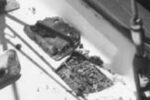
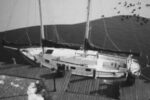
The Rawson 30 has a hefty 12,000-pound displacement, and carries a full keel with the two-bladed prop turning in an aperture cut in the front of the attached rudder. The original configuration had 5,000 pounds of ballast, but Steve removed 700 pounds of concrete and iron punchings from the keel and the 400-pound engine and marine gear before adding 1,300 pounds of batteries.
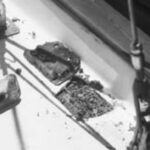
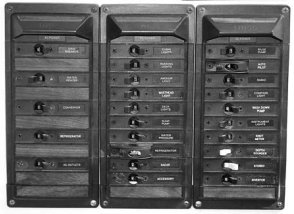
The innovative system uses 6-volt golf-cart batteries, 22 of them housed in three locations. Four of these — wired two in series, and the two pairs in parallel — make up the 12-volt house circuit. The house circuit powers a 1,500-watt inverter that supplies power to 115-volt AC loads. A 15-amp battery charger allows the system to be recharged from the marina AC shore power.
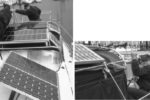
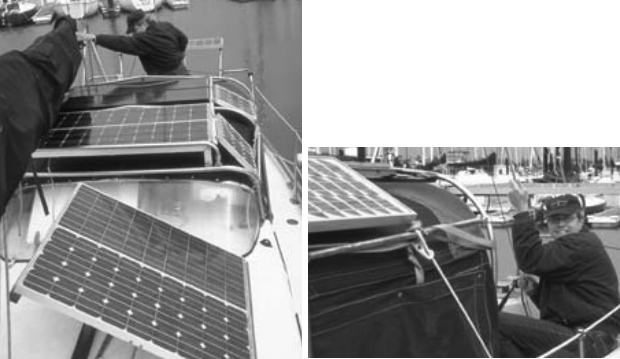
The propulsion system is three banks of six batteries wired in series to give 36 volts, with all banks wired in parallel to each other. There are a total of seven solar panels in the system. One charges the house battery bank, and six charge the drive system bank. A DC-to-DC converter allows the six-panel array to assist in charging the house bank by converting the nominal 36-volt input to a nominal 12-volt output.
Initially Steve controlled the 8-hp, series-wound fork-lift truck motor with on/off and reversing contactors. He later added a pulse-width-modulated motor controller that allows him to vary the speed of drive. With just contactors, the motor was either off or at full power. In final form, a small device called a “pot-box” is held in the helmsperson’s hand while maneuvering. With one hand on the tiller, Steve used the other hand to adjust motor speed and direction while maneuvering in his marina and at our destination across the bay. He made it look easy.
Same propeller
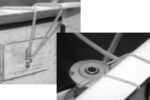
The fork-lift truck motor is mounted above and ahead of the prop shaft, which has its own inboard axial and thrust bearings. Power is delivered to the shaft with a 2.5:1 two-inch wide cog-belt drive. The boat uses the same two-bladed prop that the gas engine turned.
In our trips across the bay, we motorsailed with the mainsail up in winds that varied from nil to perhaps 15 knots. Steve controlled the motor thrust from the “potbox,” blending in enough auxiliary thrust to hold our speed up as the wind came and went. We never hoisted the jib, so I’m not sure how Rainbow sails without electric boost.
As expected, the motor was pretty quiet and almost vibration-free. There was a vibration that I suspect was associated with the two-bladed prop aligning twice per shaft revolution with the deadwood in front of it and the rudder blade behind it. Some of that might be eliminated by using a three-bladed prop, but Rainbow’s sailing properties would suffer for it.
The quietest engine drive in my (fairly limited) experience is a well-muffled Atomic 4 with a direct-drive transmission. Compared to that drive, Rainbow’s drive was noticeably quieter, although not completely silent. Compared to diesel drives I’ve known, I might be willing to say that Rainbow’s electric drive made practically no noise at all.
While the pulse-width-modulation motor-speed controller has been troublesome — it has been replaced twice — Steve is convinced that it is well worth having in the system. Without it, the motor drew 120 to 130 amps when it was powered, and it drove the boat at 5 to 5.5 knots in flat water. With the controller in the circuit, Steve can throttle back to 50 to 60 amps and get 3.5 to 4 knots. In so doing, he can obtain the 8-hour powered range he wants. The latest version of the controller installation includes a heat sink and a cooling fan, and Steve thinks this will end the failures. With the motor drawing 10 to 20 times the maximum energy that the solar panels can put out, they should not be considered a factor in the range calculation.
Ducted heat
Any electric motor has efficiency losses that show up in the form of heat. Steve has ducted cooling air from the motor to the cabin where it takes the chill off. He quantifies this recycling by saying that at full motor power, the duct discharges heated air that feels like a hair dryer set on low.
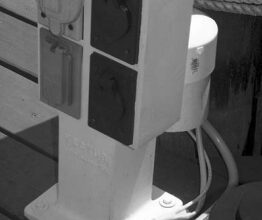
Steve has, at various times, lived aboard Rainbow. This shows in the collection of devices that are connected to the house system and the inverter. Along with a radio and television, he has a microwave oven, refrigerator, espresso maker, and computer. All the comforts of home.
All in all, this is a slick system well-suited to the way Steve uses his boat. He’s quite satisfied with it and quietly proud of how well it works . . . well, almost satisfied. He’s working with a fuel-cell company and intends to install one of these as soon as a suitable experimental fuel cell is available.
I was not taken in by his reasoning. Anybody who can jackhammer 700 pounds of ballast out of his boat and replace it with a well-designed and fairly low-cost electric drive could have changed a few water pumps and fixed an oil leak. The repowering of Rainbow was not about any of that. It was about novelty and experimentation. The muses called, and Steve went where they pointed.
Is this practical? Don’t tell me about practical. Sailing is not practical. It is interesting, and it is fun. And with an electric drive like the one on Rainbow, motoring is almost as smooth and quiet as sailing.
Thank you to Sailrite Enterprises, Inc., for providing free access to back issues of Good Old Boat through intellectual property rights. Sailrite.com