An electric auxiliary motor is smooth, quiet, and reliable, but . . .
Issue 20 : Sept/Oct 2001
Boats often outlast some of their mechanical components, such as their auxiliary engines. If you own a 20- or 30-year-old boat, you may be considering a new motor for her. There are many options available, ranging from going without an engine to having a new diesel professionally installed. One of the more intriguing possibilities is the electric option.
A few years ago, electric propulsion was limited to small, low-speed launches and canoes or represented by small electric trolling motors used on bass boats. Today, a dozen or more companies produce electric-powered boats, and at least three companies offer electric auxiliaries suitable for use in cruising sailboats up to 30 feet. A few people are installing electric motors in considerably larger cruisers, often in combination with a diesel generator to extend range. An ultimate example of such a hybrid is the 100-passenger electric catamaran ferry, Solar Sailor, that operated in Sydney, Australia, for the summer Olympics.
While larger electric auxiliaries for cruising sailboats and their associated battery banks are not as cheap as a do-it-yourself installation of a rebuilt inboard engine, they are approaching the cost of a new diesel installed by a paid mechanic. For a small daysailer, an electric trolling motor can be a cost-effective and quiet alternative to a new small outboard.
Electric-powered boats are hardly a new idea. Some of the earliest small low-speed launches of a century ago were electric. But as gasoline engines became more powerful, lighter in weight, and more reliable, the graceful electric fantail launch slipped away into technological obsolescence, its smooth slow way across the water losing out to speed, power, and noise.
Leisurely progress
But a certain segment of the boating population still enjoys the quiet, leisurely progress of a displacement hull, and that is the market that has led to a revival of interest in electric motors as a primary or auxiliary power plant. Compact Yachts, in cooperation with The Electric Launch Company, is even offering an optional electric auxiliary on new sailboats up to 27 feet. These are being sold as the Windborn line.
The biggest attractions of an electric auxiliary are probably its lack of vibration and noise, and its reliability. Once installed, the system is simple to operate. Solomon Technologies representatives claim to have only eight moving parts in their motor, and they tout the reliability because it was the power source for the Mars Rover. Other electric motors have only one moving part. Electric drives have no water pump, no transmission, no muffler, no starter Bendix, and no fuel pump to go wrong . . . all components that at one time or another have given me a lesson in on-the-spot troubleshooting and maintenance during a 17-year association with my two-cylinder Universal Blue Jacket Twin. For those who tackle mechanical issues reluctantly, fewer components is a definite plus as is the smooth silent power delivered by an electric auxiliary at the push of a button.
But electric power for boats also has shortcomings. Primary among these is the limited storage capacity of today’s lead-acid battery. One builder states that its minimum criterion for its 22-foot low-speed launches is that they have an endurance of eight hours running time at 6 knots. A number of other installations give less than that: typical is five to six hours, or 40 to 50 miles of range at a speed of 4 to 5 knots. For those who mostly daysail, this is probably adequate, especially if they can supplement battery charging through solar or wind power. Several companies offer extra onboard charging through solar panels or by adding a generator to the installation to make the boat a diesel/electric hybrid.
Not fast and not far
When considering electric propulsion for larger cruising monohulls in the 25- to 30-foot range, it is important to be realistic about expectations. These auxiliary drives are smooth and quiet, but they are not generally as fast as gasoline or diesel engine drives, and the technology is simply not available to enable them to have the range of a diesel drive.
A good way to evaluate alternative drives in terms of their range is to add up the weight of all the machinery and the weight of the fuel needed to move the vessel a given distance. The distance is the key to this evaluation. Among internal combustion engine options, for example, if the desired range is extremely short, the lightest drives (engine plus fuel load) are two-cycle outboards, followed by four-cycle outboards, then gasoline inboards, and finally diesel inboards. This order is established because the horsepower-per-weight of engine machinery is the significant factor.
As longer distances are considered, the order will exactly reverse, with the diesel drive being the lightest and the two-cycle outboard being the heaviest. In both evaluations the weight of machinery (engine, marine gear, shaft, prop, and bearings) is added to the weight of tanks and fuel. As the range is extended, the weight of the propulsion system will begin to be a significant part of the weight of the craft. This is well understood in the case of military and commercial aircraft operations, for example, where fuel load displaces payload to achieve maximum range.
To some degree it is possible to trade speed for range, and it is common for the designers of electric drives to do this to improve range. A displacement monohull traveling at hull speed requires much more than twice the horsepower needed to travel at half of hull speed. By sizing the motor in the drive for 70 to 80 percent of hull speed, the range of a boat can be extended.
Very short range
Also in favor of the electric drive is the efficiency of the motor and battery in converting stored electrical energy into mechanical energy at the prop shaft. The motor/battery combination is more than twice as efficient as a small marine diesel. In spite of these factors, the range of an electric drive is extremely short when compared, pound for pound, with any of the other internal-combustion engine drives.
The problem lies in the storage battery. The energy density of batteries is extremely low. Calculations may vary depending on what factors are included, but in rough numbers — taking the usable storage capacity of an AGM battery as 30 percent of its rating — it takes 53 pounds of batteries to store the energy that a diesel engine can extract from one pound of diesel fuel. With factors of over 50:1, electric drives simply cannot be expected to achieve the range of any of the other engine options. While a four-ton monohull with a modern diesel and a 20-gallon tank can easily go 200 miles in average conditions, an electric drive in the same boat will be very hard-pressed to go 50 miles.
More batteries may be added to extend the range of an electric-drive vessel, but the weight added will quickly become significant enough to influence the characteristics of the vessel, including the amount of energy needed to move it a given distance.
Deep-cycle batteries can withstand an occasional draw down in excess of 50 percent, but recommended practice is to limit discharge to 50 percent of rated capacity and to consider the batteries recharged when they reach 80 percent of capacity. It will not hurt them to recharge to 100 percent of capacity; in fact it is good for them. But the charging rate drops off as the batteries are brought up to full charge, so the recharge time is extended greatly when they are brought to 100-percent recharge.
Extending endurance
For this reason, electric boaters who need gasoline- or diesel-engine-class range should investigate the cost of a supplemental onboard generator, so they can operate as a diesel/electric to extend endurance. While a small generator won’t deliver the power that a 10-hp diesel will, its engine is able to operate at its most efficient rpm while generating current. So, at least in calm water, it’ll do fairly well. Extending range with a generator also gives you supplemental power for such amenities as onboard refrigeration, but it comes with a hefty price tag.
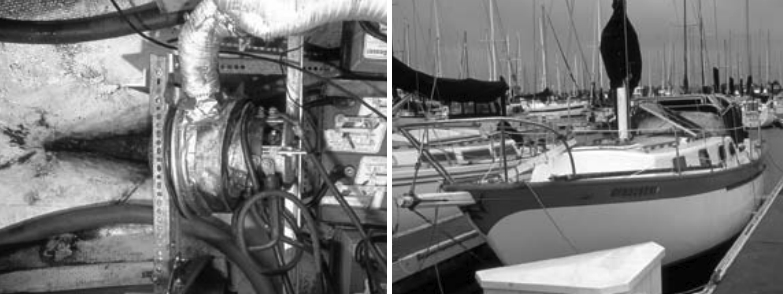
One of the most intriguing electric auxiliaries using supplemental onboard charging is the Electric Wheel, sold by Solomon Technologies. The Electric Wheel, originally designed for automotive use, takes advantage of regeneration technology. Originally installed as a drive motor on each car wheel, it acted as a generator during braking to feed power back into the battery bank. Solomon Technologies adapted this capability to use some of the wind energy collected by a boat under sail to regenerate. As you sail along, the prop drives the shaft that then runs the motor as a generator to produce current that goes back into the battery bank. Solomon Technologies’ owner, David Tether, claims that the motor will start feeding power back into your batteries when the wind gets up to five knots. Sailing along near hull speed, he estimates you’ll reap about an hour’s-worth of running time under power from three hours of charging under sail.
Increased drag
There is, of course, no free lunch. A price must be paid in the form of increased drag. John Finnerty, of Solomon Technologies, estimates that drag will reduce your speed under sail perhaps 3⁄4 knot while your batteries are charging. But once they’re topped up, you can eliminate the drag by letting the motor kick in to give you a boost. Since it runs quietly and smoothly, you probably won’t even know it’s on. A side benefit of an installation of this type for those sailing on long passages is that the ocean cruiser can enjoy a generous supply of juice to power the watermaker, stereo, beer cooler, and electronics without running an engine for charging.
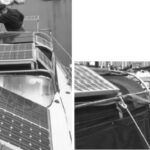
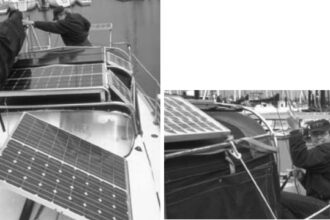
Another option that works for smaller boats only is to use solar power from photovoltaic panels for supplemental charging. A small daysailer could get an hour or so of running time from a week’s-worth of charge from a 20-watt panel. However, larger battery banks and more powerful systems will gain little more than a trickle charge from small solar panels.
Regardless of configuration, all electric power plants consist of a motor, a battery or bank of batteries, and a controller to regulate the current to the motor. Most large installations also include an e-meter that provides information on how much running time you have left in your batteries. Motors range in size from little trolling outboards operating off a single deep-cycle battery to units large enough to push a 48-footer.
The simplest and least expensive motor is the ubiquitous trolling motor seen on bass boats everywhere. They come in 12- and 24-volt sizes. A 24-volt motor will generate 65 to 70 pounds of thrust, enough to power a Catalina 22-sized boat at near hull speed in flat water. A marina neighbor of mine clamped a small 30-pound thrust outboard onto the transom of his 2,000-pound daysailer. The little motor, with a single deep-cycle battery, pushed his 19-footer in and out of the dock and got him back after he was becalmed a mile or two from home port. He didn’t go very fast under power, but he said it was faster than he could paddle.
Self-sufficient
That size motor probably cost him about $250. For another $200 you could add a 20-watt solar panel to make your boat self-sufficient . . . at least for short runs. A couple of companies offer a refinement on the electric trolling motor in the form of a sterndrive system suitable for a catamaran or a 20- to 25-foot monohull. These use 24-volt motors and reduction gearing so they can swing a larger prop. A unit made by Sillette-Sonic, of Britain, claims to be powerful enough to replace a 10- to 15-hp internal-combustion engine. With four batteries, Sillette-Sonic will give about six hours of cruising time.
In addition to being very simple to install, one advantage of transom-mounted electric trolling motors is that they leave more room in the cockpit of a small boat. The motors are also considerably lighter than a comparable inboard electric installation of similar power. But boats bigger than 22 feet will probably require a more powerful auxiliary electric motor. And most small trolling motors are direct-drive and so turn a small prop at a fairly high speed, which is not optimal for pushing a larger heavy-displacement hull.
Most companies selling electric boats recommend absorbed glass mat (AGM) type batteries. These are sealed, maintenance-free batteries well suited to repeated deep discharge and recharge cycles. Sealed batteries eliminate any possibility of explosive hydrogen gas buildup, and they can be mounted on their sides, giving more flexibility in locating them in odd corners of the hull for optimum space and weight use. AGM-type batteries also lose charge more slowly than do conventional flooded batteries.
Replacing batteries
The big dollar drawback to electric installations, though, is battery life. Most manufacturers estimate well-maintained lead-acid batteries will last about five years. The cost of new deep-cycle batteries will buy quite a lot of maintenance, filters, diesel fuel, and other odds and ends for your internal-combustion system. Still, for some situations, electric auxiliaries may be worth the price. Andre Dionne, of the Electric Launch Company, claims that if you amortize the cost of the batteries over their lifetime, the cost per trip becomes competitive with many diesel or gasoline-powered auxiliary installations.
Most of Solomon Technology’s installations employ two of their smaller model motors, one in each hull. The shared batteries can be placed where they do the least harm to trim.
As described in an article reprinted from Multihulls magazine posted on the company’s Web site, Solomon recently replaced two 25-hp outboards on a 43-foot cruising cat weighing 16,000 pounds with two 6-hp motors and two 18-inch diameter, 14-inch pitch props. This boat generated 5 to 7 amps sailing in a 15-knot wind and after an hour replenished all the power used during her 20-minute passage under power to open water. The propeller change also improved low-speed maneuvering, her owner reported.
Other applications
Solomon has also installed electric auxiliaries in a number of 30- to 35-foot monohulls. One recent installation was a 10-hp motor (and supplemental generating set) aboard a 48-foot Cherubini as a replacement for a 65-hp Perkins. In early 2001 the boat was preparing to get underway from England to cross the Atlantic with her new plant. Solomon offers two models of its Electric Wheel, which the company claims will repower boats up to 12 tons displacement.
John Finnerty first got acquainted with the company when he was considering re-powering his Cal 29 after its diesel died. His typical sailing routine included a 30-minute trip under power out onto the open Chesapeake Bay for a daysail, and he liked the idea of a quiet reliable auxiliary that wouldn’t object to frequent short runs. He put a 6-hp motor in his sloop and was so happy with it that he started selling Electric Wheels to other sailors.
The Electric Launch Company, of Highlands, New York, is another manufacturer that retrofits older sailboats with electric propulsion. A typical recent installation described on the company’s Web site was that of a 4-hp, 48-volt motor with four 4D AGM batteries in series, for a 26-foot sloop. This was a replacement for a 7.5-hp diesel. The company claims it gave the boat a range of five hours at 7.4 knots. As with the Electric Wheel replacements, The Electric Launch Company’s Andre Dionne says you may have to replace the prop and/or shaft as part of the installation. Most of the electric motors ELCO uses operate at around 1,700 rpm, less than some diesels, even with 2:1 reduction drives, and they will be more efficient with higher-pitch props.
Whether to repower with the electric option is a decision we’re going to try to defer by keeping our Atomic 4 chugging along for a few more years. But the appeal of some new technology that is truly “green” is undeniable, and we may yet ultimately repower with electric. Perhaps the 21st century will see the old idea of an electric boat make a comeback. Thanks to scientists, engineers, and backyard tinkerers alike, it might be possible using non-nuclear, non-fossil-fuel energy. It’s an intriguing aesthetic for the New Millennium auxiliary yacht.
Susan sails Lake Ontario with her husband, Chris, on Titania, a 32-foot Chris-Craft circa 1968.
Thank you to Sailrite Enterprises, Inc., for providing free access to back issues of Good Old Boat through intellectual property rights. Sailrite.com