What to do when fire strikes on a boat and there’s no place to hide
Issue 37 : Jul/Aug 2004
There is always some uncertainty in life, especially when it comes to boats. It wouldn’t be an adventure otherwise. But one adventure we all want to avoid is a fire on board. If a fire starts in a building, you can leave the building and go to a safer location. In a boat that isn’t always possible.
Although it’s unlikely, there is always some chance that a fire will occur and a fiberglass or wooden boat can burn to the waterline and sink. Most fires are preventable. Minimizing risk is the most effective means of dealing with fire hazards. If you keep the tiger in his cage, you won’t have to deal with the emergency of his escape. However, if he does escape, you need to be prepared for that too. Quick detection of the smoke or fire is mandatory because unconfined fire spreads exponentially with time. Finally, depending on the situation, you must be prepared to fight the fire or make the decision to abandon ship.
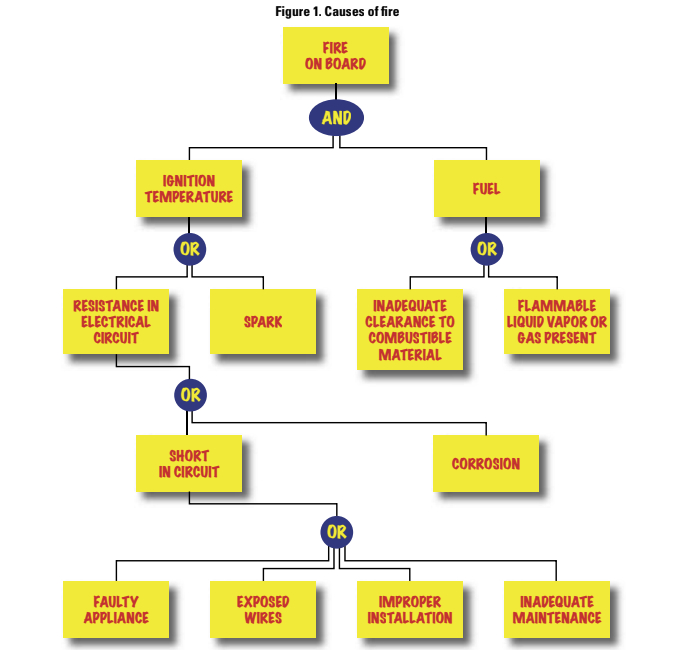
A fire doesn’t happen without a reason; there is always a cause and a sequence of events that lead up to it. One way to look at the possibility of an adverse event happening is by using what engineers sometimes call a fault tree analysis, a model to help identify alternative sequences of events that could lead to an accident.
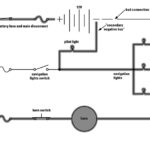
For example, take a fire that started with the heat from an electrical system. To start, this fire needed fuel heated to ignition temperature (and oxygen, which is almost always present in the air). Look at the first branch below “Fire on Board” in Figure 1. Notice that it is an “and” gate. Both fuel and ignition temperature need to be present. To have fuel present, I made the chart indicate the existence of either an improper clearance to a combustible (like a wire lying on paper, cloth, or wood) or flammable or gas vapors. That is an “or” gate because either could supply the necessary fuel. On the other side of the chart is ignition temperature; either a spark can supply it (perhaps from a motor) or abnormal resistance can cause a wire to heat to ignition temperature.
Figure 1 isn’t complete by any means. For example, the flammable liquid vapor had to come from somewhere, but one thing leads to another. Proper inspection, maintenance, and testing of the electrical circuits and appliances will break up the sequence of events that lead to fires caused by the electrical system. Be diligent about inspecting electrical connections in places where flammable vapors might be present, such as in the engine compartment. Be sure the batteries are well ventilated because charging, especially overcharging, produces explosive hydrogen gas. There are some excellent books on the subject, such as Sailboat Electrical Systems: Improvement, Wiring, and Repair by Don Casey. Also, read the article by Gord May in Good Old Boat, March 2003.
Flammable liquids such as alcohol and gasoline are commonly involved in boat fires. Here are a few preventive measures:
- Inspect all the components of the fuel system from the tank to the carburetor for leaks and condition.
- Look and smell for leaks. You may be able to smell a problem before you see it.
- After refueling, sniff the bilge for gasoline vapors, check concealed spaces, and run the blower before starting engine.
- Storage of fuels: use only containers approved by Underwriters Laboratories or equivalent for storing flammables.
Gasoline is a mixture, and its flash point varies but is about minus 45° F. That means that it is always giving off flammable vapors at temperatures anywhere near any area where I want to be sailing. Diesel (fuel oil) varies also but has a flash point above 100° F, so it isn’t nearly as volatile as gasoline. Yet, it can give off flammable vapors in a hot engine compartment.
Marine stove alcohol is just denatured alcohol and has a flash point of about 60° F. Propane is a gas under normal conditions, so it is always an explosion and fire hazard. By law, every manufacturer is required to provide you with a Material Safety Data Sheet (MSDS) that lists the flash point and much other important safety and health data. I find that manufacturers almost always provide the MSDS information online.
Since it is usual to cook over an open flame, it shouldn’t be a surprise that galley fires are not uncommon. Propane is a great fuel for cooking, but if you have propane on board be sure the tank and piping arrangement are installed according to the latest standards. The tank, regulator, and solenoid valve have to be in a separate vapor-tight compartment with a drain that vents overboard. Propane has a density of about 1.6 compared with air at 1 (and gasoline at about 3) so it can accumulate in the bilge. Avoid that at all costs; use your blower before starting the engine to ventilate the bilge.
The safest alcohol stoves are the new non-pressure types. Alcohol fires can be put out with water. Be sure to store the extra alcohol in a safe place where it won’t be damaged or spill when the boat is heeling or in a seaway. Don’t take more alcohol than you need on a trip.
I notice that my curtains can be positioned over the stove if I am not careful. All combustibles — such as paper, clothing, and wood — should have adequate clearance from the stove, especially above it, since a flare-up (common in pressure alcohol stoves) or grease fire can reach quite high. When I had a propane-fired stove, I shut the valve at the tank when I wasn’t using it. You should inspect the entire propane system regularly. Use soapy water and a brush to test for leaks when the system is under pressure.
Bernard Moitessier is said to have reduced the weight of his boat, Joshua, by a ton by eliminating what he didn’t need to sail around the world without stopping. I doubt if you have a ton of unneeded material on you boat, but it is a safe bet that you could find considerable extra stuff. The fundamental principle of good housekeeping is to have what you need neatly stowed so it doesn’t come loose when the boat rocks and rolls and so you can locate things when you need them. How much paper, paint, thinner, and extra fuel do you really need? How long has it been since you took everything out of those deep lockers and got rid of the stuff you haven’t used for years?
Make sure that combustibles are stored away from exhaust pipes, heater vents, stoves, and ovens. Keep the engine area free of oil and rags. If you don’t allow smoking on board, you have eliminated a serious fire hazard.
If the tiger escapes, you need to know quickly so you can protect yourself and make plans to put him back in his cage. A working smoke and fire detector is a real asset if a fire starts while you are asleep. Battery-operated smoke and fire detectors are inexpensive. Another good device is a gasoline fume detector (sniffer) that can detect gasoline vapors and sound an alarm before they reach an explosive mixture with air.
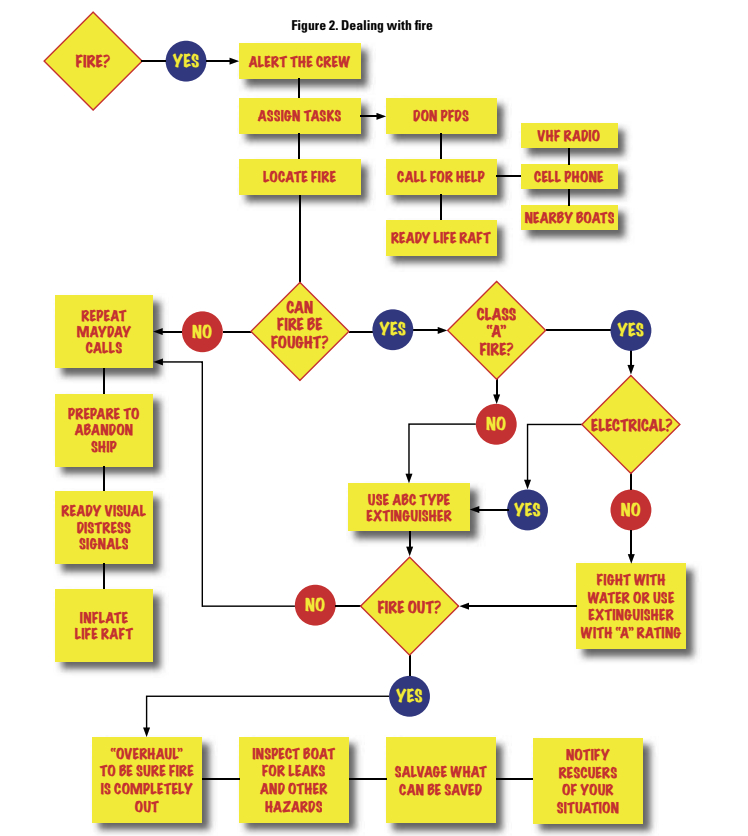
Figure 2 shows some of the decisions you will need to make if you discover a fire on board. If the fire is in the engine room, there is a problem with fighting it because opening the engine compartment will introduce more oxygen and could cause the fire to flare up and get quickly out of control. To help alleviate this problem, you might consider an automatic extinguishing system for the engine compartment. These systems sell for between about $100 and $800, depending on the size you need. They automatically activate at 165° F and use an agent that does not leave any residue.
The decision to fight a fire is a tough one. Certainly you shouldn’t risk your life to save property. Yet, if you are at sea and fire breaks out, the alternative to extinguishing it may be as dangerous.
The first thing to do is to alert the crew and don PFDs, call for help, locate the fire, and, if possible, extinguish it. Notify any potential rescuers of your situation. If the decision is made to fight it, you will need the appropriate type of fire extinguisher (or a multipurpose ABC type). If you decide to abandon ship, you will need to prepare the life raft and collect emergency supplies. If you are successful in extinguishing the fire, make sure there are no smoldering embers.
A little fire is quickly trodden out,
Which being suffer’d,
rivers cannot quench.
Shakespeare — Henry VI
Thank you to Sailrite Enterprises, Inc., for providing free access to back issues of Good Old Boat through intellectual property rights. Sailrite.com