A Pacific Seacraft 25, the last of her kind, sets out for the Gulf of Alaska and beyond
Issue 11 : Mar/Apr 2000
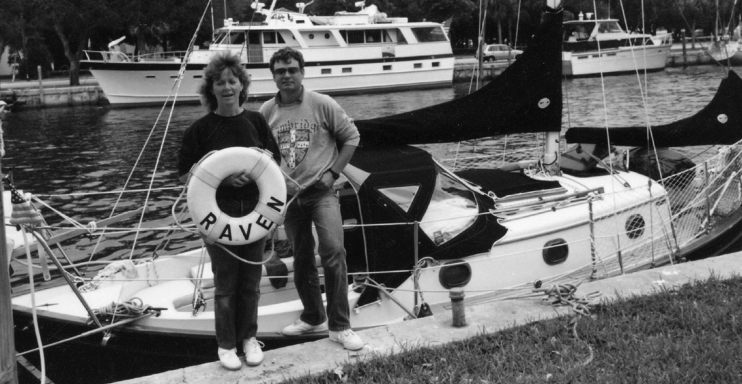
The longshoreman was an old seadog with Skye-blue eyes and a Scottish burr, watching me from the corner of his eye as he straightened the freighter’s drop lines. “Your boat?” he asked, not taking his eyes off the crane swinging dockside.
“It is,” I said, also riveted to the cradle above our heads.
The crane had swung a bit too far, and the old man motioned for the operator to bring her back on center, which he did with a jerk, causing my heart to flutter.
“Sailed her far?” he asked over his shoulder, and I could hear Dungeness in his voice.
“Round ’bout the Horn, Cap’n!” I wanted to say. But . . . “She’s my first boat and I’ve not laid eyes on her before now.”
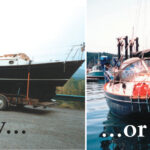
He smiled hugely and looked at me for the first time “All’s the better lad, you’ve got it all in front of you, then.” He studied the lines of the Pacific Seacraft 25 in her oak cradle, settled now on my flatbed trailer. Her black hull gleamed in Puget Sound’s morning mist, and the weathered teak hatch took on a varnished look. The old man kicked loose the line and stood, hands on hips, appraising the boat. “She’s a yar boat, lad . . . a yar boat.” He cocked his head at the vessel. “A wee bitch, I’ll grant ya, but one for the sea.”
Tom Cooper had just started Seacraft Yacht Sales on Lake Union, in Seattle, and as a struggling young broker, had gone far out of his way to find me this boat. He called me at home in Colorado early one morning in 1988. “I think I’ve located that Pacific Seacraft you’ve been wanting!”
“A 25?” I answered, hardly daring to think this might be the right one, after a year-long search.
“Yes . . . but she’s in Alaska, and I haven’t seen her myself. She’s an ’80, commissioned in ’82 . . . the last one built . . . all factory options . . . she needs some work, but I think she’s a good one and worth the effort.” He paused. “She could be barged down to Seattle. The owner’s thinking of listing her down here, so we might work something out.” I took this for an omen as I had intended, ultimately, to sail to Alaska.
We did work something out, and two weeks later I was in Seattle with my truck and gooseneck trailer, watching her come off the freighter. As proof of my credentials, I had bought her sight unseen, no survey, no guarantee, all on the strength of a few pictures and Tom’s cautious endorsement, thus ending a search that had taken me from California to Florida, and back to Seattle several times.
I felt I had done my homework though, debating over a year the pros and cons of a number of traditional, ocean-capable, pocket-cruisers. The Orion 27, by Pacific Seacraft, was a first choice, but too big to trailer conveniently and out of my price range in any case. Ditto the Nor’Sea 27, which I also liked. The Flicka fit the criteria and was probably even more seaworthy than the 25 but was just not as pleasing in my view. As an old salt once advised, “Get one that pleases your eye. You’ll be looking at it more than you’ll be sailing it.” I admit I’ve always had a thing for double-enders. Throw in a bow-sprit, cutter rig, and a sweet sheer, and you’ve got me.
Special interest
The 25 was conceived by Henry Mohrschladt, creator and president of Pacific Seacraft, and was their first production model, soon followed by the Mariah 31, a larger version of the same boat. Being the last of her run, it appeared Pacific Seacraft had taken a special interest in this particular boat, showering her with amenities. I later heard that Henry himself kept a keen eye on the project, even though he was then deeply involved with the new Crealock designs which were soon to make Pacific Seacraft world-renowned.
I towed her back to Colorado for a refit, even though she had been lightly used. Her sails and engine were like new, but she had not been “tended to,” and the Alaskan weather had taken its toll.
As one who had made a business of restoring classic European sports cars, I looked forward to renovating this neglected beauty. The teak decks, which had been a major factory option, were still sound, though badly weathered, as were the teak hatch, caprails, cockpit grate, hatch boards, and so on. One of the companionway trim pieces had split and would have to be replaced, but for the most part, marathon sanding and varnishing would put the brightwork in order.
The list of factory options was impressive: in addition to the teak deck, cockpit grate, and main hatch, they included a private cabin forward, with a real door, a teak-and-holly sole, a marine head, a kerosene stove (I thought this was a real plus at the time), a BMW 7-hp diesel, a black hull, and a cutter rig with a club-footed staysail. All lines were led aft, and the heavy cruising main had two sets of reef points with a jiffy-reefing system. All hardware was bronze, including ports, winches, through-hulls and deck fittings.
Sailing sabbatical
Though she had sat in the water for six years, there was not a single blister on the hull. This I attributed to her heavy gelcoat, high quality lay-up, and the very cold salt water of Alaska. Nonetheless, our first major project was sanding the hull down to gel and applying six coats of good epoxy barrier, then bottom paint. I was looking at a two-year sailing sabbatical, the last portion of which was to be in the Florida Keys. Warm salt water and tropical critters might not be so kind to an unprotected hull.
The interior cushions were sent off to the upholsterer to be copied in four-inch high-density foam covered in quality marine fabric. With the cushions out, we could strip the interior of locker doors and covers, bilge hatches, and so forth, and thoroughly clean and paint all the enclosed spaces. We could also clean and oil the interior teak.
We were then ready for the custom interior joinery we felt was needed for extended cruising and living aboard such a small boat. A poor but honest young cabinetmaker had recently moved to town and opened a small shop, and we were fortunate enough to discover him in time to give him a considerable amount of our money. Though admitting he knew nothing about boats, he was enthralled with the Raven and her “teak furniture.”
Together we designed pull-out drawers in every available space, and two additional hatch boards for the cabin sole, for added bilge access. There were to be louvered teak vent panels installed in the hanging locker, lower V-berth panels, and cabin door, along with several custom-made, roll-front, teak cabinets, one in the head area as a medicine chest and several in the main saloon. A friend had made us a stained-glass raven panel, which was framed as a companionway drop-board, along with another featuring an insert of insect screening, a decision we later applauded, both in Alaska and Florida.
Matched to perfection
The cabinetmaker proved to be an excellent craftsman and took the project quite seriously, since it was his only job, working day and night for the next three weeks to meet our self-imposed deadline. Upon completion, the greatest compliment I could offer was that “I couldn’t see where he had touched a thing.” Everything looked factory-original and matched to perfection. We were delighted.
While the boat was at the cabinet shop, we turned our attention to the standing rigging, which was inspected and deemed good, other than a few lock rings and cotter pins. The mast and boom, on the other hand, were showing some signs of abrasion, probably suffered on the freighter from Alaska. We decided to do the spars in white two-part epoxy, which became a pretty involved process but turned out well and later exceeded my expectations for durability (this included the overspray on the house, patio furniture, and dog). A tri-color light with emergency strobe was fitted at the masthead along with a Windex and new VHF antenna. I also took this opportunity to stuff the mast with foam blocks for two reasons: first, to keep the wiring from slapping around in there; and second, to provide additional buoyancy for the mast in the event of a knockdown (as advised by a fellow down at the pool hall who once raced Lasers).
We now turned our attention to the ground tackle, replacing the original anchoring gear with a 22-pound Bruce, which fit the bow roller as though designed for it, coupled to 100 feet of chain, followed by 200 feet of 5/8-inch nylon rode. After long deliberation, I decided to really wreck the budget (West Marine was already sending me warm personal notes of encouragement on a regular basis) and ordered a Simpson-Lawrence manual windlass, which some might have considered overkill on a boat this size. But it certainly did look salty up there on the bow, just as my West advisor said it would, and it did prove handy, later on, for raising the first mate in the bosun’s chair . . . until a bow-wave from an Alaskan ferry pretty much curtailed that usage.
Not a problem
Next stop was the welding shop, run by a giant of a man we locals affectionately referred to as the Poo-Bear (not in his presence, of course) where a bow chock, side arms, and adjustable pads were added to the trailer. How to remove the original oak cradle from around the boat had been puzzling me, as we had no suitable lifting device.
“Not a problem,” Poo-Bear said, grabbing a chainsaw. Before I could come up with a reason not to, he had cut it away from the hull — in less time than it takes to carve a Thanksgiving turkey actually. “Not a problem,” he said again, stacking the oak wood (now in stove-size chunks) next to his woodstove.
While I don’t recommend the following, ever, we did support the weight of the entire boat on the screw-jack pads while slipping a new support plank under the keel. There was absolutely no sign of flex or stress in the hull during this maneuver — a tribute to Pacific Seacraft’s lay-up schedule, coupled with their generous bonding of bulkheads and cabinetry. Happily, later in our voyaging, I would see even more evidence of their bullet-proof construction. A good compounding and waxing of the black hull completed all we could do in Colorado, and after collecting the new cushions, we were ready to haul her back to Washington state for final commissioning and preparation for our maiden voyage to Alaska.
Arriving in Port Townsend, Wash., in May, we were right on schedule for a proper departure north to Alaska (the rush was on) and quickly made arrangements to have the renovated Raven lifted off the trailer and placed in the water, where the mast was stepped and rigging adjusted for the short trip under motor to the Alcohol Plant Marina at Port Hadlock, where a slip had been arranged for the final preparations.
Custom dodger
Chief among the necessities for such an arduous voyage would be a spray dodger; so counseled the dockside experts. A Northwest passage could not be attempted without one, in their view. Thus, a custom dodger and matching canvas by Petric & Hassey, of Port Townsend, were fitted at no little expense of time and money. (It turned out that the dockside experts were right, too, and the dodger became our most cherished modification.)
We were now running behind schedule, and the main pack had set sail, if not for Alaska, at least for the San Juans and Gulf Islands. By now, the hangers-on at the marina had us figured for the ubiquitous cruiser wanna-bees whose boats are never quite ready, and whose umbilical cord to the dock tethers them forever.
But, in fact, all that was left to do was one final “feeding frenzy” at West Marine, in Seattle, where we were received as those feared lost at sea, seeing as how no orders had been received from us in several days. Two huge shopping carts full of merchandise soon restored their faith. We now had an inflatable dinghy, electronics in the form of a loran, new VHF, and depth sounder, and enough additional “stuff” to put the boat several inches below the designer’s projected waterline. The first mate had been busy at the local markets, and it was a comfort that should our vessel be swept out to sea, we had stores enough to last at least until Japan. Truly it was time to go.
The next morning dawned cool and foggy as we slipped our lines and pointed her north, past Wilson Point and into the Strait of Juan De Fuca. Thus began a great voyage (relatively speaking) and one which would take the little PS 25 to the Gulf of Alaska, followed by the Gulf of Mexico and beyond. She was all we had hoped for, and by far a better boat than we were sailors, a fact which would stand us in good stead in many a tight spot we unwittingly put her in. She was indeed “a yar boat.”
Ron and Terrel Chappell have sailed and lived aboard small boats, off and on, for the past 14 years, from Alaska to the Keys. They currently trailersail a Com-Pac 23D, primarily in the Pacific Northwest in summer and Baja in winter.
Thank you to Sailrite Enterprises, Inc., for providing free access to back issues of Good Old Boat through intellectual property rights. Sailrite.com