Channeling old masters through metal tubing
Issue 93 : Nov/Dec 2013
When Jennifer and I bought Phoenix, a Hans Christian 33, we had the luxury of being able to install some systems from scratch and thus design them the way we wanted. But when it comes to implementing the designs I envision, although I fancy myself having the patience and skills of Michelangelo, my work inevitably reveals itself to be that of a maladroit.
I have always thought it was a shame to see various antennas affixed — sometimes with hose-clamp contraptions — on a pushpit rail. The cables are bound to the stainless-steel tubing every so many inches like a lady on a railroad track — but with ugly zip ties. The final wince is evoked when I notice cables protruding from holes in the hull like half-ingested spaghetti.
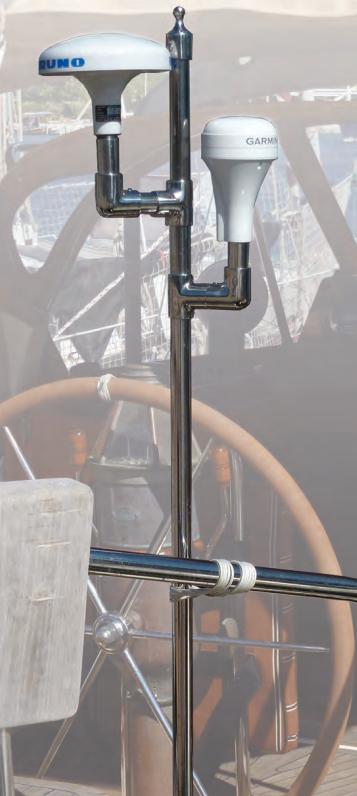
Not wanting to do likewise, I considered our options. I had three antennas: a Garmin GPS, a NavTex mushroom, and a WiFi stick antenna. There had to be a way to build an antenna post that would appear all of an elegant piece.
I perused the web pages of marine suppliers. None offered antenna-post solutions. I was going to have to be my own designer. My criteria were that wires could not be visible; the post had to be of stainless steel for durability, strength, and ease of maintenance; and it had to look like a work of art . . . or, at least, nice.
After wandering the aisles of marine suppliers and hardware stores to see what was available off the shelf, I decided to build a stainless-steel “cactus.” A rod rising from the side of the hull would have parallel upright branches to support the antennas.
Gathering components
Following a morning of coffee and sketching, I set off for a marine supply store to get the parts. My first stop was the tubing department. I chose 1-inch tubing to accommodate the Ethernet connector for my WiFi. Since I wanted my antenna post to rise above my pushpit, which would make it about 4 feet tall, and I also needed tubing for the branches, I bought a 6-foot length.
Next, I went to the antenna section, where I bought two stainless-steel antenna pedestal mounts of the type with a flat plate welded to the bottom for flush mounting (West Marine model 409888). My plan was to cut the base plates off, leaving me with tubes threaded to accept antennas.
Then it was off to the rail-fixtures aisle. There, I bought tees and 90-degree elbows for the cactus. When inspecting the pieces, I noticed the chrome units by Zamak weren’t hollow all the way through. As this is critical for leading the wires internally, I was glad to see that the stainless-steel versions were indeed hollow.
The tricky purchase was the base. First, there was a design choice. Rail bases come in rectangular or round. But, more important, they are offered in 30-, 45-, and 60-degree angles. Some DaVinci type might be able to calculate the angle needed. I employed the “buy it, try it, return it” method.
Eyeball alignment
Phoenix has a canoe stern with moderate tumblehome approaching the gunwale. Experimenting with different placements of the base and the inserted tube resulted in varying degrees of approximation to vertical. But none was perfect.
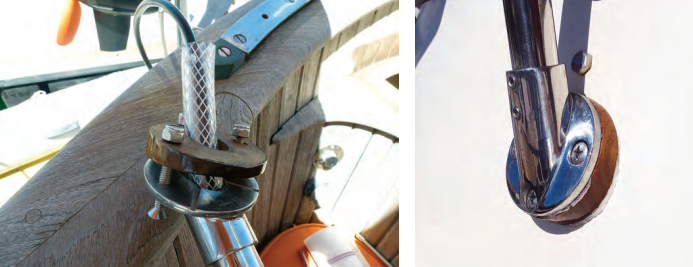
Lingering in my collection of spare and retired parts I found a teak flagpole-base wedge I had removed from my previous boat. While my hand cramped up clamping the contraption together, I asked Jennifer to look from different angles to judge whether our cactus would be erect.
“Yeah. I mean, I think so. It looks good. I can’t really tell, but it doesn’t look off.”
Only M. C. Escher would have required anything more precise than that.
I had to cut the wedge to fit the stainless-steel base and bore a hole in the middle for the wires. A little sanding and varnishing made it look as if all its life it had really wanted to be an antenna wedge instead of a flagpole wedge.
In the Bimini section of the marine store, I found a finial. A top-ball top cap was the perfect topper.
Sculpting metal
Cutting the tubing to length was not easy. A friend offered his miter saw and we used a grinding wheel. We got the job done, but it was more butchery than Bernini. Later, our Bimini maker said we should have brought the tube to him and he would have cut it to size in minutes.
Drilling holes in stainless-steel tubing is also not easy. The metal must be drilled slowly because it hardens when heated, and a drill press or drill attachment is needed to prevent the drill bit sliding off to the side.
Finally, I had a machine shop tap a thread for the top-cap’s setscrew. I wish I had also asked them to drill my holes. They would have done a neater job.
By the time I finally assembled my antenna post, I discovered that we would be using 3G modem sticks in our laptops to get Internet access instead of relying on WiFi. Consequently, my post ended up with an unused hole. Oh well, another defect in the Degas.
After watching YouTube videos of how to drill into a hull, I made a nice hole in Phoenix. Jennifer and I led the wires and, just as we were about to bolt the post to the hull, I noticed that it would be prudent to fit chafe protection at the through-hull. I cut open some water hose, wrapped it around the wires, shoved half the 6-inch hose into the tube, and left 3 inches hanging into the cockpit lazarette.
A loose end tied up
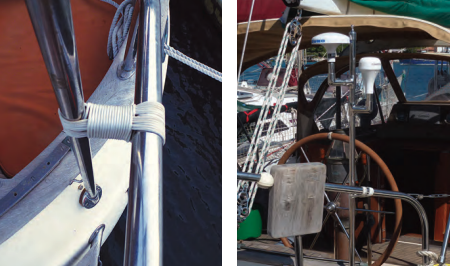
A final touch was needed — some kind of bracing to give the post additional support. Someone, someday, was going to lose their balance and reach for the post. Unsupported, it couldn’t endure that kind of force.
“Don’t do anything ugly to ruin the design,” Jennifer said from behind her crossword puzzle.
“Of course not,” I retorted and began to brood.
I had to admit she was right. The best I had come up with was odd clamps and bent brackets. A small sacrifice in a Seurat, I figured. But now that was out.
My solution was, in fact, the pièce de résistance. I would fashion a short dowel, filed concave on each end and lashed in place with cord.
“Sounds salty,” even the woman of crosswords admitted.
Pièce de résistance? Hardly. The result did not quite match the vision I had, inspired by the 20th century knot guru, Hervey Garrett Smith.
All in all, we love our new antenna post and we’re proud that we have something so unique. But I also take solace in Salieri’s final words in the movie Amadeus: “I absolve you of mediocrity.”
Mathias Dubilier and his wife, Jennifer, are receiving NavTex and GPS signals while cruising the Mediterranean on Phoenix, their 1986 Hans Christian 33. Follow their voyage and musings at www.dolphinsvoyage.blogspot.com.
Thank you to Sailrite Enterprises, Inc., for providing free access to back issues of Good Old Boat through intellectual property rights. Sailrite.com