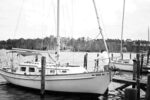
They named their Nicholson 35 Passport . . . indeed she was just the ticket for their journey south
Issue 8 : Sept/Oct 1999
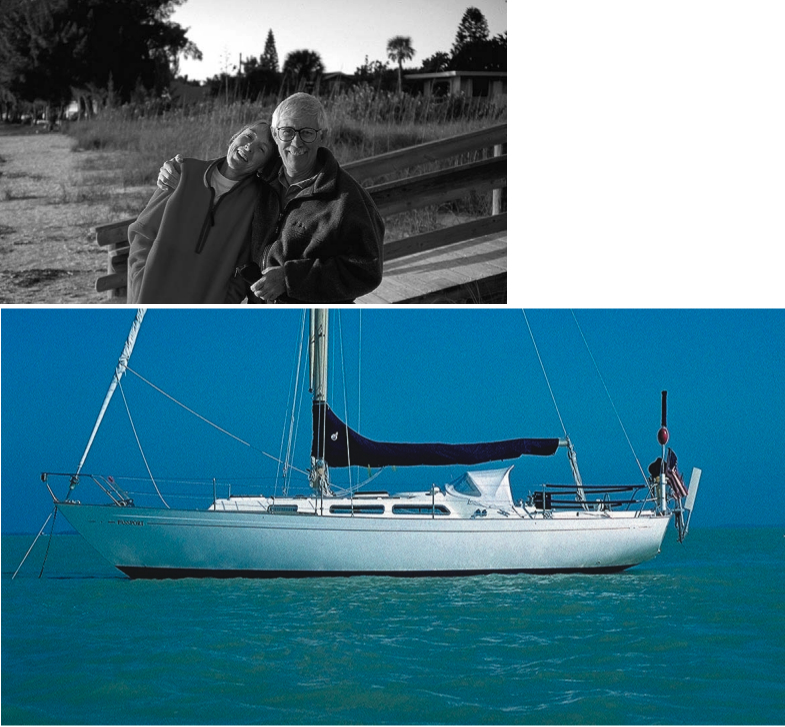
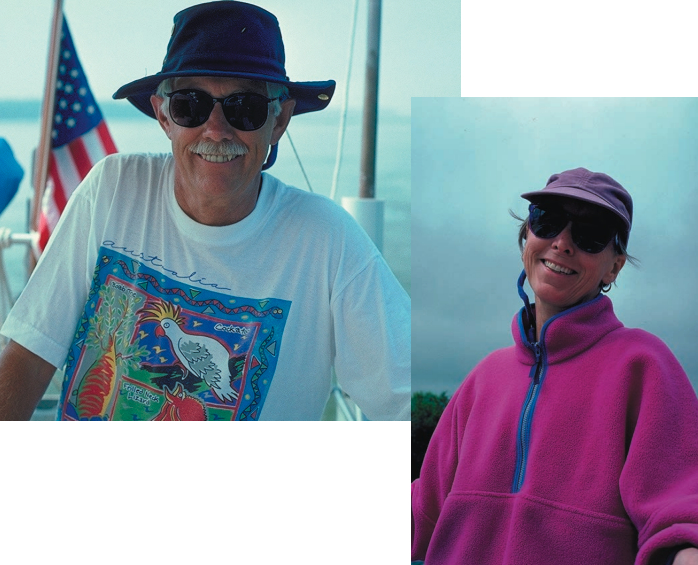
Once John and Sandy Larson had developed a dream for semi-retirement and a two-season lifestyle, they began considering the type of sailboat that might figure in the winter sailing portion of their dream. It should be able to go offshore. It should be between 30 and 42 feet. It should be able to carry a couple of folding bicycles. The list began to grow.
“We thought we’d shop for a while, kick tires, you know,” John says. “We really didn’t intend to buy that early.” Semi-retirement was to begin in 1999. The dream took shape in The sailboat, a Nicholson 35, became part of the family as soon as the mission was clearly defined. John and Sandy read articles and climbed through many hulls. One boat in particular that stands out in their memories is the Bristol 40 yawl, which Sandy says, “didn’t have a head — it had a master bathroom.” But it wasn’t for them.
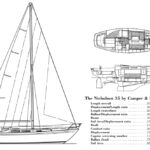
They’d read about the Nicholson 35 in Practical Sailor (March 1, and were pleased to find one for sale in Soundings. Right away they knew they’d found the boat for their dream. Unfortunately, the dream wasn’t scheduled to begin quite yet. But fortunately, the time was right for buying used boats. (The price was right, if the timing was not.)
John ticks off the selling points: “She had a real chart table and a wet locker by the companionway. There were lee cloths on all berths. She had two CQRs, a windlass, all-chain rode, an Aries windvane, a Perkins 4-108. This boat was meant for serious sailing. Thinking of our list of items that made a seafaring boat, this one had them.”
The boat was built by Camper & Nicholsons, one of the oldest yachtbuilders around. The British firm dates back to 1782. The Larsons’ Nick 35 was built in 1973 for a French architect who sailed it on the Mediterranean. A nice touch for the French owner, the British boatbuilder provided the boat’s manual in French. This has been less helpful for the subsequent English-speaking owners.
The second owners bought it in 1983. Free spirits, as John and Sandy describe them, they had spent much of their lives traveling about in a camper truck. They had never sailed. But the dollar was strong compared with many foreign currencies, so they flew to Europe to shop for a sailboat.
There must have been a few learning experiences along the way, but the pair lived aboard for the next 10 years. They sold the boat to the Larsons in Annapolis with most of her original equipment still in working order and with the interior basically unchanged. The significant modification these owners undertook was the conversion of the boat’s electrical system from the European standard to 110 volts when they brought it back to the U.S.
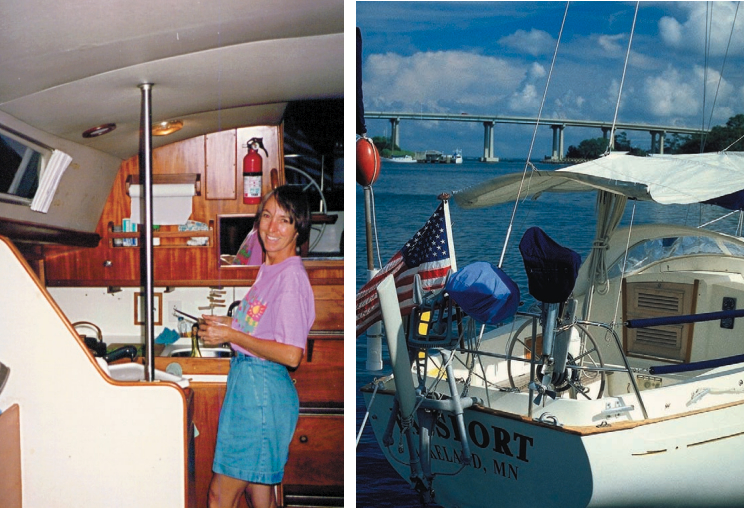
John, an architect with a passion for building and tinkering, and Sandy, a systems analyst, began the next level of modifications just as soon as the boat was delivered to its temporary home on the St. Croix River between Minnesota and Wisconsin. They added roller furling, an inverter/charger and control panel, gel cell batteries, a bookshelf and storage cabinet, and a dodger. They replaced the standing and running rigging and all hoses below the waterline.
They installed cigar lighter sockets in the cockpit and navigation station; a water filtration system; new faucets, pumps, and a shower head; a GPS/laptop navigation system; a vented and sealed propane system; and a holding tank, pump and Y-valve. They removed the vinyl overhead, replacing it with wooden battens, and they recovered cushions, rebedded bow and stern pulpits and chainplates, built a cockpit table, and replaced the laminated galley tabletop with teak.
John grew up sailing the St. Croix River. “I fell in love with the water from Day 1,” he says. His first boat, acquired at age 6 or 7, was an old tin rowboat from his uncle. It soon became a sailboat with the addition of a piece of galvanized pipe and a sheet from his grandmother’s collection. By the time he’d reached junior high, John built a Sunfish-type boat as a shop project, and the builder-tinkerer in him was set free. After high school, he built a 12-foot scow.
The usual things came next: a stint in the Army, marriage to Sandy, a couple of kids, and a move back to Minnesota.
The family wasn’t in Minnesota long before John was able to find a great deal on a 19-foot Norwegian double-ended keelboat. The wood lapstrake leaked like a sieve, Sandy recalls. It didn’t matter. The boat had beautiful lines.
Sandy’s earliest sailing experiences were aboard that boat. In fact, she earned her “captain’s license” the day their son Ian fell overboard, and John jumped in to get him. That was the moment that Sandy took the helm and became a sailor.
The fleet grew in size the weekend Sandy traveled to South Dakota to visit her parents. John already had the plans and materials to build a 27-foot sharpie ketch. But a friend offered him a sharpie he’d admired, as long as he could buy it by the next day when the friend was due to move out of town. John’s phone call to Sandy is remembered by the two of them as the question cum announcement: “How would you like to have another boat?”
The sharpie had nice lines but was not a great sailor, the Larsons agree. It had sitting headroom, and the centerboard was a quarter-inch steel plate. It was not ballasted, John says, “But it could reach like a witch.” The planned 27-foot sharpie ketch was never built. Instead, its wood and other materials went into a string of smaller boats John built over the years. These projects are the reason the Larsons have opted for a two-season lifestyle. Sandy says, “If you take him away from his building projects too long he gets crabby.”
John says only, “We don’t want to be liveaboards. We’ll have two lifestyles.” One, of course, will be in a thoroughly modern home which John designed, with a trailersailer parked nearby. The other lifestyle is bobbing on the hook in a beautiful bluewater sailer. This second lifestyle, no matter how romantic it may sound, is much more akin to camping. The Larsons just spent three months sailing and at anchor living sumptuously without a refrigerator or cooler. Going without ice was a choice they made to simplify logistics. But we’re getting ahead of the story.
The first boat to be named Passport by the Larsons was a 23-foot fiberglass Stonehorse. A work of art, John says, it had gorgeous curves at the cockpit rail. Unfortunately, when it was heeled and a powerboat went by, the wake washed over those gorgeous lines and filled the cockpit.
The second Passport is the Larsons’ Nick 35. This one, too, has beautiful lines but is unlikely to fill up with water. Since she came into their lives a bit ahead of schedule, the Larsons were able to spend the next four years outfitting the boat and getting to know her while river sailing. At the same time that the Larsons were working on the modifications to Passport listed earlier (and many more which good old boaters know never even make the lists), John had one other — umm dare we call it a project? — going in the back yard. This project was started with the plan that it would be completed before the bigger boat joined the family. But family planning has never been as scientific as you might believe.
It seems that ever since John built that first woodshop project boat in junior high, there’s been a boat or two on his drawing board or taking form in the garage. There have been canoes (an ultra-light one in particular) and dinghies over the years. A recent project is Danny Greene’s nesting dinghy, the Chameleon. And there was that sharpie ketch which never got past the planning stages.
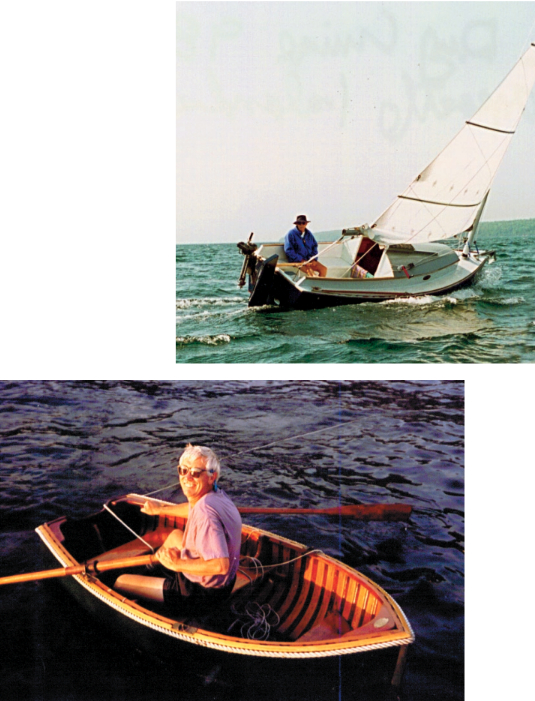
But with plans for semi-retirement looming, John had begun another ambitious project — a trailerable sailboat they could use when spending summers in Minnesota. This boat is an 18-foot Norwalk Island sharpie, designed by Bruce Kirby, which John started in 1992. Made of plywood sheathed in Dynell and epoxy, this traditional-looking sailer is a thoroughly modern boat in terms of building materials. The carbon-fiber unstayed mast and fully battened main are the final proof that, while John may appreciate traditional lines, he is not a believer in reviving or reliving a previous era.
The sharpie was launched six years later in 1998, and has been a pleasure to sail, John and Sandy agree. Her off-center centerboard gives them room below and does not create a noticeable performance difference from one tack to another.
Best of all, this boat was nearly ready to step in as the Larsons’ substitute sailboat when Passport began her journey back to salt water in 1997. The first leg of that journey took John and Sandy down the Mississippi River to the Ohio River to the Cumberland River and to Kentucky Lake, which they recall fondly as some of the most beautiful country and finest sailing they had experienced to that point. This led to the Tennessee River and to the Tenn-Tom Waterway, which connects the Tennessee and Tombigbee Rivers. A straight ditch 26 miles long, the Tenn-Tom was built by the Army Corps of Engineers in the 1980s. The Tombigbee River reaches the Gulf of Mexico at Mobile, Alabama.
John and Sandy counted 43 locks on the journey. On this trip they saw the arches of St. Louis from the water, were awed by tugs pushing as many as 54 barges at a time, and learned the fine art of navigating a six-knot boat in a five-knot current.
From Mobile, they sailed to St. Petersburg, Fla., where Passport was hauled for the season. Another short trip allowed them to take Passport to the west coast of Florida the following season. They had planned to cruise in the Bahamas that winter but John’s work demands postponed the departure time, and Sandy’s caused an early return to the north country, so they sailed the west coast of Florida, ducking the El Niño storms of 1998. A year later, they were back on track.
They left Tampa Bay by the end of January 1999. The first day’s shake-down cruise proved to be just that — pretty shaky. The forestay broke, due to a fitting failure. Luckily, they were not far from the boatyard, and it was soon repaired. They had hoped to sail around the south coast of Florida, and visit a few of the Florida Keys, but the weather was not cooperative.
Instead they tucked up inside the Okeechobee Waterway and started their journey south by passing through one more inland waterway. Fortunately, this is a lovely trip through Florida’s orange groves and sugar cane fields. Next, they traveled down the east coast of Florida on the Intracoastal Waterway. After a few days’ wait at Fort Lauderdale, they found a favorable weather window for crossing the Gulf Stream. They anchored Passport at Gun Cay in the Bahamas under a beautiful full moon.
Next they crossed the Grand Bahama Banks. This takes two days. Overnight they had the eerie sensation of anchoring miles from the nearest land in 12 feet of water. Then they moved on to Chub Cay in the Berry Islands and to Nassau, followed by another jump to the Exuma chain.
Good sailing friends flew into Georgetown to join the cruise for a few days. They island-hopped back up the cays, snorkeling, reading, and hiking. All too soon, it was time to drop the friends off in Nassau.
They counted their remaining days and realized there was no time to visit the Abaco chain this year, although it had been on the itinerary. After a few hours spent studying charts, they decided to go on to Grand Bahama, stopping at Lucaya to wait for a weather window to cross the Gulf Stream to Cape Canaveral. They estimated the trip to be 27 hours.
This time the Gulf Stream crossing was not so benign. When they were a few hours out, the forecast changed for the worse. Luckily they were in a good old boat. With heavy winds and the Gulf Stream current carrying them along at 9 and 10 knots over the ground, it was quite a ride. Although the waves towered over her stern, Passport marched along, building Sandy and John’s confidence in their boat. They appreciated Passport’s seakindliness even more when they spoke to others who had made the crossing at the same time and had experienced any number of saltwater baths from following seas.
Now Passport waits near Cape Canaveral for the continuation of the cruise . . . up the East Coast after this winter.
Karen Larson is editor of Good Old Boat magazine. She has written about sailing for Sail, Cruising World, Sailing, Northern Breezes, Lake Sailor, and Lifeline. Her publishing career began as a newspaper feature writer and page editor and later grew into a thriving newsletter production business.
Thank you to Sailrite Enterprises, Inc., for providing free access to back issues of Good Old Boat through intellectual property rights. Sailrite.com