Issue 8 : Sept/Oct 1999
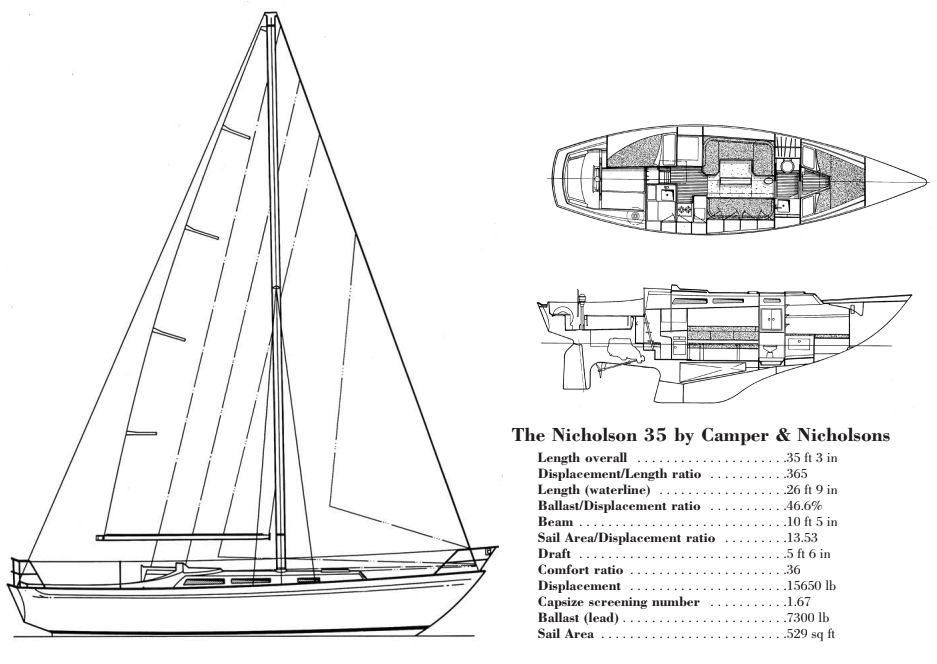
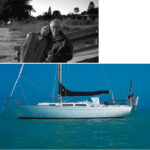
The Nicholson 35 is a handsome yacht with a sweet sheer line and well-proportioned overhangs. Designed in the early 1970s, the vessel exhibits many of the traits of the oceangoing cruiser/racers that were created during the closing years of the CCA and RORC rating rules, and those rules tended to ensure an able craft. A look at the numbers will assure any knowledgeable sailor that this is, indeed, one 35-footer capable of extensive bluewater cruising.
Her capsize number is remarkably low by contemporary standards, far below the unsafe 2.0+ that I recently calculated for a couple of modern French cruisers. This is due to her modest beam and very hefty displacement, almost super-heavy in comparison to modern designs. However, this combination would be very reassuring if you were caught out in a full gale at sea. Her unusually high ballast ratio would be doubly reassuring in a blow and will help the 35 stay on her feet in a stiff breeze, despite her moderate draft and beam.
That husky displacement and moderate beam also produce a high comfort ratio for her size, right up there with the Block Island 40 and Bermuda 40 reviewed in the July issue of Good Old Boat. She will have an easy motion in a seaway, unlike the corky motion of a beamy, light-displacement hull. That will help a great deal to quell a queasy stomach when the going gets a bit too bouncy.
Although her displacement is quite high, the 35 will pick up waterline length as she heels, due to her graceful overhangs, so the displacement/length ratio is not as high as it first appears. Even an increase to a heeled waterline of 28 feet will reduce the D/L ratio to 318, a more reasonable figure, so the Nicholson 35’s potential speed is undoubtedly higher than the static numbers would seem to indicate.
Below the water, the 35 has a longish fin and a large, skeg-hung rudder which should ensure good tracking and an easy helm. I was pleased to see that the lead ballast was encapsulated in the fin and not hung by corrodable stainless steel bolts as many builders have done in the past and still do. It has always remained a mystery to me why stainless bolts are used with lead ballast when bronze bolts are superior. I expect that the answer lies in the cost of the two materials.
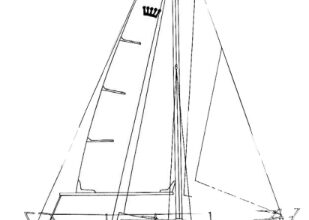
I did not have any dimensions on the sail area and had to calculate this by scaling a very small drawing, so it may be off a few square feet one way or the other. Still, the 35’s sail area is definitely on the short side by today’s standards, and that will affect her light-air performance. This was quite typical of the cruiser/racers of her era, as the racing rules permitted very large headsails without penalty. As a result, designers kept the sail area small to lower the rating and depended on 170-percent genoa jibs and reachers to move the boat through the zephyrs. In addition, British designers were always more conservative than their North American counterparts when it came to sail area, since their creations had to face the blustery winds and gales of the English Channel and the North Sea. The storms in those waters are a far cry from the light summer breezes that tend to prevail in Long Island Sound, the Chesapeake, and the Pacific Northwest.
So, if you sail a Nicholson 35 where the breezes are gentle, you will find that a large 160- to 170-percent genoa is necessary to get the best out of her. Yet, despite that smallish sail area, the Nicholson 35 is no slouch, and her PHRF rating is faster than many out-and-out cruisers, such as the Crealock 37 and Tayana 37, according to one report. On the other hand, a small sail area is not a great handicap for ocean crossings. So what if you arrive a day or two later? During the voyage you have enjoyed the benefits of a small and easily handled rig, and that can mean a lot more to a short-handed cruiser than making a fast passage.
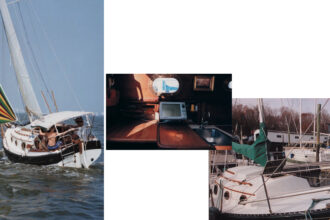
The biggest difference between this good old boat and the modern crop of coastal cruisers is the beam. The relatively narrow beam of the 35 and her short waterline give her accommodations not much roomier than a contemporary 30-footer. You won’t find the double berths, separate staterooms, or rounded, angled interiors beloved of today’s designers. But you will find a very workable galley, an unusually large navigation center, generous storage, and a V-berth that does not dwindle to a point at the forward end. It is, definitely, a sensible and seagoing arrangement.
You’ll also find quality workmanship, as the Camper & Nicholsons yard is noted for solid construction, integrity, and pride of craftsmanship. Many of the 35s were built under a Lloyds Hull Moulding Note covering the basic fiberglass hull, deck, and bulkheads, and they could obtain the Lloyds 100 A-1 certificate if the owner was willing to pay the added fees for all the additional visits by a Lloyds surveyor. I have gone through this on a number of designs, so I can assure the reader that any boat that can meet Lloyds’ requirements is a strong and well-built yacht indeed.
The Nicholson 35 may not have all the modern conveniences: no room for a microwave, no stall shower, no bidet. But she does have everything that’s essential for a safe, oceangoing cruiser. Her good performance, quality construction, seaworthy hull, and workable arrangement put her right up there with the best of the bluewater yachts in her size range.
Ted Brewer is one of North America’s best-known yacht designers, having worked on the America’s Cup boats, American Eagle and Weatherly, as well as boats that won the Olympics, the Gold Cup, and dozens of celebrated ocean races. He also is the man who designed scores of good old boats, the ones still sailing after all these years.
Thank you to Sailrite Enterprises, Inc., for providing free access to back issues of Good Old Boat through intellectual property rights. Sailrite.com