Ignore chafing gear, and your gently aging boat will begin showing her age
Issue 8 : Sept/Oct 1999
One of the fastest ways to get a good old boat looking and acting older than its actual age is to forget about chafing gear. Sheets, halyards, dock lines, blocks, and sails all suffer unnecessarily when you ignore simple, inexpensive methods and materials for preventing excessive wear and tear. In fact, installing some anti-chafe gear can make your boat look a little more traditional as well as teach you a few new crafts that were once quite common among sailors.
Good antichafing gear is also a safety issue. Insurance adjusters can always come up with a few dozen tales of boats lost due to dock or mooring lines that chafed to smithereens in a storm. Additionally, races are lost and cruises are truncated when badly worn gear unexpectedly gives up the ghost, and you have to search for replacements. So the small task of installing and upgrading good antichafing gear is always a wise investment of time, usually at very little cost.
Critical chafe first
If you have no chafing gear at all aboard your boat, the first items to address are dock, mooring, and anchoring lines. No matter how smooth your bow and stern chocks are, the seesawing action created by a storm can make short work of even the thickest nylon lines.
The least expensive and easiest solution is to wrap the line in some old garden hose, or any pliable plastic tubing for that matter. In fact, brand-new clear plastic tubing is inexpensive enough to use right off the shelf. At my local hardware store in Maine, it’s $1.03 per foot for one-inch (inside diameter) clear tubing and less for three-quarter and half-inch sizes.
To wrap a line, simply slit the hose lengthwise. Then open it up and wrap it around the line. Be sure the hose extends well clear (at least six inches) of the chock, both on the outboard side and the inboard side. Duct tape will hold the tubing in place for at least a season — if the line is not repeatedly immersed as a mooring line would be. For mooring lines frequently immersed, the hose can be kept in place for the season with marline sewn into the ends of the hose and through the line itself.
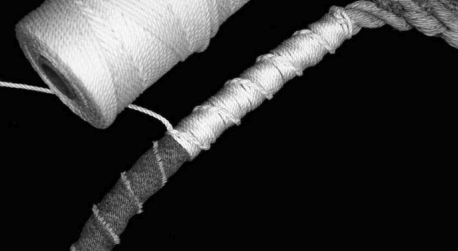
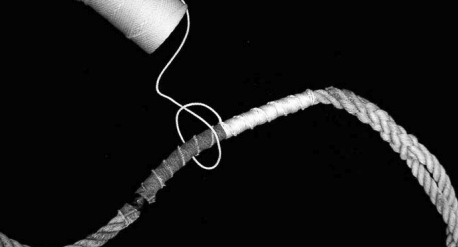
If you prefer a slightly more nautical appearance to your chafing gear, the old-fashioned procedures of parceling and serving a line still work as well today as they did 400 years ago. Parceling is wrapping a line with a long strip of heavy cloth, traditionally canvas. But as the photo below shows, denim from an old pair of jeans works just fine too. The parceling cushions the line and, when applied to the uneven surface of three-strand rope, makes a smoother surface for applying the serving twine.
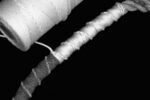
Nylon makes the best serving twine, preferably a size #40 twine or bigger. Any commercial fisherman’s supply store should have nylon twine on hand, usually for about $4 for 150 yards of the stuff. Simply wrapping the parceling cloth with the twine holds everything in place. But I prefer to put a half hitch in the twine every time I go around the line. (See photo at bottom on facing page) I’ve found this procedure not only holds everything in place more securely, but you also end up with a spiral of knots that looks better than just a plain wrapping of twine.
Un-chafe critical points
Reducing chafe at critical points in your running and standing rigging also pays big dividends. The lines on good old boats frequently rub on fairleads, handrails, toerails, standing rigging, and lifelines. Making your running rigging chafe-proof is not practical. Instead, you have to address the source of the chafing.
To de-chafe standing rigging and lifelines, it’s back to the local hardware store’s plumbing department. Using off-the-shelf PVC plumbing pipe, you can install anti-chafe gear for less than half the cost of comparable marine catalog items. Take, for instance, shroud rollers.
If you have quarter-inch standing rigging, buy some half-inch PVC or ABS rigid pipe at 5 to 15 cents per linear foot. After studying the approximate points at which running rigging lines cross standing rigging cables, cut an appropriate length of pipe. Like the anchor line chafe tubing, the shroud pipe should extend a minimum of six inches above and below the point of contact.
Cut the pipe with an ordinary hand or circular saw. Once you’ve got the appropriate lengths cut, slit the pipe lengthwise. This can be done on a table saw (a friend’s or the one in your offspring’s shop class) or by renting a small-blade (approximately 4 1/2 inch diameter) circular saw. In either case, a fine-tooth panel blade works best. If you use a hand-held circular saw, be sure to securely clamp the pipe to a workbench before proceeding. Once you’ve slit the pipe, slip it over the cable and close the slit at the top and bottom of the pipe with rigging tape. Although the photo on the next page shows this idea executed with wooden (oak) shroud rollers, the procedures are essentially the same.
Static fairleads are another source of running rigging chafe. The simple solution here is to substitute a block for the fairlead. That can be expensive (between $25 and $60 each), so sometimes just a larger fairlead will significantly decrease the chafe while still keeping the line where you want it.
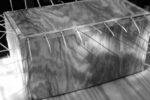
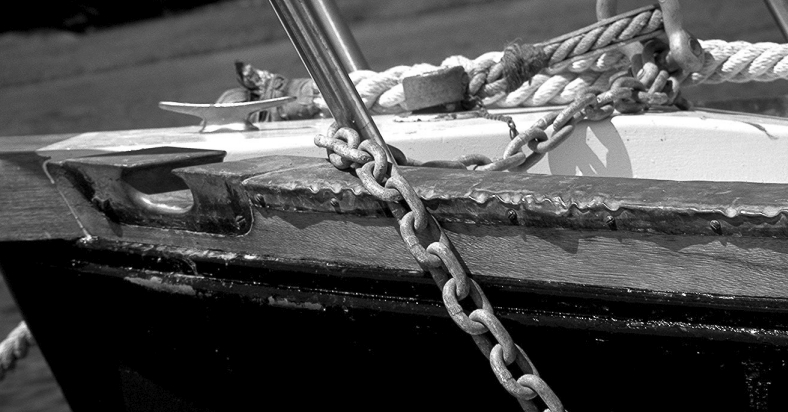
Likewise, wooden toerails, handrails, dorade boxes, and the like will chafe lines that regularly come in contact with them. The solution here is to get a piece of copper flashing at the local hardware store or roofing supply store. Cut an appropriate-size square to cover the wood and screw it into place. As the photo above shows, this procedure is effective where heavy-duty running rigging wires or anchor chains chafe the wood, rather than the other way around.

Noise reduction too
Reducing chafe in some areas can also have the secondary effect of reducing onboard noise. This is particularly true of thump mats for deck blocks. In light air, sheets in these blocks sometimes go slack, allowing the block to slam on the deck. If you’re trying to catch a catnap below, this phenomenon is quite noticeable. And even if you can sleep through the racket, eventually the deck or the block (or both) will show distinct signs of wear due to the pounding.
The easy (but expensive) solution here is to install spring-loaded deck blocks. Costing between $40 and $120, the block is held upright by a spring mechanism between it and the deck. Alternatively, you can install a thump mat for between 50 cents and a dollar, depending on whether you like the simple modern approach or the old-fashioned style.
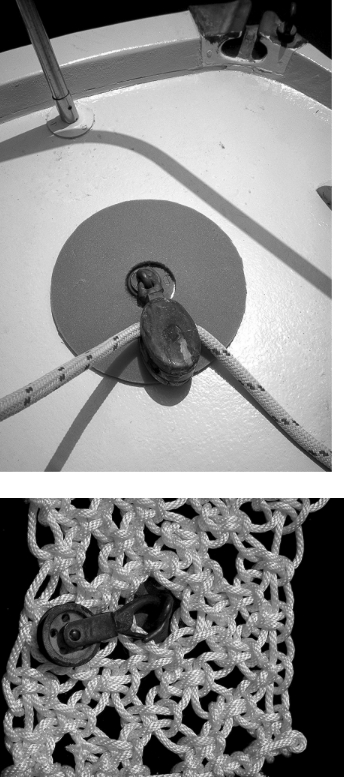
A modern thump mat is made out of thin (about 1 inch) closed-cell foam. It’s important to use only closed-cell foam, which is sold in many department store sporting goods sections as a “camping pad.” It’s normally used as a pad under your sleeping bag. Because closed-cell foam won’t absorb water, it also makes an ideal thump mat. With a pair of ordinary scissors, just cut out the size you need to cover the area being thumped. Then cut a hole in the middle big enough to fit the base of the deck block. Closed-cell foam stretches, so the hole can be smaller than the block itself and stretched to fit. Use an epoxy glue to hold the pad in place. Ordinary deck paint for fiberglass boats can be used to make the pad blend right in with the rest of the deck.
Alternatively, traditional-looking thump pads can be made from inexpensive polyester clothesline, several hundred feet of which can be obtained from a hardware store for around $5. Using basic macramé techniques, a half hour’s worth of work can produce a thump mat much like the one in photo below. If you want to get even fancier, your local library no doubt either has or can get a book on macramé, which is the sailor’s age-old fine art of weaving ropes into usable items.
There are, of course, many other approaches for preventing chafe, both in the areas already mentioned and elsewhere on the boat. No doubt readers of Good Old Boat have some of their own inventive ideas and procedures. Please send them in, and we will print them in the magazine or the Good Old Boat newsletter for subscribers. In the meantime, some of the ideas mentioned here may help your boat last longer, work better, and look more attractive.
Ken Textor has lived and worked aboard boats for 22 years. In addition to work he did for the former Small Boat Journal (this Small Wonders column is dedicated to the memory of that popular magazine), he contributes to a number of sailing magazines and has written a book, Innocents Afloat: Close Encounters with Sailors, Boats and Places from Maine to Florida. Ken also offers boat deliveries and pre-purchase surveys for other mariners.
Thank you to Sailrite Enterprises, Inc., for providing free access to back issues of Good Old Boat through intellectual property rights. Sailrite.com