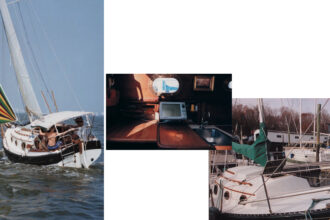
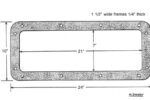
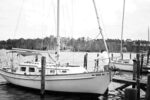
The voyages of Tania Aebi and Brian Caldwell popularized this sturdy 26-footer
Issue 8 : Sept/Oct 1999
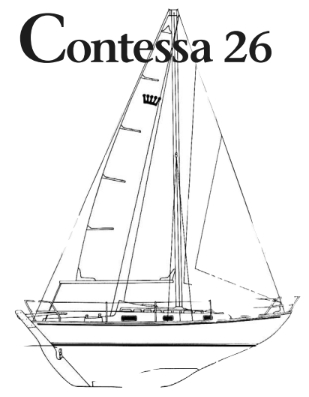
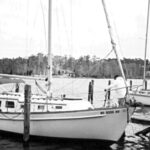
The Contessa 26, also known as the J.J. Taylor 26, is one of many variations on the basic Folkboat theme, but she has several unique claims to fame. Not the least among them is the name of her designer, British naval architect David Sadler, who also designed the Contessa 32.
You may recall that the Contessa 32 was the only yacht to finish in her class — the smallest class, incidentally — in the infamous Fastnet Race of 1979. When a particularly vicious storm hit the racing fleet between England and Ireland, five yachts sank, 19 were abandoned, and 15 lives were lost. Only 85 yachts of 303 starters crossed the finish line.
Although the Contessa 26 is far different from the Contessa 32, above the waterline and below, Sadler’s ability to design safe, seaworthy boats is quite evident in the Contessa 26 as well.
The 26 was also well publicized by the circumnavigations of Tania Aebi and Brian Caldwell. Aebi became the youngest woman to sail around the world alone in Varuna — although she was technically disqualified for sailing one short leg with a companion. Later, Brian Caldwell chose a bright red 1975 Contessa 26 called Mai (Miti) Vavau — “Waves from a Distant Storm” — for his attempt to become the youngest person to sail around the world alone.
From the very first, the 26 gained a reputation for seaworthiness combined with good performance. Many of the entrants in the early singlehanded races across the Atlantic chose Contessa 26s, and they were also well represented in the Round Britain and Ireland Race.
The English boatbuilding firm of Jeremy Rogers first began building the Contessa 26 in 1966, and the demand for them was so great that in the first three years of production, 350 of the fiberglass hulls were laid up. But molds were shipped in 1969 to Toronto, Canada, where the firm of J.J. Taylor & Sons also started production.
In 1983, the Canadian firm redesigned the deck and interior and started using lead ballast instead of iron, which lowered the cabin sole and gave more headroom. A year later, the Canadian manufacturer dropped the name Contessa 26 and changed it to the J.J. Taylor 26.
Some 400 Contessa/Taylor 26s were built in Canada, and many of them found their way to the United States where they are still going strong.
Basic design
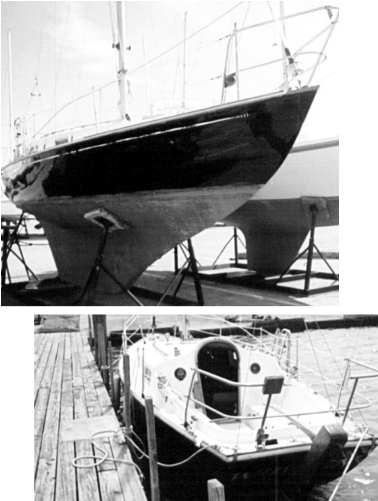
When you look at the lines of the Contessa 26, you can’t help but think “Folkboat.” The raking stern with its outboard rudder; the long, curved tiller; the sweeping sheerline; that gracious bow overhang: they’re all signs of her Folkboat heritage. That’s where her seaworthy genes and her classic Scandinavian good looks came from. But perhaps it would be more accurate to describe her as a Folkboat modernized and improved.
She’s thoroughly traditional, with her full-length keel, but her masthead sloop rig is taller and skinnier, her foresail is bigger and more efficient, and she is more powerful to windward. A smidgen more beam has improved her accommodations without destroying her performance under sail, and a tip-tilt main hatchway has given her 5 feet 8 inches of headroom below — at least over a small portion of the cabin.
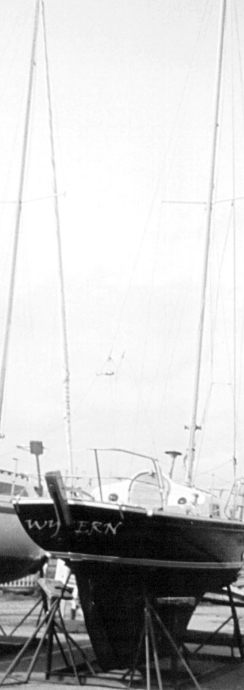
The hull is solid fiberglass, and the decks and cabintop are fiberglass cored with end-grain balsa. Balsa is good for insulation, and it’s pretty effective at containing water damage to a small area. Nevertheless, deck leaks over a long period can lead to delamination, so check all the upper surfaces of the boat carefully if you’re buying an older model.
The cockpit is of average size for a boat of this displacement and is self-draining, but it might be made smaller for extended ocean passages. If a breaking wave fills it, the boat will become vulnerable to the next wave approaching from astern, because she does not have excessive freeboard.
Taylor models built after hull #300 incorporated an anchor well in the bow for the first time, which created handy stowage for the ground tackle and kept the foredeck clear of toe-stubbing obstructions.
The standard engine is the 7-hp Farymann, a single-cylinder, raw-water-cooled diesel thumper that is reputed to use only 1 quart of fuel an hour at a cruising speed touching 5 knots. As the Contessa’s fuel tank holds 12 gallons, that indicates a range under power in calm conditions of 240 miles.
Maximum power is developed at 2,500 rpm, but the propeller shaft, working through a 2-to-1-reduction gearbox, runs at only half that speed, pushing a 12-inch diameter x 9-inch pitch two-bladed prop. It’s a no-frills engine installation with a reputation for reliability, but it’s neither smooth nor restful in action, and you continually need to make sure it can’t succeed in its frenzied efforts to shake itself loose from the engine mounts.
Accommodations
There is a small bulkheaded forepeak up forward that acts as a chain locker. It’s not the best place for much weight, so close to the bow, but there’s not much choice. Aft of the chain locker comes the usual forecabin, dominated by a V-berth with stowage and tankage beneath it. If you’re planning to sail a 26 around the world, you’d be better off with a workbench and more stowage space up there. You’re not likely to want to cross an ocean with four people on board in a boat this small unless you’re also interested in hair shirts and self-flagellation.
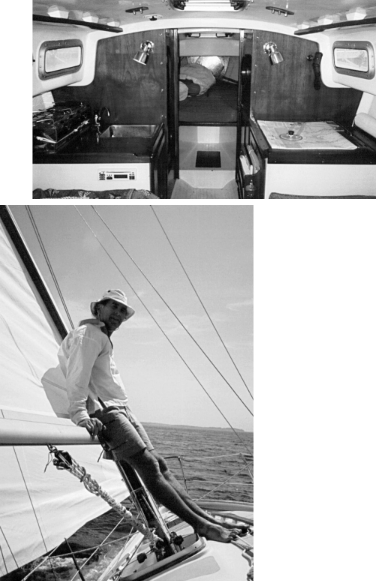
Aft of the V-berth there’s a hanging locker to port and a head compartment to starboard. Then comes a split galley, a good way to provide decent working space for the cook in a boat of this size, although some people find it easier to cook in the usual place under the main sliding hatch, where the light and ventilation are a lot better. On the Contessa, the stove and a top-opening icebox are to starboard, while the sink and counter space are to port. Aft of the galley there are settee berths on either side, the ends of which tuck under the cockpit seats. Removable companionway steps on the centerline give access to the engine compartment, and you can also get to the engine through a panel in the cockpit sole, but it’s mighty cramped in there.
There are two large opening hatches on the later Taylor 26 models, one in the forecabin and another conveniently above the galley area. They help distribute light and air down below, but some people still find the living quarters of the 26 rather cavelike because there is no sliding hatch over the main companionway. Instead, the coachroof slopes up sharply at its after end to form what amounts to a half-round solid dodger, except that it doesn’t extend aft over the cockpit. It looks like the back hoop of a prairie schooner. Some people call it a bubble, others call it a hump. Whatever it is, it’s quirky. It makes the entrance to the cabin very strong and seaworthy, but it takes some getting used to.
The rig
The rig is strong and simple — she’s a single-spreader, masthead sloop with fore and aft lower shrouds. The forestay is housed well inboard so you can sit down, wedge yourself in the pulpit facing aft, and handle the staysail from up forward if you need to.
The sail area is modest — the mainsail has an area of just 154 square feet. She’s designed to take a No. 1 genoa of 251 square feet, a No. 2 genoa of 208 square feet, and a No. 3 genoa of 178 square feet. The working jib has an area of 126 square feet, and the storm jib is a very manageable 70 square feet.
The spars are anodized aluminum, the reefing is jiffy, and the mainsheet secures at the aft end of the cockpit. All very standard and well-tested. No surprises here.
Performance
The Contessa 26’s PHRF rating is 252, exactly the same as the Nordic Folkboat and the Cape Dory 25D, which also are part of this series of articles. With her 21-foot waterline, her maximum sustained speed is a little over 6 knots, but of more importance for deepsea cruising is the fact that she’ll reach a high percentage of her top speed fairly easily under sail, without being overpressed. That adds up to good daily runs and fast passages.
The design has proved docile and well mannered under all conditions. Tania Aebi proved that the Contessa 26 could be handled with perfect confidence by a 95-pound woman.
Known weaknesses
- As on all boats with balsa-cored decks and coachroofs, watch out for hollow-sounding areas where water may have entered and begun the delamination process.
- Some owners have added a shoe to the aft end of the keel. It overlaps the bottom of the rudder and prevents stray lines from jamming between the rudder and the keel.
- Depending on the boat’s fore-and-aft trim, the scuppers on the sidedecks may not be able to drain all the water that gathers there. Some owners have made new scuppers in better places.
- If you’re venturing into stormy waters, you may want to beef up the rudder with a third pintle and gudgeon, just in case.
Owner’s opinion
B. J. Caldwell’s Mai (Miti) Vavau was rolled over in the stormy Indian Ocean. One night, at midnight, with the tradewinds blowing at 40 knots, he heard the deafening roar of a breaking wave approaching from astern. An explosion engulfed the boat, he said, and she was rolled upside down. He found himself lying on the cabin roof inside the main saloon and praying for his boat to right herself.
As the ballast keel slowly pulled her back upright, he pulled out a hatchboard and scanned the deck for damage. Miraculously, he said, the mast was still up and in one piece, but the rest of the boat was in complete disarray.
Although it took him the rest of the night to restore order, the only permanent damage he found was a blown-out staysail and a broken solar panel. He faced another severe test when he rounded Cape Agulhas, also known as the Cape of Storms. In fact, southwesterly gales blowing over the fast-flowing Agulhas Current forced him back into port five times over a period of two months, but his boat survived without serious damage.
Tania Aebi also experienced her share of heavy weather and frights, but Varuna also escaped permanent damage. Both skippers were of the opinion that they could not have found a stronger, more seaworthy boat for the price.
Conclusion
This is a Folkboat that has grown a little wider, a little longer, a little deeper, and a little heavier. She somehow doesn’t look as delicately pretty as a Folkboat, but she’s probably more seaworthy, if that’s possible. Her trademark companionway hump makes for accommodation that resembles a badly lit, cramped dentist’s waiting room — unless a large opening hatch has been fitted overhead — but it does provide reassuringly solid shelter and separation from bad weather.
If you’re serious about cruising, and especially if you’re a singlehander, this boat will perform well and look after you when the chips are down. She’s small enough to give you the feeling that you’re always in control, but large and tough enough to survive really bad weather. For somewhere around $15,000, you should be able to find one in reasonable condition. Good seaboats don’t come much cheaper than that.
Thank you to Sailrite Enterprises, Inc., for providing free access to back issues of Good Old Boat through intellectual property rights. Sailrite.com