Issue 9 : Nov/Dec 1999
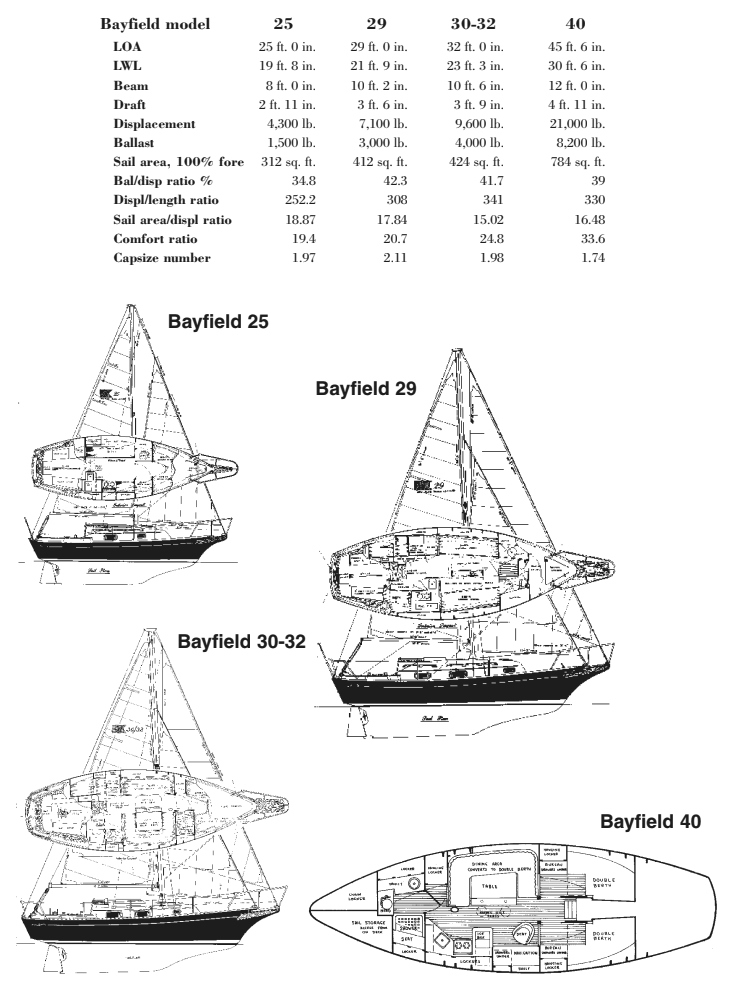
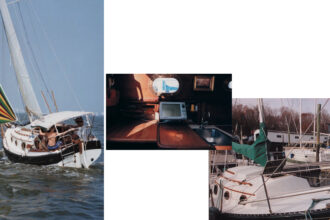
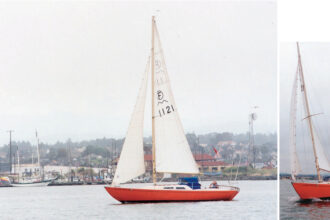
Over the years, from 1974 to 1990, Ted Gozzard designed and built 10 or more different production sailing-yacht models, ranging from the Bayfield 23 to the handsome Bayfield 40. I must admit I was quite shocked when I first saw the boats, as their prominent feature was an exaggerated bald clipper bow, complete with trailboards, but without a bowsprit.
A clipper bow without a bowsprit! This is simply not done, old boy! But it was done, and it proved to be a very successful line with many boats built in all the various sizes. Still, being a traditionalist, I have to admit that the 32-C and the 40, both having bowsprits, are far and away the most attractive designs of the entire series, to my eye.
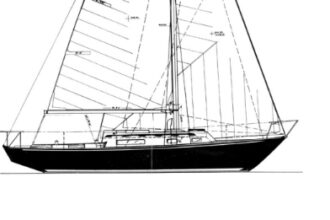
With the exception of the shorter keel on the 23, the line is characterized by full-keel underbodies of rather shoal draft. They certainly will not point to weather, compared with a deeper-draft fin-keel yacht, and the increased wetted surface will reduce light-weather performance. However, the keel area is large enough to keep leeway moderate; the boats will have good directional stability; and the shoal draft will let the cruising man poke the bow into many pretty gunkholes forbidden to the deep-draft crowd. There is much to be said for that last advantage.
One other advantage of shoal draft rarely mentioned is that, in the ultimate storm, the boat is less likely to be capsized than a deeper-draft yacht is. The shoal-draft vessel is more likely to be shoved sideways when hit beam on by a steep, breaking sea, whereas the keel of the deep-draft boat tends to dig in, and then the boat is rolled by the sea. Combined with her very good capsize-screening formula number, the Bayfield 40 would seem to be a truly excellent choice for the serious bluewater cruising skipper.
You will find that the sail-area figures noted in the comparison below do not agree with those advertised or published elsewhere. It is apparent that the advertised figures are not for the main and 100-percent foretriangle but are the actual area of the mainsail and the headsails. With a double headsail rig, this gives quite a misleading impression. The jib and jib topsail together may have as much or more area as a sloop’s large genoa, but they are never as efficient, particularly to windward. My sail-area figures are for the main and 100-percent foretriangle and may not be exact, as they were scaled from very small prints, but they are close enough for comparative purposes and will give a better idea of potential performance.
In any case, the sail area of the Bayfields is on the generous side, with the exception of the 30-32, and the boats should move along very nicely even in a light breeze. It is probable that the 32C with its bowsprit was created to increase the sail area of the 30-32 model in order to improve light-air performance.
Of course, with generous sail area, it is desirable to have solid stability to keep the yacht on her feet when it breezes up. That should not be a problem as the boats have good, but not exaggerated, beam and, particularly in the larger sizes, excellent ballast ratios. With their long keels, it is also probable that the ballast is well spread fore-and-aft. This will help to lower the center of gravity, despite the shoal draft, and thus add even more to stability.
I was pleased to see that the larger boats all feature a keel-stepped mast. This setup is much stronger than a deck-stepped mast and, in the event of rigging failure, the keel-stepped mast usually breaks at the spreaders. This leaves a stub still standing that can provide the basis for a get-home jury rig. While yachts with deck-stepped masts have sailed all over the world, I still feel that the keel-stepped mast is a desirable feature in an offshore cruiser, such as the 40.
There is no doubt that the Bayfield line was designed for the cruising sailor and, if you can live with that bald clipper bow, the boats will serve very well indeed for the coastal cruising family. However, if your aspirations
include sailing the oceans to far-off ports, then a Bayfield 40 in particular deserves serious consideration. Her layout is unusual, but it looks to be very workable for the liveaboard couple. More importantly, the other features of the design definitely spell out “serious bluewater cruiser” — long keel, moderate beam, shoal draft, husky displacement, good ballast ratio, versatile ketch rig. The Bayfield 40 has it all and is handsome enough to deserve admiring glances everywhere she sails.
Ted Brewer is one of North America’s best-known yacht designers, having worked on the America’s Cup boats American Eagle and Weatherly, as well as boats that won the Olympics, the Gold Cup, and dozens of celebrated ocean races. He also is the man who designed scores of good old boats . . . the ones still sailing after all these years.
Thank you to Sailrite Enterprises, Inc., for providing free access to back issues of Good Old Boat through intellectual property rights. Sailrite.com