Issue 13 : Jul/Aug 2000
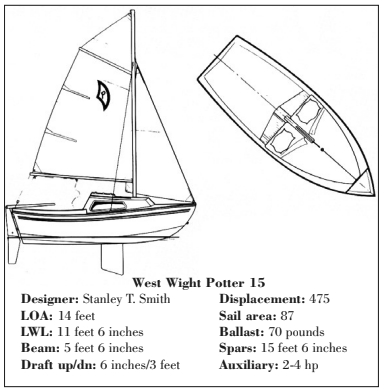
The West Wight Potter was designed by Stanley T. Smith, a life-long sailor whose family had a long history as boatbuilders in the western region of England’s Isle of Wight. Production began in the late 1950s at West Wight Plycraft, Ltd., the Smith boatbuilding firm. Built out of marine ply with a sliding gunter rig, the West Wight Potter is a mere 14 feet overall, with a small cabin and modest sail plan.
She is intended for pottering (British term for puttering — hence the name) in the rivers, estuaries, and bays of the English coast. Although she wasn’t meant for bluewater cruising, Smith nevertheless wanted the Potter to be seaworthy and to perform well. He succeeded.
Famous forerunner
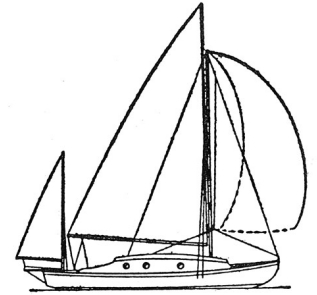
Stanley Smith knew something about small boats. In 1949, he and his brother, Colin, designed a 20-foot sailboat and built her in a chapel basement in Halifax, Nova Scotia. They named her Nova Espero (New Hope, in Esperanto). With an inverted dinghy lashed to the topsides as a cabin, the two brothers sailed the diminutive ship to England (from Dartmouth, Nova Scotia, to Dartmouth, Devon), a stormy passage that took them 44 days and put them in the national spotlight.
In 1951, after upgrading and refitting the little Nova Espero in England (she was given a proper cabin and altered from a sloop to a yawl rig), Smith again sailed her across the Atlantic from Dartmouth to New York, this time with his friend Charles Violet, to mark the Festival of Britain. The east-to-west crossing against the prevailing wind and current took 111 days (almost 16 weeks), including layovers in the Azores (for rudder repair) and Nova Scotia. The story of this remarkable journey is modestly and beautifully reported in Smith and Violet’s The Wind Calls the Tune. Nova Espero was one of the smallest boats to cross the Atlantic, and her sailors became heroes in a nation that treasures its rich maritime history.
From these transatlantic travels in Nova Espero, Stanley Smith gained valuable insight into what makes a little ship seaworthy. He employed that knowledge and experience in designing the Potter. Smith explained his theory behind the design:
The high shoulders forward give the boat those few important inches of freeboard just where they are needed to discourage the bow wave from getting carried up by the wind when sailing close-hauled. The lower freeboard in the waist . . . it is at this point where we most frequently get in and out of the boat, where the natural form of the surface of the sea dips down when the boat is moving, and a green sea seldom finds its way on board here. The “kick-up” toward the transom, the greater freeboard aft, is very reassuring when contending with awkward following seas. The result is a small craft that feels bigger, more compatible, and safer than any other boat her size.
These characteristics also give the Potter its sweeping, jaunty sheerline that is so eye-catching and full of character. The Potter’s generous beam, flattish bottom, and hard chines also give the boat a stability uncommon in one so lightly ballasted.
Potter comes stateside
In the mid-1960s, Herb Stewart, from southern California, saw the West Wight Potter in an English sailing magazine. He and a friend purchased one from Smith’s English firm. They received permission soon after to produce the Potter in the United States at their newly-formed HMS Marine in Inglewood, Calif. Royalties were paid to Smith until West White Plycraft, Ltd. closed its doors in 1969. Stewart then obtained the international production rights to the 14-foot Potter.
Using the wooden hull of Smith’s plywood boat as the plug, HMS Marine began producing a fiberglass version of the English mini-yacht in the late 1960s. More than 3,500 West Wight Potters have been produced and sold in the United States, an impressive production run for any boatbuilder.
I visited HMS Marine in Inglewood in 1977, as I owned one of the early gunter-rigged Potters, to see the plant and talk with Stewart. If memory serves me right, the unpretentious operation was producing about two boats a week at that time.
In the beginning, HMS Marine constructed the Potter with wooden spars and a sliding gunter rig (like the English version). In the early 1970s, however, Herb Stewart changed to a sloop rig with an aluminum mast and boom, and a loose-footed mainsail. The Potter’s slowness in light air was a frequent complaint of U.S. owners. Stewart eventually re-powered the boat by developing an ingenious simulated gaff rig with a full batten at the top, which gave the main a fuller roach. He slightly increased the size of the jib as well. These changes enlarged the total sail area by 20 percent (from 72 to 87 square feet) and gave the Potter a marked improvement in performance.
Herb Stewart sold HMS Marine to Joe Edwards in the early 1980s. In 1993, Larry Hart of International Marine bought the Potter production rights from Edwards, and introduced a number of improvements in the fittings and the manufacturing process. The company today reports an annual production of 250 Potters.
Changes
Over the years, and as different firms produced these boats, there have been other changes that have aided the boat’s performance, increased safety, and made it more marketable. The weight was redistributed and reduced, positive foam flotation was added, and multi-colored sails were offered.
Not all changes have been welcomed by all Potter sailors, however. One was the elimination of the lazarette in the aft portion of the cockpit. This did away with excellent cockpit storage (for fenders, lines, and other things a sailor would prefer not to bring below) and gave the cockpit a more molded, less traditional look. I am quite sure that sometime in the evolution of the American Potter the transom free-board was reduced a few inches, which decreased some of Smith’s protection from following seas and removed some of the spring in the sheer line. The boat, however, continues to retain much of its original charm and salty appearance. In the 1980s, under Edwards’ direction, the Potter 14 was marketed as a 15-footer (factoring in the bow pulpit and transom-mounted rudder) and called it the West Wight Potter 15, although it is still the same hull.
In 1971, Stewart began producing a sloop-rigged 18-footer of his own design, called the HMS-18. Although its lines are different from those of the Potter, it has the same full shoulders forward, the flattish bottom, and hard chine. Missing, though, is the springy sheer line that gave the little Potter its briny character.
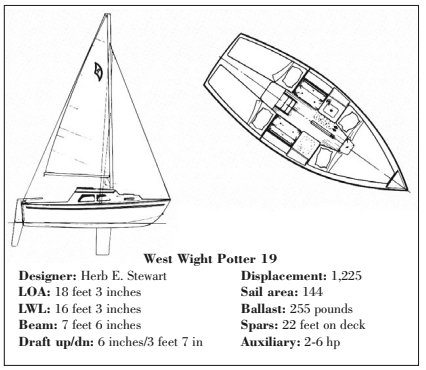
Joe Edwards began marketing the HMS-18 as the West Wight Potter 19, hitchhiking, no doubt, on the identity and success of her little sister. Again, without changing the hull, the manufacturer added a foot to the boat’s LOA by factoring in the bow pulpit and transom-hung rudder, a marketing strategy that apparently enhanced the small ship’s appeal. The Potter 19 has gained in popularity in recent years.
Today, a new Potter 15 sells for as little as $4,495, and the Potter 19 sells for $7,995. There are, of course, used Potters available for less. Prospective buyers of used Potters would do well to check the Potter owner association Web sites for listings.
The West Wight Potter 15 is advertised as “easy to trailer; easy to rig; easy to launch; easy, yet exciting, to sail,” all of which is true. With its 6-inch draft (with the board up), it is also easy to beach and is ideal for thin-water cruising or gunkholing. It has a self-bailing cockpit and is self-righting in the event of a knockdown, provided the cabin is not flooded with water. Potters produced in the last two decades are non-sinkable.
Accommodations are rather Spartan on the WWP-15, but the cabin does give you storage for your gear and a place to sleep out of the weather with a bit more comfort than a pup tent. On a 15-foot boat, you can’t ask for much more. Cooking, however, will have to be done in the cockpit or on shore. Some owners have cockpit awnings or tents that extend the protected living space in bad weather.
Potter exploits
The sailing prowess of the little West Wight Potter is legendary. Not only have Potters been sailed in the bays and estuaries of Great Britain and North America, but a few have made rather extraordinary journeys that helped create the Potter legend. Stanley Smith sailed one of his early Potters from England to Sweden, a distance of 800 miles across the unpredictable North Sea, to deliver the little boat to a Swedish customer. John Van Ruth singled-handed his Potter, Freya, from Puerto Vallarta, Mexico, across the Pacific to Hilo, Hawaii, a distance in excess of 2,200 miles. When Van Ruth arrived in Hawaii, he was confident the boat was sufficiently seaworthy to take him the rest of the way across the Pacific. David Omick sailed alone in his Potter the roughly 1,000 miles from Seattle, Wash., to Ketchikan, Alaska.
Few persons have done more to promote Potter sailing in North America than Lawrence Brown has through his numerous articles in national sailing magazines and his book, Sailing on a Micro-Budget (later released as Frugal Yachting: Family Adventuring in Small Sailboats) published by Seven Seas Press. John Hart, David Diefenderfer, and Steve Flint also have written accounts of their adventures in their Potters. Some of us remember Judson Abbot’s chilling story in Small Boat Journal (November 1987) of his ordeal on Lake Michigan in his Potter, So Small.
The West Wight Potter is a recognized class boat in North America and several Potter associations have arisen over the years that now maintain websites on the Internet. The Potter is back in production in Great Britain, and there are associations of enthusiastic Potter owners there as well. Yet the North American popularity and success of the Potter have never been equaled in Great Britain. Several years ago I talked with Sir Robin Knox-Johnston after he spoke to a gathering in Chicago. I mentioned my love for the West Wight Potter. I was surprised when he responded, “I am not acquainted with the boat.” The Potter’s legendary reputation does seem to be an especially North American phenomenon.
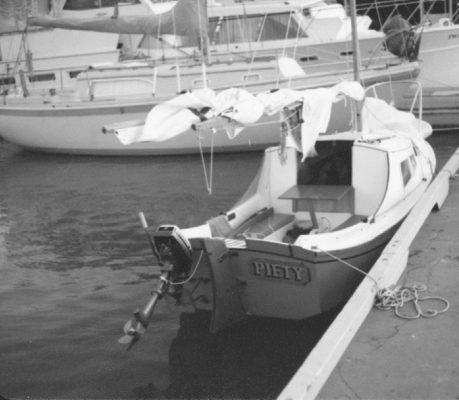
Craig sailed Piety, his West Wight Potter (#397), on San Francisco Bay while living in Berkeley in the 1970s and early 1980s. He now lives in Chicago, co-edits Twin-Keeler, a newsletter for owners and admirers of twin-keeled sailboats. He sails a Westerly Warwick in northern Lake Michigan with Escanaba as his home port. He has had articles published in Sailing, Practical Boat Owner, The DIY Boat Owner and other sailing periodicals.
Thank you to Sailrite Enterprises, Inc., for providing free access to back issues of Good Old Boat through intellectual property rights. Sailrite.com