She gives you that burning yearning
Issue 13 : Jul/Aug 2000
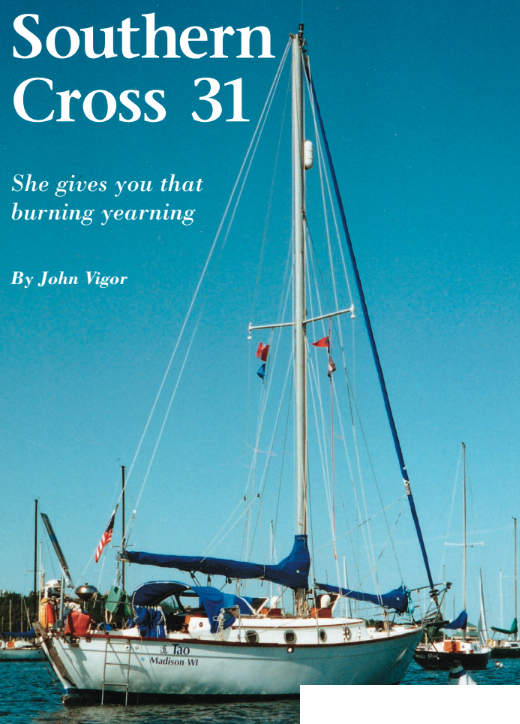
If you’ve ever stood on a dock alongside a Southern Cross 31 you’ll know the meaning of the word yearning. It’s that deep and anxious longing or desire you feel as you run your eyes over her deck and rigging.
The desire hits you on two levels. The first longing is for the boat herself, this pretty little creature with the delicate sheerline and the cheeky little bowsprit. The second, almost simultaneous, longing is for the exotic places she can take you, places where the constellation after which she’s named hangs high in the southern sky. Suddenly your nostrils tingle with the hot spicy scent of a tropical island. And what’s that on deck just forward of the cockpit? Could it be white coral sand from somebody’s bare feet? Ah yes, this is truly a boat to yearn over, a beautiful boat just longing to visit the earth’s beautiful places.
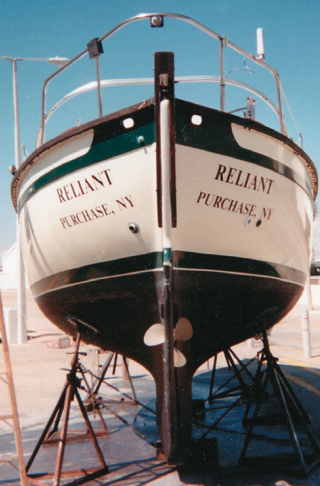
Colin Archer, the famous Scotsman who lived in Norway and produced designs of sail-powered sea-rescue boats, would have approved of the Southern Cross 31. She has much the same sort of underwater body as Archer’s much-revered designs, a full keel with a long flat section at the bottom, and not much of a cutaway forward. She also has an outboard rudder and the famous pointed stern that was said to make the Colin Archers so seaworthy in heavy following seas.
From 1975 to 1987, more than 130 fiberglass SC31s were built by C. E. Ryder in Newport, Rhode Island, and about half of them were sold as uncompleted hulls to do-it-yourselfers. For this reason, although they all look similar on deck, you never know what you’ll find below on this boat. The factory-finished boats have a standard interior layout, but home-builders always have their own ideas, and they’re inevitably better than the designer’s ideas — or so the meddlers think. Mostly, in fact, they’re not, but there may be a few that will surprise you.
The price of a used SC31 varies according to the design and finish of her interior, too. You might find an early one being offered for somewhere around $35,000 to $40,000; later models finished professionally will cost proportionately more. But if you can afford it, it’s a relatively cheap ride to paradise.
Basic design
Thomas Gillmer, the designer of the Southern Cross 31, is much admired for seaworthy cruisers constructed in a robust traditional manner. His credentials are impressive. He was professor of naval architecture and headed the design departmentat the U.S. Naval Academy in Annapolis.
The SC31, interestingly enough, is actually a close cousin of another famous boat that came off his drawing board — the Seawind, built by Allied, which was the first sailboat built of fiberglass to circumnavigate the world. The Seawind was the forerunner of the Seawind II, another ocean-proven design to be profiled in this series. The SC31 is really a Seawind with the aft end changed from a transom stern to a double-ender and a few other alterations. She has a little more beam, a little more internal volume, and her displacement has gone up half a ton.
One of this boat’s claims to fame is that her hull is cored with Airex foam. That makes her more buoyant in case of a bad leak, and it also insulates the interior against cold and noise. The condensation so often found inside fiberglass hulls in cold waters is almost non-existent in this boat, and the thudding of waves against the topsides is far more muted than it is in solid fiberglass boats.
No material is perfect, however, and some critics express concern about the strength of a cored hull — not its mechanical strength or rigidity, which is probably far greater than that of a solid fiberglass layup, but its ability to resist punctures. The critics maintain that two thin skins of brittle fiberglass with a thick soft core in the middle are not as safe as one thick skin of fiberglass. Their worries stem from the fact that the outer skin is more easily penetrated by a sharp object in the water, a deadhead hit at speed, or a rock pinnacle that the boat has run up on. It’s rather like a balloon that, blown up too tightly, can be exploded with the slightest prick of a pin. On the SC31, it’s a question of impact resistance, of course, and some people believe the SC31 is lacking in this respect, at least in theory.
Those of us who have no way of discovering whether this is a real problem, or merely a hypothesis propounded by nautical naysayers, console ourselves with the thought that even if the outside skin is punctured, there is another skin inside, plus that extra thickness of plastic foam. We can hardly believe it would be more dangerous than a single solid skin cracked right through.
Because foam is reputed to be adversely affected by the sun’s heat, the fiberglass decks and cabinroof are cored with edge-grain balsa, which is more forgiving. It’s also standard practice in most production boats. In areas of stress, or where fittings are likely to be bolted right through the deck, solid plywood is substituted for balsa.
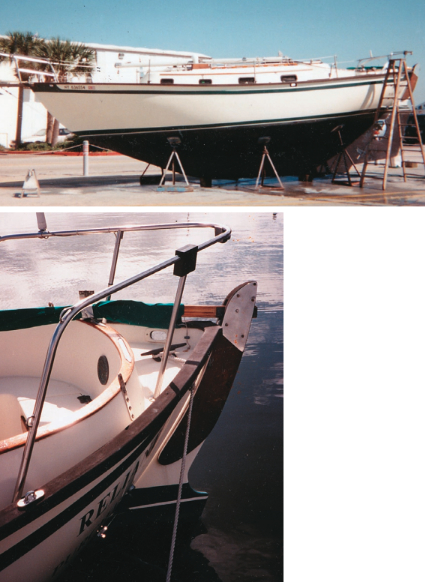
The boat’s underwater profile, as we’ve already seen, is old-fashioned, well tested, and therefore greatly comforting to conservative cruisers. The outboard rudder is efficient and easy to get to if anything goes wrong.
It’s the modern fashion to cut away more of the keel’s forefoot than Gillmer did on the SC31, and this helps in two ways: first, it reduces the surface area of the underwater hull and, therefore, the resistance it produces. Second, it makes the hull more maneuverable, at very slight cost to its ability to keep tracking in a straight line. It also, incidentally, moves the center of lateral resistance aft, which helps resist a boat’s tendency to gripe or bore into the wind — the phenomenon known to practical sailors as weather helm.
But the old-timers gave their boats deep forefeet for good reasons. That amount of grip on the water, so far forward, helps a boat heave to quietly and mind her own business when you leave her under reefed sails with the helm lashed to leeward slightly. The old working boats from which this design sprang had to endure many hours of gales at sea with their heads tucked under their wings in this fashion. The downside of a deep forefoot is that a boat running with too much canvas in a capful of wind and large swells may tend to trip over her keel and broach to. But with reasonable caution and ordinary care, this situation should never arise; and, in any case, we’re talking here of mere degrees of risk. There is no implication here that a boat with a deep forefoot is inherently unseaworthy. An overcanvased fin keeler is far more likely to broach to under those conditions than is any boat with a traditional keel. All boats have strong points and weak points; the best sailors know which is which, and act accordingly.
The SC31’s coachroof is low and streamlined. Her topsides are low, too, so she presents little top hamper to the wind. Her sidedecks are reasonably wide for easy movement fore and aft, and she has bulwarks to delight the hearts of those of us who habitually drop the pin of every shackle we open and live in fear of the “ping-splash” that signifies its loss forever. The bulwarks are also very comforting when you have to walk along a leeward sidedeck that’s under water, of course.
The cockpit is small. That is to say, it’s the right size for sea work. It won’t accommodate the whole family, complete with grandparents and kids, for Thanksgiving dinner, but it does provide a safe haven for a lonely watchkeeper or two in the wee hours of the morning. It also has that most desirable feature in an ocean-going boat, a nice strong bridgedeck.
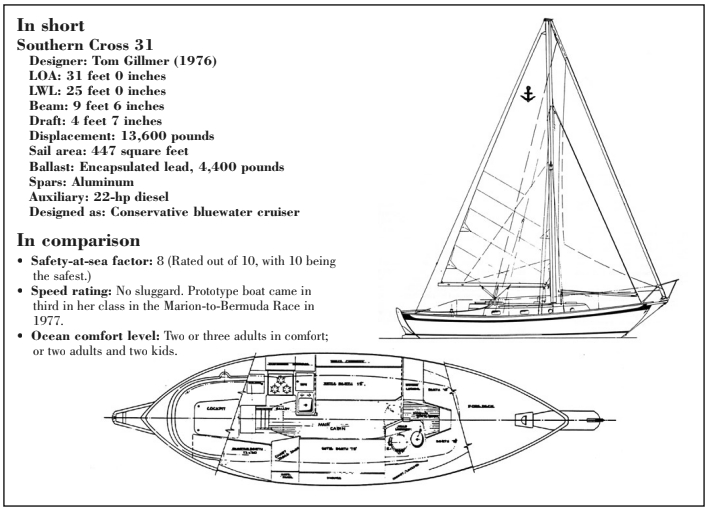
The weighted keel is a lead casting encapsulated within the hull. It weighs about 4,400 pounds, which is about 32 percent of the boat’s displacement, just about the right amount to give her an easy motion at sea.
Given the high number of home-finished boats, the auxiliary engine could be almost anything, but most of them will have a 22-hp diesel squeezed under the companionway steps. That’s plenty for a 6-tonner, and should give her a range of 250 miles or more, thanks to the 34-gallon fuel tank.
Accommodations
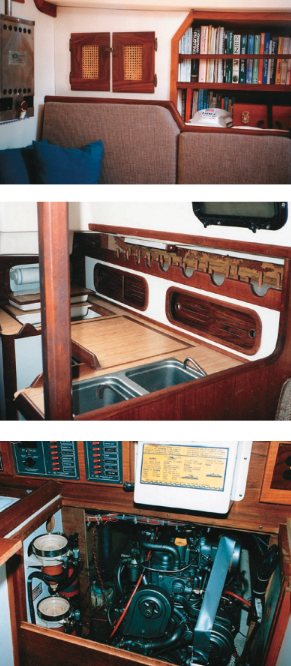
For a boat displacing more than 6 tons, there is not a lot of room down below on the SC31, but she will accommodate two adults, maybe three, in reasonable comfort on long passages, and more for shorter coastal trips. The forward cabin has the usual V-berth arrangement, which is awkward to scramble into and out of at the best of times. At sea, it’s mostly unusable and becomes ad hoc storage for everything from the deflated rubber dinghy to the spare stormsail. It would be far more useful on a long-distance cruising yacht to convert this cabin into a workshop with a bench and generous storage areas, but on production yachts it’s almost always crammed with sleeping places because a plenitude of berths is what the builder’s sales department wants.
Aft of the fo’c’s’le there’s a head compartment to starboard and hanging space opposite. The main saloon on factory-finished models is very straightforward: two settee berths with a galley aft to port and a chart table aft to starboard. A quarterberth was an option, but it meant a foldaway chart table instead of a fixed one, which a proper cruiser really needs quite badly. Nice as it is, the quarterberth won’t be missed at sea if the number of crewmembers is kept down to one or two.
The galley, it must be admitted, is small and inadequate — but then, on a 31-footer it usually is, and the SC31’s galley is no smaller nor more inadequate than any other in its class. Yacht designers all seem to chant the same mantra in this connection: seagoing cooks must suffer. And they do. Over the years of production, the galley did receive a little more attention, however, and the single sink became two sinks in a projecting peninsula, presumably to enable the cook to do twice the amount of washing up or to finish the normal amount in half the time.
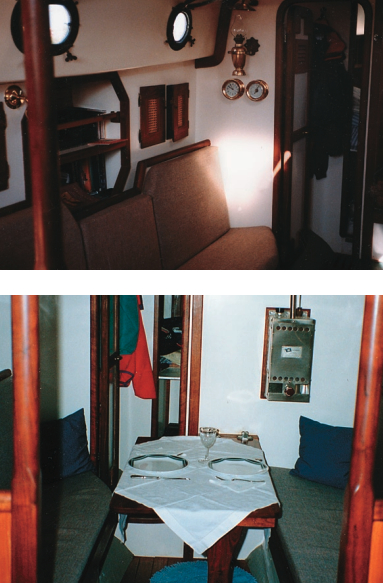
The standard of finish supplied by C.E. Ryder was commendably high. For example, there are eight ports in the coachroof sides, and they all can be opened. And if that’s not enough in the way of ventilation, there are also two large opening hatches overhead.
The rig
Tom Gillmer gave the SC31 a modern masthead cutter rig with a jib set from a short bowsprit and a staysail set from the stemhead. The total working sail area is just under 450 square feet, so the rig is easy for one person to handle.
This is yet another boat with an aluminum, deck-stepped mast, but it does at least have a wooden compression post to transfer the thrust directly to the keel. One wonders why so many designers shy away from keel-stepped masts, especially on pure cruisers, which are not so likely to be hauled and have the stick removed every winter. Mast partners add valuable strength and stiffness to a keel-stepped mast.
The original design featured a club on the foot of the staysail, but some owners will probably have discarded it in favor of a loose-footed sail because the cutter rig is already cluttered on a boat of this size. Besides, you really need a self-tending staysail only when you’re contemplating frequent tacking, and that’s something a deepsea cruiser shouldn’t have to do.
Performance
While the SC31 is no round-the-buoys racer, her long waterline helps her maintain respectable average speeds on long passages. Her modest draft of 4 feet 7 inches, combined with a low-aspect-ratio keel, means she’s not going to pass any fin-keeled racer/cruisers on the beat, but she’s capable of showing them a thing or two on a close reach in choppy head seas and, of course, she really comes into her own on beam and broad reaches.
Some critics, bent on gainsaying Professor Gillmer, wonder whether the SC31 is ballasted enough. Her design displacement is 13,600 pounds, of which about 32 percent (4,400 pounds) is a lead casting in the keel cavity. In the good professor’s defense, it can be said that this was regarded as a perfectly acceptable ratio for working boats of this type, which carried their engines, fuel, water, and sometimes internal trimming ballast, low down in the hull. In those days, too, perhaps people showed more common sense about stowing heavy gear, books, and provisions as low as possible in the boat and about keeping all these things in place so they wouldn’t shift during a rollover.
Known weaknesses
- Although balsa-cored decks are standard among production boats, many suffer over the years from water intrusion, which leads to delamination and great loss of strength. If you’re buying an old SC31, check her decks and cabintop for hollow sounds and flexing.
- Check the outer skin of the hull carefully for punctures or cracks. Water won’t necessarily penetrate the inner skin or even spread through the plastic foam core, so this kind of damage is easy to overlook.
- Most factory-finished boats were supplied with alcohol stoves. They’re not the best choice for ocean cruisers, who mostly prefer propane, kerosene, or even diesel cookers.
Owner’s opinion
Bob and Judy Boudrot sail their 1980 factory-finished Southern Cross 31, Second Wind, out of Manchester-by-the-Sea, Mass. Bob, past commodore of the Southern Cross
Owners’ Association, calls her a go-anywhere boat in any weather. “I feel very confident that I could take her anywhere in the world,” he says. “She’s a salty-looking boat that always draws looks and comments in a new harbor,” he adds.
Second Wind is very well-found and carries extensive instrumentation and safety equipment. “But I’d add a steering vane, single-sideband radio, and an EPIRB for extended offshore work,” he says.
As far as performance under sail goes, “she roars on a reach, but struggles upwind in light air. In 12 knots or better, she’ll do 5 to 6 knots at 35 degrees apparent wind.”
If the wind increases while she’s sailing to windward, Bob first reefs the mainsail, then rolls up the genoa progressively. “Over 25 knots, we’re down to two small headsails, or perhaps the club-footed staysail alone, and if she develops weather helm we ease the reefed main.”
Under power, her two-cylinder Yanmar pushes the boat at 5.8 to 6 knots, using about half a gallon of fuel per hour. “It’s noisy and bouncy but reliable,” he notes. “I think she may be a little over-propped, since I can only get up to 2,600 rpm at full throttle.”
Major upgrades to Second Wind since her launching have been an Edson wheel and binnacle, autopilot, engine instrumentation pod on the companionway bulkhead, a Max-Prop, radar, a laptop and navigation software, a separate starting battery, a holding tank, two anchors on the bow ready to run (35-pound CQR and 12H Danforth) a CD/FM player, and a zip-on Bimini extension to the dodger.
“I’m also planning to add a second manual bilge pump, mechanical refrigeration, and to move the split backstay to the aft end of the hull because it crowds the helm in its current location,” Bob adds.
If you’re planning to buy a SC31 for offshore work, Bob strongly advises you to have the stainless steel pintles and gudgeons on the rudder replaced with bronze ones, as he did. Also, have the deck tapped (to locate a waterlogged core and possible delamination), and check for a watertight hull-deck joint.
On ocean passages, Bob suggests the SC31 could carry a 6- gallon jerry jug of diesel on deck or in the port cockpit locker to provide 10 hours of emergency running time. You can also catch extra fresh water on deck during rain squalls, he maintains. “The SC31 has a high toerail, and I’ve read where people gather rain through a freshwater fill pipe on deck.”
Bob judges the accommodations to be comfortable for two people for extended offshore work, “although a third person could fit in, considering that there are two sea berths in the main cabin with lee cloths.”
Conclusion
Owning a Southern Cross is like being a member of an exclusive club. There is, in fact, an owners’ association with its own extensive Web site on the Internet designed and maintained by Second Wind’s first mate, Judy Boudrot. It maintains crew and owner lists, advertises boats and equipment for sale, and features pictures of SCs in action. The association also publishes newsletters and organizes an annual get-together in Newport, Rhode Island.
Two SC31s were being offered for sale on the owners’ Web site in late 1998. Hull number 85, launched in 1979, was being offered in New York state for $27,500. She had a 20-hp Yanmar engine, Aires self-steering vane gear, a dodger, various electronic instruments, and a dinghy. A sistership, called Badger, hull number 51, was going for $33,500 down in the U.S. Virgin Islands. She had a Monitor self-steering vane gear, a 10-foot fiberglass sailing dinghy, upgraded standing rigging, and a wide range of electronics, including ham radio. There was no mention in the advertisement of what kind of engine she had.
At prices like these — less than those of many luxury cars — the SC31 represents a bargain buy for the ocean voyager who prefers a solidly-built, highly conservative hull in the Colin Archer tradition.
John Vigor is a professional journalist. The author of The Practical Mariner’s Book of Knowledge, The Sailor’s Assistant, and The Seaworthy Offshore Sailboat, he has worked for major newspapers around the world and is a frequent contributor to leading sailing magazines. He has sailed for more than 40 years in boats 11 to 40 feet in length and logged some 15,000 miles of ocean voyaging. In 1987 he and his wife, June, and their 17-year-old-son sailed their 31-foot sloop from South Africa to the U.S. This series of boat reviews is based on articles from John’s book: Twenty Small Sailboats to Take You Anywhere.
Thank you to Sailrite Enterprises, Inc., for providing free access to back issues of Good Old Boat through intellectual property rights. Sailrite.com