Asia’s largest and oldest boatbuilder is still in business after 130 years
Issue 13 : Jul/Aug 2000
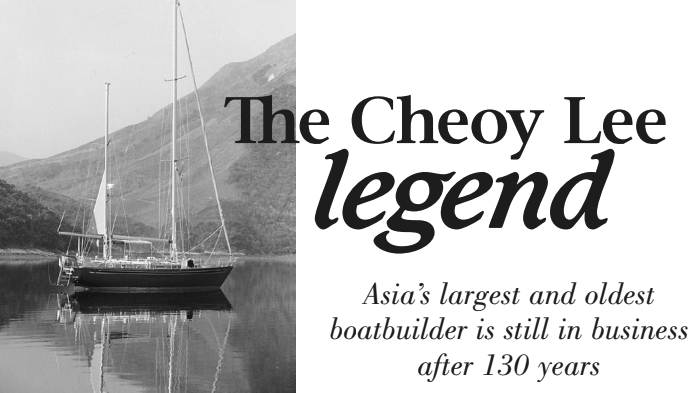
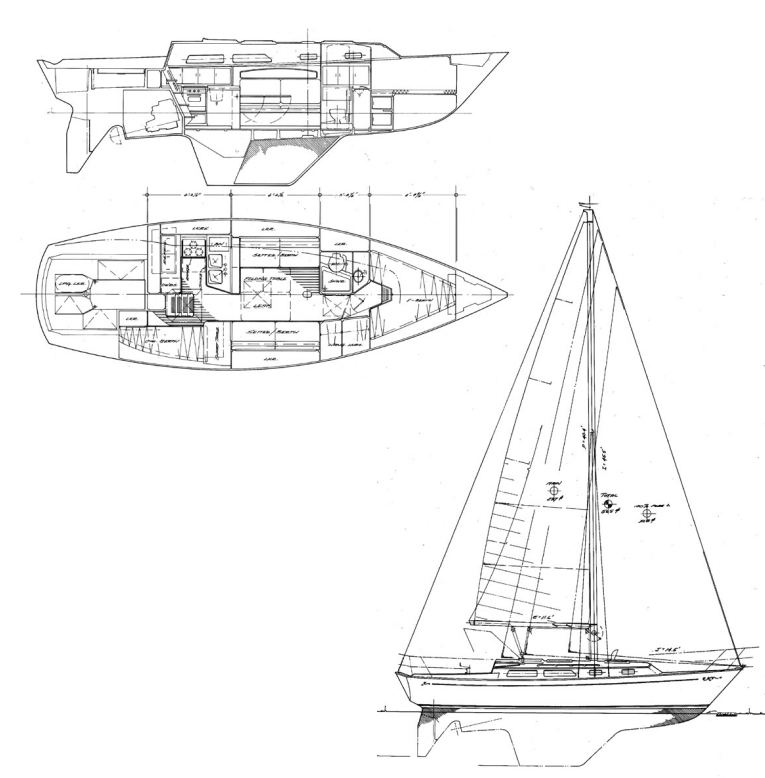
Cruise the waters of the Bahamas, the Gulf of Mexico, or Lake Michigan, and you’ll find yachts built by Cheoy Lee. In the British Virgin Islands, we found Cheoy Lee Offshore 31s favored for their liveaboard comfort, cruising capabilities, and a much-desired 3-foot 9-inch draft, crucial for carefree island-hopping. But few boating enthusiasts associate this Hong Kong-based shipyard, now more than 100 years old, with the production of tugs, ferries, pilot boats, and patrol boats for a demanding commercial market. Fewer still know that the Chinese characters for Cheoy Lee translate into a “Happy and Prosperous Business.”
The beginnings
Started by the Lo family in Shanghai in 1870, the Cheoy Lee Shipyard specialized in the production of wooden commercial craft and powered cargo vessels built to outrun the Japanese blockade during World War I. In 1936, when the Japanese overran China, then Cheoy Lee president, Lo To, moved the company hub to Hong Kong Harbor. Although all operations ceased for a brief period during World War II, the company resumed production at the end of the war.
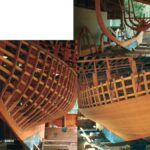
It was during the prosperous 1950s that the shipyard diversified, producing teak sailboats (and motor yachts) billed as “classic bluewater sailing yachts built to Lloyd’s of London standards,” with the goal of making the sport of sailing attractive and affordable. But Cheoy Lee, family-owned for four generations, was already making progress in the development and testing of a then-revolutionary material called fiberglass or glass-reinforced plastic (GRP). Their studies for Lloyd’s of London included numerous combinations of resin and glass and intensive strength testing until a successful mix was found. The shipyard phased out wood construction in the 1960s, becoming one of the first companies to use “glass.” They also pioneered GRP/foam sandwich technology in the marine field.
By the mid-1970s, Cheoy Lee boasted a 1,200-employee shipyard on Hong Kong’s waterfront. Two decades later, the bottom virtually fell out of the recreational, small-boat market, causing Cheoy Lee to concentrate its efforts on the production of larger, semi-custom sailing yachts, transoceanic trawlers, and long-range cruisers. Over the years, close to 4,700 Cheoy Lees (sail and power) have been delivered worldwide.
The U.S. market
Cheoy Lee’s Hong Kong location, the availability of natural Burmese teak, and a cheap labor force made its entry into the American boat market an immediate success. Although Cheoy Lee had been known in this country since the 1950s, it wasn’t until the following decade, with the perfection of fiberglass technology, that the company seriously introduced U.S. buyers to its Far Eastern craftsmanship — a level of workmanship that had been unheard of from U.S. yards — and prices that undercut the competition. While some Asian shipyards are noted for having the interiors completed by finish-work families who physically move aboard, the Cheoy Lee Shipyard has always operated a more sophisticated yard.
There are many stories of Cheoy Lee’s early popularity in the U.S. One concerns David Toombs, of Lion Yachts. In 1960 David, a United Airlines pilot, spotted a Cheoy Lee 35-foot Lion Class sloop in California. He fell in love with the all-teak design by British naval architect Arthur Robb and imported one for himself. Then he discovered that everyone who saw the boat wanted one, so he started selling boats. After selling 25 Lions in about three months, he had the name for his business. According to David, he set up the company’s East Coast dealer organization in 1965 and was hired by Cheoy Lee to put them “on the map here.” The first hull on record, imported in 1960, was #782, and about 2,000 yachts were sold up to 1990. After 80 trips to the Cheoy Lee Shipyard, David figured he spent more than a year of his life in Hong Kong. Lion Yachts, on occasion, also handled other boats, some from Holland, and others, like the Ta Shing products, from Taiwan. David, himself an avid sailor, in addition to the Lion 35, has owned a Robb 35, a Rhodes Reliant, an Alden 50, a Luders Clipper 48, and a Cheoy Lee/Perry 48. He now cruises on a Pedrick 43 sloop.
Woody-looking
Cheoy Lee owners a few decades ago were much like those who covet them today. Though they range in experience, all are cruisers — not racers — at heart, in search of a seaworthy, classic “woody-looking” boat. Cheoy Lee used teak above and below the deck to give the illusion of a wooden boat. For example, the Rhodes Reliant, constructed of fiberglass from top to bottom, sported a “teak” cabin. The basic structures, with their bulletproof fiberglass hulls, have withstood the test of time, and enthusiasts from coast to coast favor the early models for modernization and complete rebuilds. By today’s standards, the early Cheoy Lee sailing designs are relatively narrow and heavy, but they possess unusual stability and a high level of comfort.
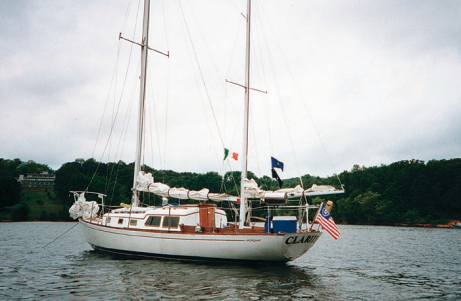
Our Offshore 31’s 8-foot 10-inch beam is slender compared with the 10-foot-plus breadth of modern boats of comparable size. Having been an inland sailor most of my life, my own introduction to Cheoy Lee was on my husband Paul’s beloved Clarity, a 1967 ketch-rigged, Offshore 31. Her classic sheerline, wooden spars, and low freeboard earned her the title of “the prettiest boat on the lake.” In the midst of cleaning, painting Clarity’s bottom, and varnishing teak last spring, we dug out the original brochure that promoted the Offshore 31 as “a modified Herreshoff 28 design with a low wetted surface, long and stable lateral plane, fast and easy to handle with maximum rudder control. Ketch-rigged, she is excellent for offshore cruising.” From personal experience, we can attest to the standard company line that a full keel and large rudder make for stable cruising, especially on our shallow, inland lake where the wind and chop can build quickly and fiercely.
The designers
Cheoy Lee sailboats were designed by some of the world’s best-known naval architects, a roster that reads like a Who’s Who in ship design: John Alden, Maury Declerck, Laurent Giles, Bill Luders, Taylor Newell, David Pedrick, Robert Perry, Ray Richards, Philip Rhodes, Arthur Robb, Sparkman & Stephens, and Charles Wittholz. Ted Brewer drew some of the Luders’-designed Cheoy Lees in the late 1960s and early ’70s, specifically models in the Clipper and Midshipman series.
Contractual arrangements with Cheoy Lee were a bit unconventional in that the company usually bought designs outright, precluding the payment of royalties to designers. When a mold was nearing the end of its run, as was the case after 44 of the Reliant 40s, a new model and potential designer were sought. The shipyard was also fairly rigid in its approach to outsourcing its work. All structural designs were drafted by Cheoy Lee so they could use their own trained craftsmen and proven materials at the Hong Kong facility, a move that went a long way in keeping costs to a minimum and quality at a premium. The terms required by Cheoy Lee limited designers’ control over their own work. Cheoy Lee had the ability at the time to complete and launch a new production yacht faster than almost any other builder, usually within one year of the signing of the design contract.
Designer profile
Robert Perry designed for Cheoy Lee from 1975 to 1978 and was responsible for the 35, 43 motorsailer, 44, Offshore 48, and Golden Wave 42. When I caught up with Bob Perry in Seattle, he told me he always knew he wanted to be a naval architect. In high school he sent off letters to boat companies and dealers requesting color brochures in the 20- to 80-foot range so he could practice sketching. “Thinking back on it, these boatbuilders received letters literally scratched in a kid’s handwriting, and I’m certain that 99 percent of the letters were thrown away,” he said. “I did receive one package from a Cheoy Lee dealer here in Washington who sent me everything he had on the company. Years later, I felt proud as an established professional, to be contacted by Cheoy Lee to design for them.”
According to Bob, “it was a rather trouble-free ‘marriage,’ given that there was almost no communication with the company once the designs were sent in. Eight months later, I’d receive or see photos of the boat I designed sailing in Hong Kong Harbor.” In 1977, Bob designed the Cheoy Lee 48 at a time when mid-40- foot boats were the rage. The 48 was very popular and made an excellent liveaboard yacht even though its size approached the upper limits of what could easily be handled by one person. He considers the 48 an excellent design and still uses it as a benchmark for other projects. Bob visited the boatyard in Hong Kong but never felt as close to the owners as he would have liked. It was a style they didn’t ascribe to.
The relationship with Cheoy Lee ended when Bob Perry turned down the company’s last request for a design. “Throughout the design series, I felt I was losing control. Quite frankly, I wanted to be the fountainhead of change. I was young then; we were all pretty cocky and confident.”
Cheoy Lee today
Surfing the ’Net brings a variety of references to Cheoy Lee: broker listings from 27-foot sloops to 92-foot motor yachts; home pages created by skippers featuring their own prized “CL” sailing vessels; and owners’ organizations and Web sites devoted to a particular “cult” Cheoy Lee design, such as the Rhodes Reliant 40 (some say the most admired and sought-after glass boat from the board of Philip Rhodes). There are motorsailers engaged in chartering, like the 63-foot Blue Eagle that cruises the Caribbean and the East Coast of the United States.
So the legend of Cheoy Lee lives on in its older boats, but is the company still in the sailboat business? According to Cheoy Lee sales manager, Jonathan Cannon, the answer is a qualified yes. “We have not actually ceased sailboat production, although we do not build as many as we did in the past. Our line of motorsailers ranges from 53 to 78 feet, and we are also able to build the 43-to 55-foot David Pedrick designs on a semi-custom basis.”
Even though the future looked unsettled for the Hong Kong-based Cheoy Lee Shipyards when the British finally handed the territory over to the Chinese, the transition has been more than successful. Under the stewardship of two of Lo To’s children, Ken Lo, an engineering graduate of the University of Michigan, and But Yang, a Cornell alumnus with an MBA from Stanford, Cheoy Lee was able to expand the shipyard facilities and increase its manpower, drawing from a larger pool of highly skilled craftsmen.
On a personal note, Cheoy Lee designs are, to this day, so eye-catching, so head-turning, that even after many years of ownership, Paul and I still turn back, not once, but twice at Clarity when we are leaving the dock . . . to see that she is secure certainly, but also for one last look at an elegant lady of the sea.
Kate is a St. Louis-based writer whose articles have appeared in the St. Louis Post-Dispatch and several boating magazines. Kate and her husband, Paul, have sailed the waters of the Chesapeake, Lake Michigan, Florida Keys, the British Virgins, and the Abacos in the Bahamas. They can usually be found cruising the Tennessee and Cumberland rivers from their home port of Green Turtle Bay on Lake Barkley, Kentucky.
Thank you to Sailrite Enterprises, Inc., for providing free access to back issues of Good Old Boat through intellectual property rights. Sailrite.com