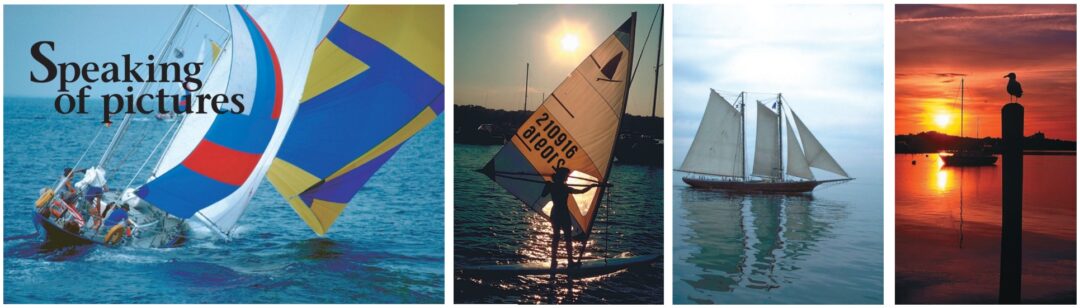
A marine photographer tells how to get that once-in-a-lifetime shot
Issue 14: Sept/Oct 2000
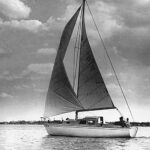
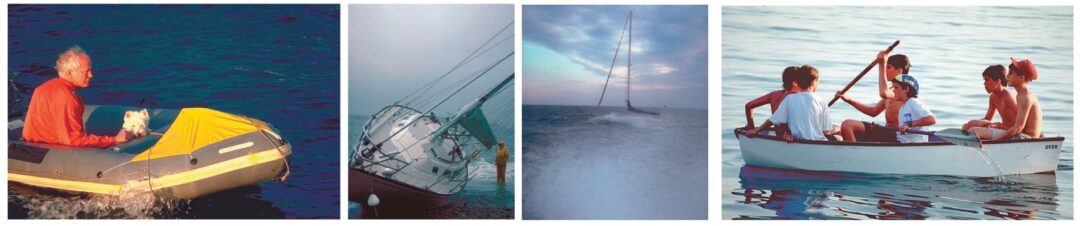
I love the sight of a sailboat romping by itself in a brisk breeze on an otherwise empty bay. I love still waters, endearing children and their patient parents enjoying the myriad aspects of aquatics, and “old salts” with their weather-beaten visages and mischievous grins. Dogs of every description aboard any kind of vessel are a continual visual feast. So are dinghies, tethered willy-nilly at docks; the doughty forms of tugs and other workboats; sea conditions and the seasons and luminous dawns and limpid dusks and on and on it goes . . . the sea heaving up an endless procession of memorable and fascinating images to admire and record.
How to harvest this parade?
I start by having my camera always at the ready. I get up in the morning with the camera slung around my neck. It is always within close reach when I’m in the cabin — on a shelf or on a seat right by the door of our boat. (After a dozen years of sailing in a variety of vessels, we now cruise in a 36-foot Grand Banks trawler yacht.) When I go up on our flybridge, my Nikon 8008 goes up with me, and it comes back down except for the briefest of trips below. As we sojourn on the sea, my camera is beside me on the seat or if it’s so rough that spray is being hurled over our flybridge, I keep it in a locker near my legs where I can whip it out and return it quickly.
A word about photography in foul weather conditions. You have to ask yourself: “Am I there for the camera? Or is the camera there for me?” You only go around this way once, and so I choose to use my camera and occasionally risk exposing it to salt spray. When this happens to the lens or body of the camera, I sponge them off as soon as possible with clear water.
Waves flatten out
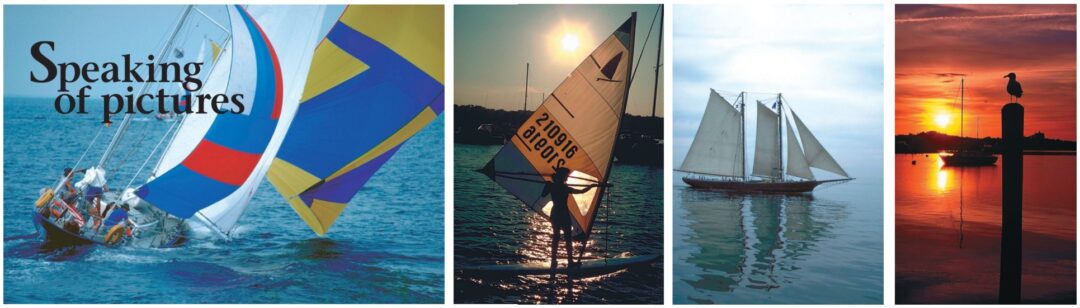
I’ve learned that even large waves flatten out in your pictures, but something of the malevolent can always be captured. Even an out-of-focus image caused by the rudeness of the motion can be evocative of nasty conditions. I take pictures through the windows if necessary, figuring that something on film is better than nothing. I welcome fog and mist (pictorially, that is) where nature does most of the work for you. A boat coming toward you, or passing, or being swallowed by mire; a buoy looming suddenly like a supernatural apparition; craft anchored or moored with their masts seemingly vanished have a ghostly quality all their own. I never dismiss a gray day as being without interest. Some of them are akin to silver, and the effects you achieve are as exquisite as etchings. I even visit locales after storms. Damaged boats and coasts are part of the panoply of life afloat. (I speak as one whose own sloop was once grounded in a gale.)
I never leave my camera in the sun, and often shift its position when underway. It’s in the sun many times when you shoot, of course, but as soon as the shot is taken, I make sure it rests in the shade. Nor do I leave it in the car to heat up as the car does when parked, particularly in summer.
Right at hand with the camera is a small canvas bag in which I keep extra film (I always have six extra rolls with me), lens tissues, and spare batteries. Most situations can’t be caught twice, so I try to ensure that I have the means to record them the first time.
I keep photography simple. My camera is almost always on automatic setting. I use only two lenses: a 70-210 zoom and a 28-85 wide-angle.
Slide film
I use slide film almost exclusively, because of my work as a photo-journalist, since slide film is required by most magazines. (Many magazines will tell you to use 64 ASA or slower film. Getting a sharp focus is difficult with the motion on boats – those you’re shooting and those you’re shooting from. A better bet is 100 ASA film such as Fujichrome’s Provia. -Ed.) I use no filters except for a skylight filter to protect the lens. This is personal preference. I revere the sight of the world exactly as it is and choose to capture it that way. But I can understand completely the lure of different kinds of filters for those who like to play around with or enhance reality. (Think what Van Gogh did in the realm of painting!) One lens is on the camera and the other in a bag right beside my extra-film bag. Depending on the visuals presented, I’ll change the lens several times during a passage.
On any leg, I frequently glance 360 degrees around, alert to picture opportunities, either sail or power. If you’re open to beauty, you find it in all kinds of craft. A common image en route to the Cape Cod Canal is a motor vessel charging toward you from astern, heaving white wings of water as it hastens rather imperially on its way. If I see a boat coming toward us that seems special enough to photograph, I shoot it as it approaches, when it’s abeam, and falling astern.
I also look up. Sometimes the sky is the picture. Sunrises, you discover, diffuse swiftly into day (shoot them quickly!), but sundowns are leisurely. I attend each of their gradations as they deepen into dark, sometimes shooting 10 or 12 slides, each of which will prove to be different, but all equally stunning. Old Sol himself can be used to dramatic effect, just emerging from the top of a sail, or the edge of a cloud, or crowning a mast or some other part of a vessel. Clouds, too, array themselves in marvelous formations, from the ominous to the awesome.
A cruise chronicle
I chronicle every cruise in pictures. I photograph the marks we pass, the bridges we go under, any landmark or other important structure ashore, all the traffic that catches my interest and every harbor in which we berth.
A host of shots are of the seize-the-minute variety. One of my favorites occurred on one of our recent cruises to Block Island, Rhode Island. I was washing the dishes at sundown, and a seagull lighted on the top of a post on our dock. I pulled off the rubber gloves I was wearing as quickly as I could, grabbed my handy camera and shot a blink-of-an-eye before the bird took off. I wasn’t so lucky up on Maine this past summer, and my loss of a photo was my own fault. Just this once I hadn’t taken my camera with me as I strolled a pier. When I dashed back to the boat to get my Nikon, ripples had ruined the absolute stillness of what had been a basin reflected to perfection.
Seize-the-minute shots are instinctive and/or happy accidents. But scores of good pictures are the result of deliberate planning.
I try to decide in advance what lens to use. Underway, I usually have my 70-210 on the camera in order to pull in the coastlines we’re skirting or any boat in the vicinity. But when we head up the East River in New York Harbor, for example, I put on the wide-angle. In this waterway there are bridges and currents and much other traffic and buildings and helos and other images that succeed each other with such rapidity (all pretty close aboard) that that lens best captures the vista and its spirit. I also use the wide-angle when shooting windjammers and large ships, and it’s the lens I take ashore. (Often I bring just one lens, not caring to lug both.) You can climb a hill and capture an entire anchorage. You can photograph local points of interest (including historic sites and statues, Victorian and other edifices, whole marinas and so forth) wonderfully well with a wide-angle.
Every angle
I take both a vertical and horizontal shot of a subject, if possible. One is usually stronger than the other when processed. And I shoot an up-close and a distant shot. When a sailboat is the subject, I shoot it from every angle. (Completely circling a boat underway is easy when you’re shooting from a 12-knot yacht, I admit!)
We position ourselves to shoot races, keeping well out of the way and the wind of the contestants and a good distance off the buoys they round. (Here the zoom is the most helpful.)
For added interest to an image, I try to wait until a boat is in front of or near a landmark such as a lighthouse or the United Nations Building before clicking the shutter.
As can anyone, I try to get in a bit of our boat in any shot underway that seeks to convey our passage and the surrounding scene — a burgee, the bow pulpit, part of the stern. If we row in our dinghy — to a secluded cove like Roque Island, Maine, for instance — I shoot the beached dinghy with the whole basin behind, combining foreground and background and setting a mood with the photo.
There is a treasure trove of “mood” shots to be had: a boat pointing seaward in a yachtyard in spring; a tender overturned in cordgrass in the fall; a snow-mantled sloop sporting the name of Sunburst. But no source of mood shots thrills me more deeply than twilight. I call it the “golden hour,” and to me it repays every bit of patient watchfulness required. You have to catch its magic. For just a minute or two (or five or ten), the setting sun will gild an entire harbor, turning masts and hulls to gold, sprinkling the water with sparkling reflections. Spread before you in that interlude will be a scene of such serenity and order you will feel transfigured by its glory.
Arrested motion
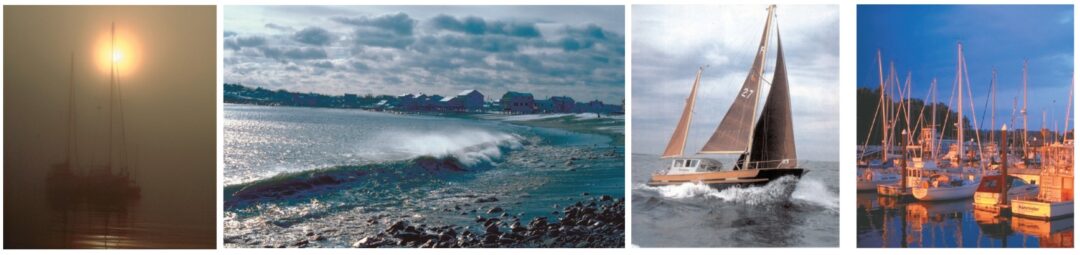
Something of the sublime is also achieved when you truly arrest motion. A sailboat in a high wind with a decided heel, masterfully helmed, is a wonder and never fails to transport this photographer. Here I never stint on film, taking multiple shots, willing to use up a whole roll, if need be.
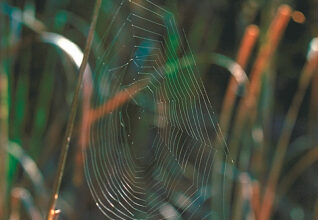
If my husband refers to my camera as “the third person” (so everpresent is it on our boat) he sometimes calls me “the spider.” That is in reference to my ensconcing myself on our flybridge for hours once we have arrived at our destination, to see what I can catch in my pictorial “web” — usually an ample sampling of the life of the harbor in all its comings and goings and changes of light.
Angles . . . planes . . . perspectives . . . patterns produce fascinating pictures: the curve of a beach or the long encircling arm of a jetty embracing an anchorage; Flemished lines; rigging; a headsail billowing out as shot from the cockpit; a varnished deck, or door, or brightwork and other parts of ships and boats. Groupings and contrasts also provide interest — tenders in clusters; rows of cradled boats; rafted vessels; a little boy looking way, way up at a big, big boat in a travel lift; a sailboat tiny against the loom of a mountainous shore; power and sail mingled.
And who can forget all the symbols of the sea you can shoot ashore? Figureheads among them, as well as anchors, nautical windvanes and signs; lobsterpots and buoys, nets and sundry other artifacts, and tools-of-the-trade.
All is grist
Almost anything can be grist to the mill for the marine photographer. Colored spinnakers. Whipping flags. Titans being overhauled in a shipyard. Cormorants (or seagulls or terns) caucusing on buoys; the ducks and geese that besiege your boat and the swans gliding regally by. (Not to mention seals and porpoises and whales and many another waterfowl or fish.) There is every kind and size of boat to be photographed, and fishers of the sea at work, and the people you couldn’t boat without (like those willing to be hoisted in a bosun’s chair), and messing-about-the-boat shots, and commissioning and de-commissioning, and mishaps, and the humorous human comedy afloat.
I find keeping the horizon level the biggest challenge in nautical photography. You’re rolling or pitching and tossing or merely being jostled by the normal motion of a boat; and if you’re shooting another vessel the same elements apply to that craft! I have to discard many a shot because of its “tilt.” You have to brace yourself as well as you can and shoot and shoot and some — but not all — of those shots will be successful.
For all your experience, and expertise, and vigilance, and thought, and patience, and practice, you are repeatedly humbled by your knowledge that often the last shot you had left on a roll that you took simply to use up the film — will turn out to be the best of the lot!
Mary Jane and her husband, Warren, have been boating for more than 25 years. She is the author of Eye on the Sea: Reflections on the Boating Life, which won first prize in a Boating Writers International competition. It’s available from Breakaway Books, call 800-548-4348.
Thank you to Sailrite Enterprises, Inc., for providing free access to back issues of Good Old Boat through intellectual property rights. Sailrite.com