A canoe-sterned, yawl-rigged, trailerable pocket cruiser for two
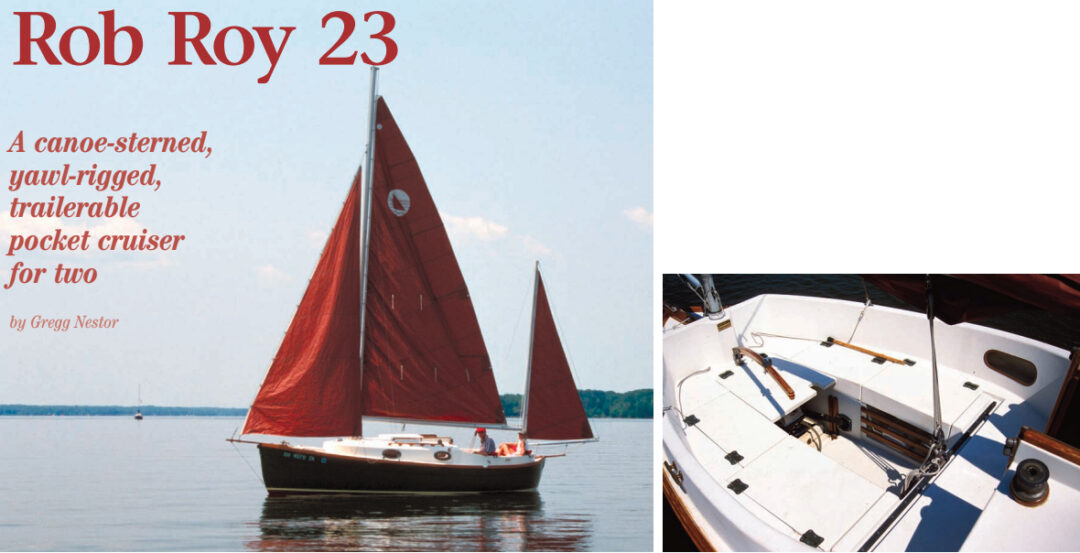
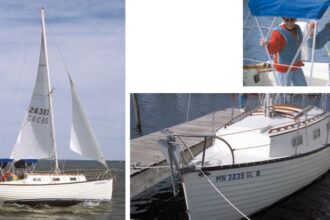
John Oney, facing page, ghosts along on Pennsylvania’s Pymatuning Reservoir in his 1986 Rob Roy 23.
Issue 30 : May/Jun 2003
Start with shallow draft. Add handcrafted quality and a dash of salty conservatism. Voila! You’ve got a Rob Roy 23.
It has been said that history repeats itself. I believe this is so. At least it has been in the case of the Rob Roy 23. For in less than a decade, Marine Concepts of Tarpon Springs, Fla., has again ceased production of this offshore trailersailer.
Inspired by the exploits of John MacGregor and his 20-foot canoe yawl, and designed by Ted Brewer, one of North America’s best-known yacht designers, this two-person pocket cruiser was first introduced in 1983. At that time, it was the only trailerable canoe-sterned yawl on the market.
In addition to its novel design, the boat sailed well, had a salty appearance, and was constructed to exacting standards. Even though it provided accommodations for only two, this unique craft addressed the needs of its crew and did it well. For seven years, its popularity was reasonably strong. Then, in 1989, Marine Concepts retired the Rob Roy in favor of the Sea Pearl line of shallow-draft daysailers.
After a hiatus, Rob Roy 23 production was resumed in 1993. Once again the last Rob Roy left the Tarpon Springs plant, this time in 1999, with emphasis directed once more toward the Sea Pearls. In total, close to 100 boats were produced. Now the molds are for sale. But maybe history will repeat itself yet again, making the third time a charm.
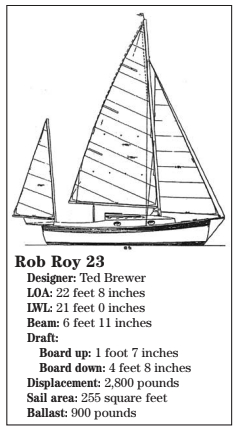
Balance, versatility, and small, easily managed sails are the attributes of the yawl, which has an overall length of 28 feet 8 inches, including bowsprit and mizzen boom. It has a length on deck of 22 feet 8 inches, a waterline length of 21 feet, and a beam of 6 feet 11 inches. It displaces 2,800 pounds with 900 pounds of ballast.
Construction
The original Rob Roy 23s, those built between 1983 and 1989, were constructed of fiberglass with balsa coring in the deck and hull. End-grain balsa is extremely light and resistant to crushing. It also affords good temperature and sound insulation. However, if the laminate is violated, the balsa quickly soaks up water through capillary action and turns to mush.
The newer Rob Roys, those built after 1993, are also constructed of hand-laid fiberglass roving, but the core is of synthetic foam. It is widely believed that the new synthetic foams exhibit superior resistance to water migration and afford excellent noise and temperature insulation. The boat has additional layers of fiberglass roving in the keel and trailer-support areas. To inhibit blistering, behind the gelcoat layer is a barrier coat of vinylester resin. The remaining hand-laid roving that makes up the laminate is wetted out with polyester resin. The hull-to-deck joint is lapped, sealed with 3M 5200, mechanically fastened, and covered with a solid teak caprail.
The Rob Roy 23 sports a shoal-draft keel comprised of 900 pounds of ballast. This includes the weight of the centerboard. The majority of the ballast is in the form of lead chunks, which are held in place with casting resin. Older Rob Roys had aluminum centerboards that were shaped like the letter “L” lying on its back. The newer boards are of fiberglass construction and are foil-shaped. The centerboard trunk is almost entirely housed inside the shoal-draft keel. Just a foot (the foot of the “L”) extends from the companionway forward into the cabin. By means of a simple pendant and cleat, the centerboard can be raised or lowered, depending upon sailing conditions. With the board down, the boat draws 4 feet 8 inches and windward performance is somewhat improved. With it up, the 19-inch draft increases thin-water capabilities and makes for easier trailering.
On deck
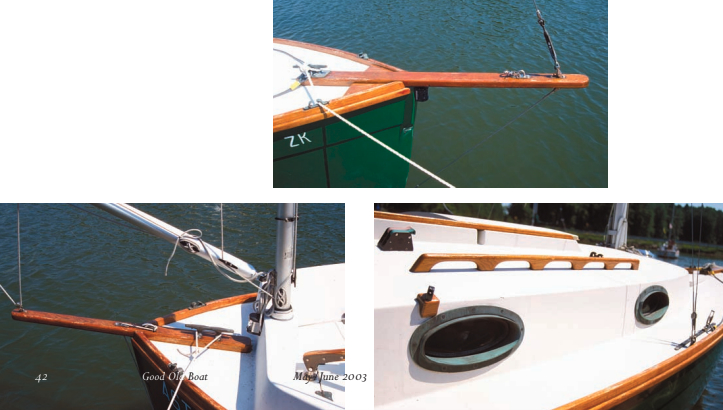
The profile of the Rob Roy 23 is that of a classic canoe-sterned yawl with plumb ends. The boat exhibits conventional sheer and moderate freeboard. The rudder is mounted inboard and is located aft of the outboard motor well. The design line of the cabinroof gently slopes forward and is carried out to the stemhead. This not only allows for a slight increase in cabin height as it runs aft, but also results in a clean, harmonious design.
All of the deck hardware, including the four oval opening ports and the two Barlow #15 winches, is bronze and adds handsomely to the boat’s salty looks. The deck fittings are through-bolted and secured to stainless-steel backing plates. Except for the forward hatch, which is a potential tripping hazard, the foredeck is uncluttered. All deck surfaces are glare-resistant and non-skid.
The shrouds are outboard, and there are narrow (10-inch) sidedecks. There are no bow or stern pulpits nor are there stanchions and lifelines. From its bowsprit to its boomkin, the Rob Roy’s considerable use of teak is functional and adds dramatically to its appealing looks.
The cockpit seats are straight and comfortable enough, with the high coaming extending smoothly aft from the cabin to offer good back support. Even though the cockpit measures 6 feet 6 inches, the canoe stern, mizzen mast, inboard kick-up tiller/rudder, and outboard motor well gobble up space at an alarming rate. The resulting deep cockpit is ideal for two. Any more crew and they would need to go below to change their minds.
Like the centerboard, the inboard kick-up rudder is easy to lift and secure in any position by means of a simple pendant and cleat. The motor well is located just forward of the tiller/rudder. This arrangement places the motor’s shaft just aft of the keel. Since the motor remains fixed in the well at all times, this positioning reduces propeller drag. The hull opening is slightly larger than the motor’s cavitation plate. This allows for cockpit drainage, while discouraging surge from a following sea or possibly prop turbulence. Aft and to port in the cockpit there is a bilge pump that can be operated from the helm.
On-deck stowage is one of the boat’s strengths. There is stowage for two 6-gallon fuel tanks (one to port and one to starboard) as well as two additional cockpit seat lockers. Below the cockpit sole is a raft compartment that also houses the battery in its own secured box. There’s also a pair of handy bins forward, one each on the inside of the coamings. At the forward end of the cockpit is a proper bridge deck. Its function is to prevent water from cascading below, should a large wave fill the cockpit. No proper seagoing craft would be without one.
Below deck
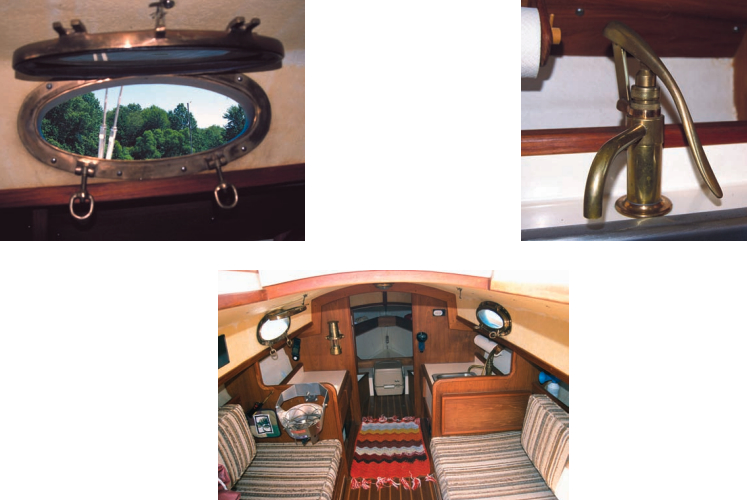
Below, the Rob Roy utilizes a small fiberglass interior pan to give the centerboard trunk a more finished appearance and to predetermine the location of the bulkheads and cabinetry. Unlike other boats of this size, this fiberglass unit is not a structural component. The bulkheads and cabinetry are double-tabbed to the hull and finished with teak veneer. All trim work is solid teak. The cabin headliner is foam-backed vinyl and, along with a teak-and-holly sole, finishes off the cabin in proper yacht fashion.
The forepeak is designed primarily for stowage, with port and starboard shelving lining the hull, a locker to port, and a hanging locker to starboard. There is even adequate room for a Porta Potti. This arrangement offers both privacy and roominess. A curtain separates the forepeak from the main cabin. One optional interior plan locates a marine head to port, removes the hanging locker, and adds a child’s berth to starboard. Access from the deck to the forepeak can be gained through the forward hatch.
Aft of the bulkhead is the galley. To port is a stove area that is large enough to accommodate a two-burner stove. A stainless-steel sink with bronze hand pump is on the starboard side. Potable water capacity is 14.5 gallons. The storage tank is forward. An optional pressurized potable water system was available. Above both of these galley work areas are pantry bins. Beneath, the teak cabinets have drawers and sliding doors with additional stowage bins. There is room for a cooler or an optional built-in insulated ice chest under the cockpit sole, alongside the centerboard trunk. The four bronze portlights open and, along with the forward hatch, provide cross ventilation and natural illumination for the cabin.
Located amidships are the settees/berths. As settees they are 4 feet 8 inches long. When used as berths, they are 6 feet 6 inches long and extend under the cockpit. By using the settee back cushions and an insert, they can quickly be converted into a platform double berth. The settees are comfortable and allow for full sitting headroom. There are shelves outboard of the settees/berths that are convenient for small items. The electrical panel is located aft and starboard, under the cockpit.
The rig
The Rob Roy is a classic canoe yawl. Its mainmast, which reaches a height of 29 feet 6 inches above the water, is stepped on deck with a hinged tabernacle. This is supported belowdecks by a central bulkhead archway that, in turn, is supported by solid teak members that reach to the keel.
While the mainmast is supported by single upper and lower shrouds, the mizzen mast is unstayed. All spars are anodized aluminum. Total sail area is 255 square feet. The mainsail comes standard with two reef points and jiffy reefing. All halyards are low-stretch Dacron, are external, and are cleated at the bases of the masts. Jib sheets are led through adjustable sheet blocks situated on two-foot sections of track that are located on either sidedeck. From these points, the sheets travel aft, through a fairlead, on their way to winches located on either side of the aft portion of the cabinhouse. The sheets are finally cleated at the top corners of the companionway by means of cam cleats. Mid-boom sheeting for the mainsail is attached to a traveler on the bridge deck and cockpit seats.
Underway
The hard bilges of the Rob Roy 23 give the boat good initial stability. As it heels, it progressively stiffens. It is a seaworthy and dry craft.
The yawl rig works fine on a reach. However, upwind the close-set mizzen suffers a bit from mainsail backwind. On the flip side, the mizzen functions well when sailing downwind. However, all the while it’s stealing air from the main. The Rob Roy 23’s performance in light air is very respectable, as is its ability to hold its own when conditions get rough. The yawl rig allows a sailor to reef and maintain balance, while at the same time lowering the center of effort.
Unfortunately, the versatility and virtues of the yawl rig often prevent the boat from reaching its full potential. For example, a sloop-rigged version with the same amount of sail area would probably accelerate faster and most definitely point closer. The boat’s engine well was designed to carry an 8-hp Honda 4-stroke. This powertrain moves the boat along quite well; however, some sailing performance is lost because of its fixed arrangement.
Things to check out
Since the hulls and decks of the earlier boats (1983-1989) were cored with end-grain balsa, check closely for balsa that has deteriorated due to water influx and migration. Areas requiring particular attention include those around through-hulls and deck fittings. If, when tapping with the handle of a screwdriver, you hear a dull thud instead of a solid ring, some potentially major work may be in the offing.
The earlier models had aluminum centerboards and aluminum-sandwiched rudders with a splash of stainless-steel welds/fasteners. If the boat is kept in the water, especially salt water, and not on a trailer, electrolysis can occur. Protect these blades with zincs.
There is a tendency for the outboard to become starved of air while under load. Enlarging the air intake will relieve this condition.
Summing up
As designed, the Rob Roy 23 is a two-person boat. Every design detail from the interior arrangement to the cockpit size to the sail plan reflects this fact. So if you’re planning on entertaining several guests with cocktails on the fantail or berthing a crew of four below, this is definitely not the boat for you.
If you appreciate simplicity in design and ease of operation, attention to detail in construction and finish, and a salty, almost nostalgic-looking offshore trailersailer, this is the boat for you. The boat is a comfortable “weekender.” Owners have reportedly cruised it for weeks at a time. Some have regularly ventured into open waters. Marine Concepts built the Rob Roy 23 well, and they stand behind it. Through refinements in construction and design upgrades, they work hard to keep Rob Roy owners happy.
There’s no shortage of boats in this size that have larger cockpits and more berths and that cost less. As simple as it sounds, the old adage rings true . . . you get what you pay for.
A 1983 Rob Roy 23 originally sold for $16,000. Today that same boat is worth about $6,000 on the used market. A 1985 version goes for around $12,000 and a 1999, whose base price was $32,000, commands $28,000. If you’re sufficiently interested or just want to whet your appetite, check out the brokerage page on the Marine Concepts website.
Thank you to Sailrite Enterprises, Inc., for providing free access to back issues of Good Old Boat through intellectual property rights. Sailrite.com