An architect crunches the numbers to compare performance
Issue 30 : May/Jun 2003
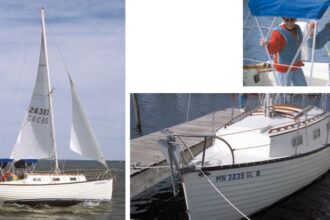
The Montgomery 23 and the two similar small cruisers in this review are classed as “trailersailers.” The problem with all of the three is that, as candidates for trailering, they are a load. Many people trailer and ramp-launch boats this size, but I tried it once with one of my Nimbles and said, “Never again.” You have 3,000 or more pounds of boat behind you, loaded with 500 pounds of equipment, food, fuel, water, clothes, books, and other cruising gear. That’s all sitting on a 1,500-pound trailer that backs up like a reluctant sow. That was not for me!
Having said that, these boats can be trailered if you have a full-sized car or, even better, a van or pickup truck with an engine of about 350 cubic inches and preferably larger. Ideally, a four-wheel drive, diesel-powered pickup will give you more reasonable fuel mileage and will have the traction to tow the boat up a slippery, slimy ramp when it comes time to haul her.
I won’t compare their trailerability except to say this: the lighter the boat and shallower the draft, the better. Let’s look at their merits as small sailing cruisers instead.
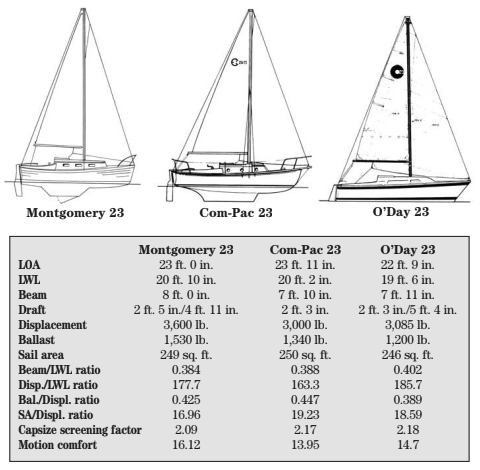
Looking at their high capsize-screening factor and the low motion-comfort figures, we can agree that none of these boats are Cape Horners, but I’ll bet someone will sail one of them to Hawaii, if it hasn’t been done already. I can guarantee that I won’t be aboard though. Their motion will be quite corky in any kind of a chop, so it would take a strong stomach as well as nerves of steel to cross an ocean aboard one of them.
The boats are all fairly beamy. They need to be in order to offer reasonable accommodations, so they are at or close to the 8-foot limit that was the legal trailerable width until recent years. Rather surprisingly, they are of quite moderate displacement with Displ./LWL ratios of well under 200, and they still manage to carry a good ballast ratio, close to or even well over 40 percent. This bodes well for their safety for coastal cruising, and I imagine that any of them could take a fairly severe knockdown and come up smiling, even if the crew isn’t.
Unusually for a trailerable sailboat, the Com-Pac 23 is a keelboat; her lack of a centerboard, coupled with very shoal draft, will put her at a disadvantage when beating to windward. Her long, fat keel also adds wetted area and will increase resistance when reaching and running. Still, with a high SA/Displ. ratio, she won’t be a sluggard either, and she’ll provide a lot of cruising pleasure for a small family.
The O’Day 23 appears to be a good all-around small cruiser, but my preference is for the Monty 23 with her slightly heavier displacement, good ballast ratio, and longer waterline. I’ll qualify that by saying that the 515-pound lighter O’Day might be the better choice where trailering is an important factor in selecting a small cruiser. Regardless, when it comes down to the mighty dollar, any of these three could be a good choice for a first boat or a small family cruiser, depending on the price and condition.
Thank you to Sailrite Enterprises, Inc., for providing free access to back issues of Good Old Boat through intellectual property rights. Sailrite.com