A neglected Lyle Hess classic receives royal treatment
Issue 30 : May/Jun 2003
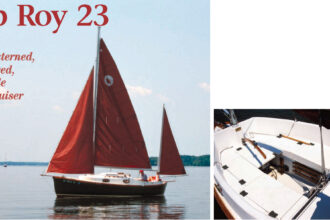
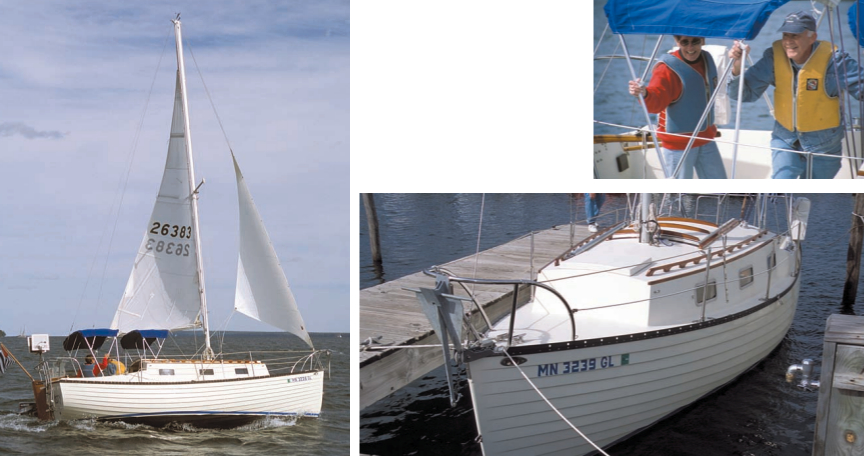
Serendipity brought a cherished cult boat into the hands of Bob and Sylvia Mann, and remarkable good fortune will bring this gem to another owner someday. The gem is a 1979 Montgomery 23, one of perhaps fewer than 20 built, a much sought-after prize among Montgomery owners everywhere.
Jerry Montgomery began Montgomery Marine in Costa Mesa, California, in the early 1970s to build dinghies and eventually a line of Lyle Hess-designed Montgomeries: 15s, 17s, and 23s. The 17-footer was the first, introduced in 1973 at the Newport Boat Show. Over the years a couple hundred were built. It was followed by the 23 in 1978 and the 15 in 1980. (Since the number of boats built was relatively small and, as they are Lyle-Hess designs, Montgomeries have acquired a high level of prestige among those who have owned or sailed them.)
“There is definitely a cult following,” says Randy Palmer, who has owned a 15 and a 17 and has elected to hang on to the 15 even though he now owns and cruises a Cape Dory 30. “Older Montgomery 17s are available in the Minnesota and Wisconsin area because of the reputation Sailboats Inc. [which was selling them] developed here. California is another hot spot for obvious reasons. Otherwise, they are rare and not as well known. The Montgomery 15 is hard to find used. We looked unsuccessfully for two years. When we heard that Jerry Montgomery was talking about selling the molds to Edey & Duff, we decided to buy a new one and keep it forever. It was one of the last ones he built before retiring in the summer of 1993. It’s even more difficult to find a 23. You really have to look for one of these.”
Unaware of status
Bob and Sylvia knew none of this, however, which made locating their boat easier. They were looking for a Pacific Seacraft Flicka or Dana when a broker brought the Montgomery to their attention. They lavished love and quite a few dollars on their discovery, named her Misty, and made her better than new. When they’re ready to sell this 23, the next owners will have a polished and pampered leak-free sailboat with all the bells and whistles.
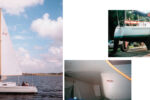
Misty was neither polished nor pampered, and certainly not leak-free, when Bob and Sylvia first laid eyes on their future boat sitting in six inches of oozing red mud on a trailer with three flat tires. The bright yellow hull was not to their taste either. They recall it as “school bus color,” and still shudder at the recollection.
Sylvia was particularly wary. She didn’t relish the idea of tromping through the red ooze to view this boat closely, and she denied ownership when they towed it home some weeks later. “I didn’t even want to trailer it home to Minnesota,” she says. Ignoring it behind the tow vehicle, she’d laugh, “I don’t know this boat. It’s just following us home.”
It was Bob who trod through the mud and who saw the possibilities. “Inside there was teak and ash. The hull was thick and solid. There was a perforated toerail. There were other good features. I realized I was looking at something very sound . . . something built very well for a boat so small,” he says, noting, “once Sylvia saw it, she was impressed with the interior.”
Misty had started life as a MORC- rated racer in a fleet of sleek and serious raceboats on a large lake in suburban Minneapolis. Named Big Bird, she wasn’t in her element there. Her Lyle Hess lines encourage cruising and gunkholing, not short trips from buoy to buoy. Among the racers of the Wayzata Yacht Club, her charms remained hidden. But elsewhere in the country her sister boats were gaining cult status among a group of Lyle Hess devotees. Next Misty was moved to Lake Superior by another owner who named her Buttercup and neglected her.
Started earlier
Bob Mann’s own sailing story began much earlier, at age 16, sailing a friend’s scow on a small lake near downtown Minneapolis. He learned to sail by pulling on lines and seeing the effects. In fact, he courted his future wife aboard that boat. Marriage and children followed. Throughout these years, Bob and Sylvia were friends, each with a different spouse. The foursome liked double dating and, once married, getting together as couples. Many years later, after the death of Bob’s wife, with Sylvia newly unattached, they renewed their long-time friendship on a different level, marrying in 1993. That day, Sylvia jokes, she “became a Mann.”
Bob’s sailboat ownership began with an Aquarius 21 in Minneapolis and then a Pearson 33 in Florida. He and his first wife bought a home on a Florida canal with sailboat ownership in mind. He made a $1,000 deposit on a 45-foot hull that was to be owner-completed. This was a Morgan racing hull with a center cockpit ketch rig sold by Starett and Jenks of Clearwater, who bought the Morgan mold. But once he started doing the math, he realized that he’d soon be head over heels into a very expensive and time-consuming project.
“I’m very handy. I’ve learned a lot about boats since. I could take on that project now,” he says, “but I’m not sure how well it would have gone then.” Rather than throwing good money after bad, he kissed his $1,000 goodbye. Sometimes common sense is the better part of valor.
Bob went on a quest for a sailboat to tie up in front of his home in Crystal River, Florida. That search led to the Pearson 33, named Seanote, on which he lavished his skills as an engineer and handyman. He earned his USCG six-pack license and offered daysail charters and overnight cruises. He joined the U.S. Power Squadron and taught classes. A move back to Minnesota and his wife’s ill health caused him to sell the Pearson.
Hurricane cruise
One great sea story goes with this boat and begs to be retold. Bob and crew took a cruise from central Florida to New Orleans on Seanote. Bad timing dictated, however, that they’d encounter a hurricane before arriving safely home. They were partly home when they learned that the latest tropical storm had been given a name: Bob. When a hurricane has your name on it, you should get the heck off the water.
They ducked into Carrabelle but had to pass under a bridge to get to sheltered waters. The storm surge had raised the water levels to the point that it was not clear whether they’d have sufficient clearance under the bridge. But they were running out of options. So under full sail and heeling at a precarious level, they passed beneath the bridge with inches to spare.
Picture a sailor like this back in Minnesota again and boatless. A new quest found Bob the second Aquarius 21 of his life. By this time he and Sylvia had married, and together the two discovered that the lack of headroom made the Aquarius too uncomfortable for Bob’s 5-foot 11-inch frame. At 5 feet 3 inches, even Sylvia lacked standing headroom.
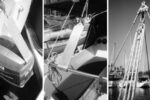
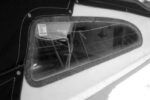
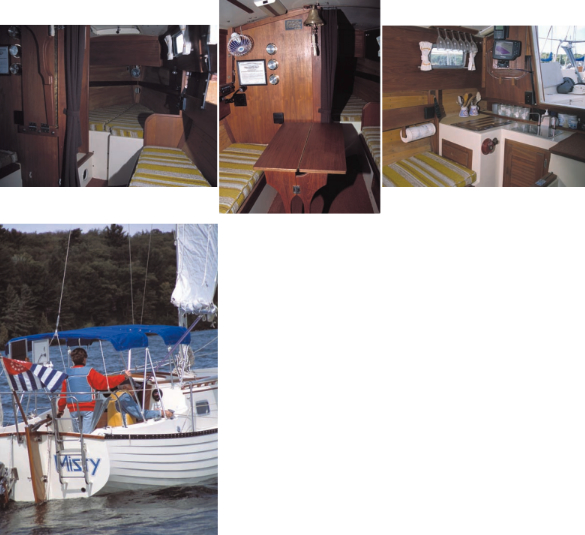
This led to the search for a Flicka or Dana and the serendipitous discovery of a forlorn yellow Montgomery 23 up to the hubcaps in mud. Since that day, Misty has been Awlgripped white to gain Sylvia’s approval. And Bob has been on a crusade against leaks, sealing the portlights with RTV and sealing every leaking bolt at the hull/deck joint with polysulfide. He’s installed two adjustable 5-watt solar panels, since Misty is pushed by a 9.9-hp Evinrude outboard. He added a second battery and, while he was at it, moved the battery switch and both batteries to the starboard side to improve the balance of the boat. He also added a steaming light, spreader lights, and lightning protection.
Beautiful teak
Woodwork is Bob’s specialty also. He says, “I like wood, especially teak, on a boat. Outside it’s a pain, but inside it’s beautiful.” Misty’s wood, both inside and outside, has been carefully restored and maintained.
In addition, he had a split Bimini built to accommodate the mainsheet; built a swing-out panel to display GPS, speed, 3-D depth, and water temperature in the cockpit; invented a television antenna mount for dockside use; modified the rudder (taking several inches off the bottom); and reinstalled the stanchions, adding a couple of inches of walking space in the process by moving them to the toerail. In addition, he beefed up the cleats and chocks on the foredeck, revised the sanitation system, added a second bilge pump, and in general spiffed Misty up until she’s better than new. She’s a gem. Still . . .
“Do you remember playing house?” Sylvia asks, recalling children’s tea parties and miniaturized toys. “We’re always trying to do things better, more cleverly limiting our personal belongings on our trips to the boat.” Misty’s ultimate fate is sealed when she adds, “I like this boat, but I wish it were a hair bigger.”
Even Bob admits — reluctantly — that this boat is much smaller than his Pearson. “It is a normal progression of thinking when moving from one boat to another,” he says. “The really hard thing is that when you want to have a trailerable and reduce the boat size from 33 feet to 23 feet, you still try to take all of the gear and features onto the smaller boat.”
Ah, well, Montgomery lovers everywhere will be standing in line when Misty goes on the market.
Thank you to Sailrite Enterprises, Inc., for providing free access to back issues of Good Old Boat through intellectual property rights. Sailrite.com