A labor of love makes a tired old 27-footer better than new
Issue 30 : May/Jun 2003
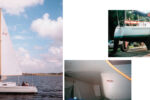
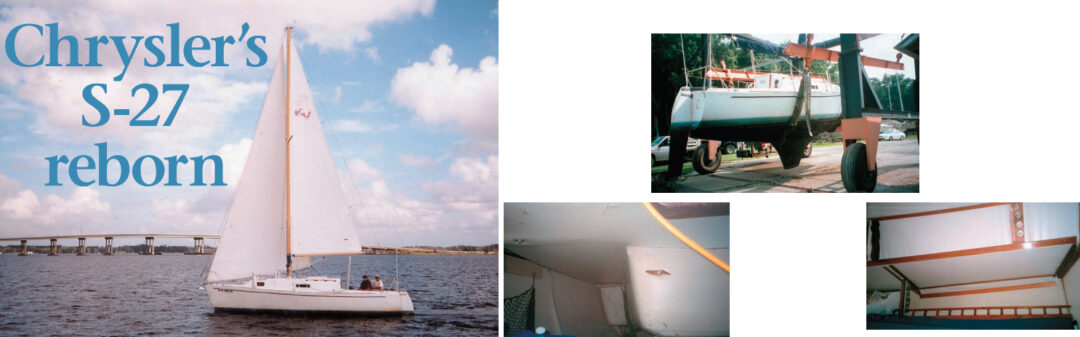
“Chrysler? Are you sure? I didn’t know Chrysler made sailboats!” The words of our friends echoed our thoughts when we bought our boat. As we delved into her history, however, we found that Chrysler did indeed build boats from 1966 to 1980. Our 27-foot sloop was built in the last year of Chrysler’s marine production.
We stumbled on our boat by accident. Because most of our interests had led us in different directions, my husband, Arnie, and I were looking for something we could enjoy together. We both like the water and since we live near the St. John’s River in north Florida, buying a boat seemed a good bet. It was the day of the Mug Race, an annual sailing event that starts in Palatka and ends in Jacksonville. We watched the sailboats as they left the docks for the starting line downriver, then strolled down the pier of a small local marina to look at the boats left behind.
One particular boat with graceful lines and a “For Sale” sign caught our eye. After brief negotiations with the owner, the boat was ours. Ignorant and innocent, we bought it without seeing the bottom or the sails! (We wouldn’t do that again, but we were lucky this time.) We knew the 7-hp Yanmar engine worked, and we liked the roomy cabin with four bunks, a small galley, and a huge head in the bow.
In appearance, the boat was a little forlorn — used but recently neglected. It appeared to be structurally sound but needed some renovating. This interested Arnie, who was looking for a project. Furthermore, the price fit our budget. We did not know for several weeks that our purchase was a treasure in disguise.
New franchise
In 1979, Chrysler Corporation introduced Chrysler Yachts, a new franchise. They contracted with Charles Morgan to obtain the design rights to his Morgan 27 and redesigned it to be comfortable for cruising and also competitive under MORC racing rules. This marriage of cruiser and racer was called the S-27 and was the proposed flagship for the franchise. She made her first appearance in Michigan at Sail Plan ’79. (This was the first of what Chrysler planned to be an annual convention bringing together the biggest names in the world of sailing.) Introduced as “The yacht for all reasons,” the new S-27 was toasted with champagne and hors d’oeuvres by an impressive array of guests.
The original specs were: LOA 27.25 feet; LWL 25.50 feet; draft 4.92 feet; beam 9.92 feet; displacement, 8,000 pounds; ballast 3,600 pounds. She was white and trimmed with teak. She was available in fixed-keel and shoal-draft, swing-keel models.
During the next year or so Chrysler built a number of sailboats of different sizes. Unfortunately, financial problems short-circuited their ambitious plans for Chrysler Yachts and an annual sailing symposium for sailing. In 1980, Chrysler Corporation applied to the federal government for loans to continue operating. As part of the federal bailout, Chrysler was required to drop the sailboat business. The last of the Chrysler S-27s were built in 1980. The total number of S-27s built is unknown, but it appears to be small. The website of the Chrysler Sailing Association lists only nine current owners of S-27s.
Special treatment
Since we have owned her, our lady has spent most of her time getting a “spa” treatment. The first step: a good cleaning from top to bottom. Next, we turned our attention to leaks. Some of the deck fittings and portlights had been improperly installed; in some cases, rotted core was the result. We removed all the leaking deck fittings and rebedded them. In addition to the leaking and rotted trim around the portlights, the Lexan was heavily scarred, reducing visibility. We decided to replace, rather than repair, them.
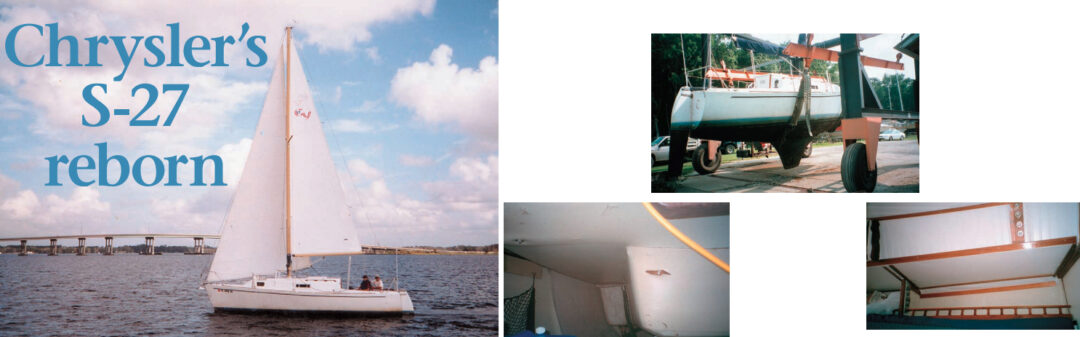
While we were at it, we removed the surrounding vinyl lining. Since the rest of the lining on the overhead in the cabin was dingy, torn, and sagging, we removed it also, leaving the bare fiberglass hull exposed. The resulting holes from the portlights were filled with 1⁄2-inch plywood, shaped and fitted to the recessed openings. We used 1⁄4-inch waxed, threaded bolts and fender washers as clamps to ensure solid glue joints. The next day, when the epoxy had set, the wax allowed us to remove the clamp system easily. The holes were filled and faired inside and out until flush with the sides. We used epoxy fairing compound and some glass on the interior for strength.
We discussed replacing the vinyl lining in the cabin but elected instead to use wood, which we thought would stay cleaner, last longer, and give the cabin a homey look. To form a base for fastening, we glued 3⁄8- by 2-inch strips to the overhead on 16-inch centers from the forward bulkhead to the companionway hatch. Thin strips of 1⁄4-inch by 2-inch tongue-in groove were presealed with epoxy and primer, then fastened fore and aft with stainless-steel 1⁄4-inch countersunk screws. To keep the lines straight, we started from the center and fit each slat individually, following the curves of the overhead. In some cases the pieces had to be spiled. It was a challenge, to say the least, but well worth it. We finished the overhead with the application of two coats of marine primer and two coats of Pettit white gloss enamel.
Port replacement
After completion of the overhead and a portion of the sides, we turned to the replacement of the ports. We wanted to keep the sleek racing lines of the design, but at the same time allow better ventilation and air circulation in the cabin. We selected 6-inch by 24-inch Beckson Rain Drain opening ports. Using the outside trim piece, we traced a pattern and cut out the wood recently placed on the cabin sides. The holes were cut about 1⁄4-inch wider than the ports in order to seal with epoxy and fiberglass cloth.
The new ports were installed from inside out with stainless-steel screws and caulked. We gave the remaining unfinished interior sides the same wood treatment as the overhead, except the boards were placed vertically and cut to length to correspond with the hull shape. The white wood overhead and sides were then trimmed with varnished mahogany.
With an eye toward the possibility of spending long periods of time aboard, we turned our attention next to refurbishing the cabin interior without changing the basic layout. We upgraded the electrical wiring for additional lighting and instruments. We rebuilt the galley sink and stove area, adding teak drawers for more storage. The sink was replumbed and fitted with a new hand-pump faucet. We recovered the various cushions, and we made curtains. We left the large forward head as it was with hanging storage, shower seat, Porta Potti, and an additional sink.
Deck repairs and replacements were ongoing. We replaced the original mainsail, which was blown out and patched, with a custom-made sail complete with the CY insignia. Arnie found a new talent for sewing when he successfully completed a new sailbag for the genoa. When we found an inexpensive source for Sunbrella, he was enthusiastic about creating a new mainsail cover. He entered a new world of zigzagging, nylon thread, and cutting with a hot knife. For a pattern, he used an old sail cover and guidance from The Complete Canvasworker’s Guide by Sailrite’s Jim Grant.

Removed hardware
Repairing the leaks required removing some of the deck hardware. While we were at it, we relocated some of the tracks. We decided to replace some of the worn running rigging as our budget allowed. In repainting the boat, we kept the white hull, but used a sand-colored contrast on the non-skid areas. Our main extravagance was an autopilot.
Since Arnie enjoys working with wood and is pleased at his newfound talent for cabinetry and sewing, most of the work on the boat has been a labor of love. He did get frustrated by the difficulty of obtaining good-quality materials and accurate tools, parts, and supplies. Because we live in a rural area, we had to travel or use mail order to get materials. We experienced a number of delivery delays, back-order holdups, and erroneous substitutions for what was ordered. Arnie also realized that the curving lines of our boat were more challenging than he’d expected when compared with the straight lines of housing construction.
I love the spacious cabin and have never felt closed in. The open ports make a big difference in ventilation. The galley is efficient and makes it easy to prepare meals. The two main bunks are comfortable, but we may indulge in better mattresses soon. The head is roomy, and friends envy us our large shower area.
To date, we have taken only short trips on the river. We have found our S-27 to be very responsive although with a bit of a weather helm. She moves easily and handles well in the gusty and unpredictable winds of a winding river. She also sails in the lightest of winds in spite of her 8,000- pound displacement. She can handle a larger-than-normal sail area for her size, but we generally use a Number 2 genoa. With a five-foot draft and fixed keel, she is extremely stable, a comforting thought for novice sailors.
On a rare day we have achieved five to six knots on a half-mile tack — unusual for river sailing. While we had a skimpy history from the previous owner, he did say she had been sailed offshore. We did not doubt it when we found well-used charts for Bermuda and the Bahamas.
Bright future
The future looks bright for our fair lady and us. I retired from my practice as a mental health counselor last fall. That frees us to explore the Intracoastal Waterway and some of the islands of the East Coast. We hope to start in Georgia and go up to the Carolinas. Our long-term dream is to visit Canada’s Maritime Provinces and explore the areas off Maine, which were the stomping grounds of Arnie’s ancestors.
Three Mug Races have come and gone since we bought our boat and the fourth will occur in May 2003, as you are reading this issue. We would like to see how she does in that race. Sometimes it seems as if she is tugging at the lines to go. While we’re a bit intimidated by the thought of racing, we may convince others to crew for us and give her the test.
And what, you may be wondering, is our lady’s name? We christened her Lotsaknots. A lady her age certainly has a lot of knots behind her. We are confident she also has even more knots left, and we hope to enjoy them for many more years. When Chrysler and Morgan set out to unite the best of racers with cruisers, they did an excellent job. We revel in the renewed cabin and delight in the boat’s grace and easy movement. It’s been a pleasure to see her bloom with our improvements, and we’re looking forward to different ports, steady winds, and all the other joys of sailing and cruising in our rare, classic “yacht for all reasons.”
Thank you to Sailrite Enterprises, Inc., for providing free access to back issues of Good Old Boat through intellectual property rights. Sailrite.com