Taking a look at a 32-footer and a 36-footer from the same stable
Issue 35 : Mar/Apr 2004
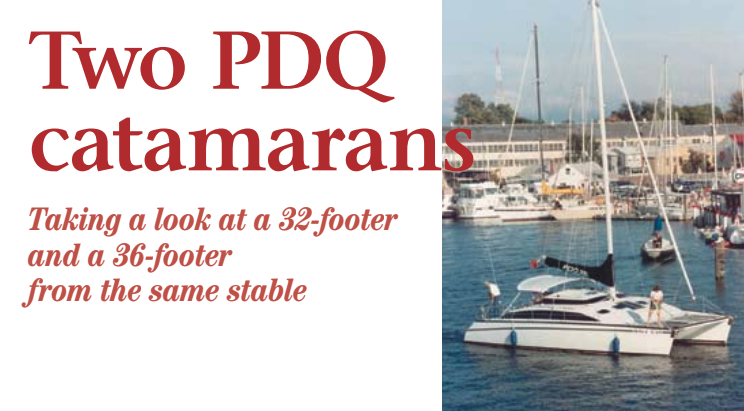
PDQ stands for Pretty Darned Quick. And that’s what PDQ catamaran yachts were designed to be. The Canadian boat-builder’s first real production cruising boat was the PDQ 34, but that was modified in 1991 with a two-foot stern extension to become the PDQ 36, one of the two models we’re taking a look at here. It became known as the PDQ Cappella or Classic.
The other model is the PDQ 32, which was introduced two years later with many advances in layout. It soon became the Mark II and finally the Altair.
The pedigree of both boats stretches back to 1987, when three extraordinary men got together to build the first PDQ yacht. Allan Slater, enthusiast and leader of the Canadian Multihull Association, was chief engineer and steadfast believer in catamarans; Harvey Griggs, an MIT graduate in structural engineering, commissioned the first yacht; and Simon Slater, Allan’s son, created the deck design and was the brawn behind the construction. In 1988, PDQ was born and has been going strong ever since.
Before we get into the specifics of each boat, let’s examine some general characteristics they share. Both the boats under review come in two versions, the classic (with twin 9.9-hp outboard motors) and the long-range cruiser (LRC) with twin diesel engines.
Rigging
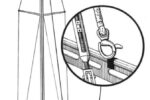
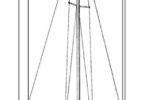
The 32 had a masthead rig up to hull #27, which was made in 1997. After that the 32 has had a 7⁄8ths fractional rig. Both variations have single-spreader diamond shrouds for mast stiffness and a pair of uppers led far enough aft to eliminate the need for a backstay. Because of the wide sheeting base of the cat, the upper shrouds don’t need spreaders, and because their aft lead eliminates the backstay, the full-battened main can support a modest roach and still tack sweetly, swinging through the space normally blocked by the backstay. These are rigging characteristics that the wide stance of the multihull make possible.
The 36 has also had two rigging designs. Earlier boats, up to hull #85, made in 2002, had a masthead rig with a headstay, two cap shrouds, and two backstays, all at the top of the mast. The backstays were brought to the deck about four feet abaft the mast. Intermediate mast support came from two lowers and a baby stay. Newer boats get mid-mast support from double diamond shrouds, eliminating the baby stay and two lowers of the earlier design. As with the 32, the elimination of the single aft backstay commonly found on monohulls allows full battens to support a larger roach.
Both models have adequate clearance under the center console to avoid the slap, bang, crash, and pound of water hitting the bridge deck, and both have narrow sterns that leave little wake.
Wake is drag, and drag is wasted energy. But while slim sterns avoid this penalty and afford better speed, they create another problem: a significant loss of carrying capacity. Hulls with fine ends and a hull-to-beam ratio of 12:1 or better have little reserve buoyancy. You must monitor carefully the weight of everything you bring aboard. And that includes diesel engines.
In my opinion the use of two diesel engines and sail drives in PDQ’s long-range models is an inappropriate use of technology. Simply put, two 9.9-hp Yamaha outboards weigh 210 pounds total, including drives, props, and so on. They are ideally positioned at almost the exact center of fore and aft rotation and thus are not subject to the problems of stern-mounted outboards. They are also outside the boat. They can be maintained through cockpit lockers.
On the other hand, two diesels, with sail drives and their related gear, weigh in at about 700 pounds. They are installed under the bunks toward the stern, thus changing the boat’s balance and taking valuable space. Thus, 500 pounds of carrying capacity is lost. In a boat designed to be a long-range cruiser, that is a lot of provisions to forfeit.
Worse, the two largest storage lockers under the rear bunks are now taken up with engines and engine-handling equipment such as through-hulls, mufflers, strainers, and so on, making those lockers, normally used for lightweight items like bedding or clothing, unavailable. Then, of course, there is the ritual of tearing apart one’s bed to check or change the oil.
Special Yamahas
The choice of diesel engines is even more contentious when you realize that Yamaha came out with a new outboard in the 1980s, a 9.9-hp, four-stroke, extra-long-shaft, big-prop, geared-down muscle machine called the Jack of One Trade.
This engine was purposefully designed to be an auxiliary for sailboats. PDQ, Sea Wind, Condor, and other manufacturers saw the inherent virtue of these ultra-quiet, powerful, fuel-miserly engines and immediately incorporated them into their vessels: thus the PDQ Classic.
The PDQ answer to the question of how to handle these outboards efficiently, without drowning, cavitation, or ventilating is a design innovation close to genius. Two central cockpit lockers hold the engines. The engines pivot at the fore and aft rotational center of the boat, thus eliminating ventilation and cavitation.
Outboard motors also have their downsides, of course, but most are mitigated by low weight, low cost, easy repair or replacement, and best of all, complete withdrawal from the water, thus dramatically reducing drag while sailing and corrosion while moored.
Sailing and handling
The PDQ 36 has skeg-hung rudders and low-aspect-ratio keels. This is excellent for protecting the bottom and keeping various lines and assorted trash from jamming the rudders. My experience with the boat is that it sails well, tacks securely, usually within 90 degrees, and goes to windward reasonably well. It is a swift boat, living up to its PDQ name.
However, because of its emphasis on performance, it comes up short on room and weight-carrying capacity for modern conveniences. I recently surveyed a PDQ 36 long-range cruiser which had every possible amenity and convenience installed.
The AC and extra refrigeration/freezer units used up all available space under the dinette seats, the engines took all the space under the bunks, and various other accessories took all the nooks and crannies to the extent that there was not a locker anywhere large enough to stow a case or two of beverage.
The PDQ 32 has spade rudders and low-aspect-ratio keels, but is deeper than the PDQ 36 by 6 inches. It, too, has good sailing and handling characteristics. It should be considered a “big 32,” whereas the 36 should be considered a “small 36” when compared with other catamarans.
Construction
Both vessels are constructed of vacuum-bagged foam core to the waterline, using hand-laid knit FRP and Core-Cell foam. Keels are sacrificial, rudders are foam/FRP sandwiches with stainless-steel rudder stocks and webs. Masts are made of extruded aluminum. Bottom blistering has not been a problem in the vessels I have surveyed.
Crawling around the innards of these vessels, the surveyor usually finds that there is little or no sloppy construction, no loose FRP ends to cut unwary fingers or any construction debris remaining in the farthest corners of the bilges. Bulkhead joints all look well tabbed according to the best industry standards.
It is tough to find any shortcuts taken. Decks feel solid underfoot, portlights and hatches are installed properly, and one gets a sense of painstakingly meticulous workmanship. The hull-deck joint is well done, glassing over the joint to make the structure a true monocoque.

Layout of the PDQ 36
As you’ll see from the accompanying artist’s cutaway view, the 36 has many characteristics that are important for a true cruising boat, especially for long passages. First is the helm layout, which is in the cockpit in close proximity to the deck activity. The person at the helm can easily see all four corners of the boat, which is a confidence-builder when maneuvering in close places.
A unique feature is the rear cabin with twin bunks, upper and lower. Families love it. The two mirror-image cabins forward of the bridge deck, close to the rotational center of the vessel, assure the best night’s sleep possible in a rough anchorage. They are full-size staterooms.
The galley, down on the port side, has more counter space than many shoreside condos. It has a double sink, a full-sized LPG range with an oven, and an eye-level, front-opening refrigerator. The earlier models had LPG refrigerators, which worked very well, and most people love them. As the models progressed, they eventually switched to 12-volt DC Danfoss-style units that are so efficient they can be powered exclusively by solar panels (certain geographic areas excluded).
The LPG models were cleverly installed in the forward sail-locker bulkhead, so all the working parts were outside the living area, thus protecting occupants from the highly overrated dangers of these units. Some other models with separate compressors took up too much locker space, and some were placed in insufficiently vented lockers, something to watch for when considering a purchase.
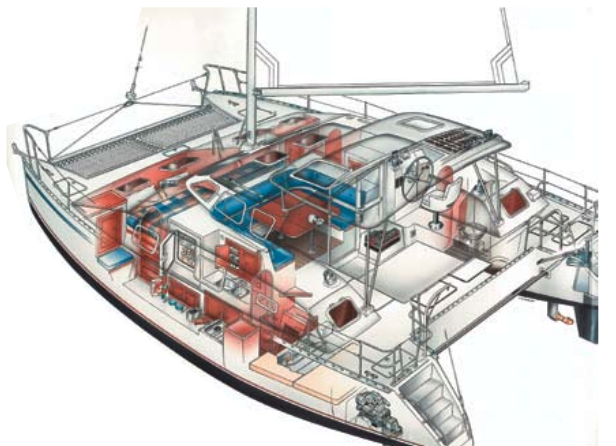
The head is really a full-sized bathroom with a full-sized stall shower, glass door and all. It is in the aft section of the starboard hull, thus not creating any traffic through the galley or navigation area, a prudent location. The holding tank is aft of the head, behind a watertight bulkhead and outside the living quarters, also a prudent location.
The navigation section is amidships on the starboard side. All the control panels are there and within easy reach of the owner’s cabin just forward of it.
All three cabins have adequate hanging lockers and storage space.
On deck
Winches are placed so they are easily operated without interference from stanchions or supports. Deck hardware is nicely installed for leading lines to winches conveniently and at good angles. Some models have all the sheets, halyards, and reefing lines led to the cockpit, although I feel this is of dubious value. Raising and lowering sails and trimming them under sail are all easily accomplished. The standard masthead main goes up easily, and it is doubtful that anyone would want to install an electric winch for it.
Ground tackle is handled only from the two bows. There is no central bow roller on the crossbeam. For those who require a windlass, there is plenty of room in the anchor locker for proper chain fall. Anchoring with a single anchor from one bow is a tried and true method and works well under most conditions. In adverse conditions, when more than one anchor is required, many people simply launch an anchor from each bow. English cats have been doing that for decades. My recommendation is to use modern lightweight anchors and nylon rodes.
Standard hard top
Newer models of the PDQ 36 have the hard top as standard. Some of the earlier models have retrofitted the hard top.
The PDQ 36 deck is not the easiest to negotiate. Sidedecks are smallish, and getting past the forward end of the cabin is difficult in poor conditions. The main deck is a full turtleback configuration and not easy to negotiate.
Forward crossbeams originally were made of FRP and fully molded into the deck mold, giving a split trampoline with a center support. Later models did away with that and used an aluminum spar section as crossbeam but still kept the trampoline in two pieces using the center joint as the tensioning point, a clever idea. Potential purchasers take note: trampolines are a high-maintenance item. Inspect them and their lashings very carefully.

Layout of the PDQ 32
This boat is a center-cockpit vessel. The twin aft staterooms are exceptionally spacious for a boat of this size. Between the staterooms is a locker containing the fuel tank and a manual bilge pump with a selector valve, a very clever arrangement providing easy access to vital gear and additional privacy between cabins. There is also a full-length lazarette in the stern. The center-cockpit configuration makes the cockpit a bit cozier.
From the central saloon, to the right and forward are the navigation station and the head. The galley is down to the left and forward. The galley of the PDQ 32 has many of the features that its larger sister has, but on a reduced scale. Going aft on either side brings you to a stateroom. Both staterooms have large hanging lockers and athwartship double-size beds.
Decks show some similar features, but one really nice extra on the 32 is the bench seat across the cabintop.
Construction of the 32 differs in some interesting ways. Many sections of the installed furniture on the 32 can be easily removed for repair, inspection, or replacement. The hard-top is standard. Standing headroom is gained in the saloon by sliding the large main hatch back into its sea hood.
When surveying these boats, I have not found any structural or user problems.
I would trust either of these two boats for almost any cruising situation. The PDQ 36 is probably the smallest catamaran I would consider for something like an Atlantic crossing, mainly based on carrying capacity. On the other hand, it is about the largest catamaran you can own before you begin to get wide-beam penalties. With an 18-foot beam, you seldom if ever will be denied a marina berth or a haulout in a travel lift. Wider than that, your options drop quickly.
Price history
PDQ prices have held up better than certain competitors. Recent searches for boats 10 years old or better show selling prices of $119,000 to $137,000 for the long-range version of the PDQ The PDQ 36 price runs from a low of $129,000 to a high of $159,000.
Thank you to Sailrite Enterprises, Inc., for providing free access to back issues of Good Old Boat through intellectual property rights. Sailrite.com