An annual physical keeps the auxiliary running fit and well
Issue 35 : Mar/Apr 2004
Since the main powerplant on a sailboat is its sails, the engine on a sailboat is correctly described when it is referred to as an auxiliary. When compared to a powerboat of similar size, a sailboat has a very small engine.
Just as the in-the-water sailor has slip rent and crane fees, the freedom and versatility enjoyed by the trailersailor has its price: the trailer and, to a much greater extent, the infamous two-cycle outboard motor.
Most engine-equipped trailerable sailboats, those up to about 28 feet, rely on outboard motors as their auxiliaries. However, not just any outboard motor will do. Most standard outboards are designed for the highspeed operation required by powerboats. (We sailors know this all too well.) Outboards specifically designed for sailboat applications have slower turning, high-torque propellers. Also, they often have longer shafts that enable them to reach the proper water depth. When correctly matched to the sailboat, an outboard can easily move a displacement sailboat at hull speed.
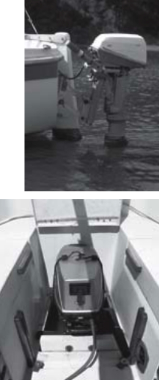
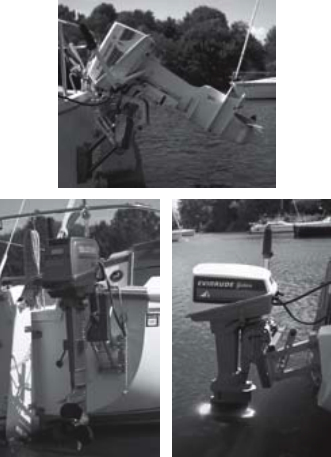
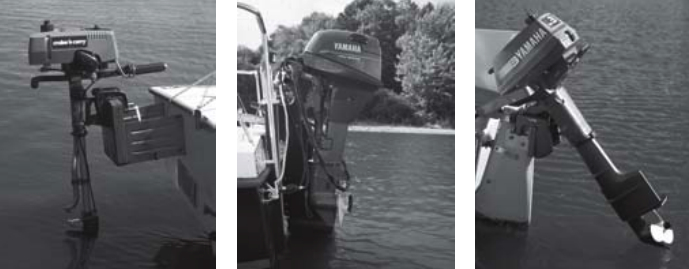
Outboard motors are mounted on sailboats in one of two fashions: in a motor well or on the transom, either fastened on directly or with the aid of an adjustable bracket. Transom-mounted outboards are the most common. They offer the advantage of being able to be tilted out of the way, thus eliminating prop drag when under sail. As on a typical powerboat, they can be easily steered. Also, since they are totally exposed, access for repairs and maintenance is excellent.
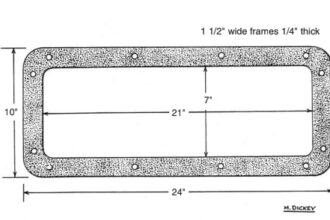
Outboards mounted in wells are less common but give a sailboat a better overall appearance than transom-mounted units. Since they are in a fixed position, their lower portions are ready to apply power at any time. However, this creates drag when under sail. One common problem associated with outboards mounted in wells is their tendency to become starved for air while under load. In some instances, the motor will choke on its own exhaust.
Today’s outboard motors are much more reliable than their predecessors of even a few years ago. Computerized ignitions, oil injection and, of course, the crème de la crème four-cycle outboards have eclipsed the earlier two-cycle outboards, which seemed to work on the “internal destruction principle.” However, even advances in technology cannot overcome the problems associated with typical sailboat auxiliary operation, namely infrequent use and slow-speed use. Here are a few things that you can do to minimize these problems.
Size it right
Outboards are designed to operate best at about three-quarter throttle or more. Therefore, it is important to size the outboard so that the sailboat can achieve hull speed at three-quarter throttle. The tendency to use too much horsepower is common. Bigger is not better. Over-horsepowering often results in the sailboat reaching hull speed at half throttle. Operating for extended periods at half throttle or less invites spark-plug fouling. Leaning out the air-fuel mixture may help, but some degree of fouling is inevitable, and this tinkering with the ratio can adversely affect engine temperature as well as high- and/or low-speed operation.
Quality fuel
The fuel of a two-cycle outboard also serves the function of lubrication. This is accomplished by mixing two-cycle oil with gasoline, either directly in the fuel tank in a fairly precise ratio or by means of an oil-injection system. In operation, the fuel-oil mixture enters the carburetor and is mixed with air. From here it is drawn into the crank-case, where some of the oily mist settles out, lubricating the crankshaft and connecting rods. The rest of the mixture enters the combustion chamber to lubricate the piston, rings, and cylinder wall. The fuel-oil-air mixture is then burned during the combustion process.
Using less than the specified amount of two-cycle oil can result in poor lubrication and excessive engine wear. Using too much two-cycle oil causes spark plug fouling, excessive smoking, and erratic carburetion. Most two-cycle outboard motors utilize a 50:1 fuel-oil mixture (16 ounces of two-cycle oil to 6 gallons of gasoline). However there are many exceptions, so follow the engine manufacturer’s mixing instructions to obtain the recommended fuel-oil mixture.
In addition to a proper fuel-oil ratio, fuel quality is another key factor. Even the smallest particle of dirt can result in carburetor problems. Cleanliness is of prime importance. Always use fresh gasoline. Gasoline that has been stored for more than 60 days, even under ideal conditions, begins to form gum and varnish. This sour fuel can form restrictive deposits and can also be a source of spark-plug fouling.
Annual maintenance
Routine annual maintenance is another means by which to increase dependability, maintain good performance, and extend the life of the outboard. Problems are more apt to develop during the off-season. A few simple steps can help avoid this likelihood. Precise maintenance steps are usually detailed in the owner’s manual. While some maintenance procedures for a particular make of outboard motor may be different, the following is a standard routine for preparing the average two-cycle outboard motor for the offseason.
- Assemble 1 gallon of gasoline/two-cycle oil mixture, 1 ounce of fuel conditioner/stabilizer, and 4 ounces of fogging oil.
- Start the outboard (operate the motor while in the water), and allow it to warm up and circulate the stabilized fuel throughout the engine.
- Stop the motor after approximately five minutes of running time.
- Remove the spark plugs and discard them or set them aside if they are to be reused.
- Spray a liberal amount of fogging oil into each cylinder via the spark-plug holes.
- Rotate the flywheel clockwise several rotations. This distributes the fogging oil throughout the cylinder.
- Remove the motor from the water, keep it vertical, and rotate the flywheel clockwise several more rotations. This will drain the water from the water pump. If the outboard motor is used in salt water, this is the time to flush it with fresh water. Also wash the exterior of the motor with fresh water.
- Clean and regap or replace the spark plugs.
- Drain the fuel from the tank.
- Drain and refill the lower unit with gear oil.
- Lubricate the following with marine-grade grease: the tilt-lock mechanism; the throttle-to-shaft gears; the carburetor linkage; the magneto linkage; the swivel bracket; and the motor cover latch.
- Remove and check the condition of the propeller. Clean and lubricate the propeller shaft. Reinstall the propeller using a new cotter pin.
- Clean all external surfaces with an all-purpose marine cleaner. Allow the engine to dry thoroughly.
- Paint over any nicks and scratches. Do not paint over sacrificial anodes.
- Inspect sacrificial anodes; replace any that are less than two-thirds their original size.
- Apply a good-quality marine polish.
- Store the outboard in an upright position, in a dry, well-ventilated area.
The major consideration in preparing an outboard motor for storage is twofold: to protect it from corrosion and to have it ready for next season’s operation.
Troubleshooting
Proper fuel, lubrication, and maintenance will reduce the need for trouble-shooting. However, even with the best of care, a two-cycle outboard motor is prone to problems and will eventually require troubleshooting. The following section lists some typical starting, fuel, and ignition system problems along with probable causes and solutions.
Engine won’t start
Fuel system troubleshooting should start at the fuel tank and work through the system, reserving the carburetor as the final point.
- Fuel tank is empty.
- Fuel tank vent is closed/clogged.
- Fuel line fittings not properly connected to the tank and/or engine.
- Engine not primed.
- Engine flooded (look for fuel overflow).
- Clogged fuel filter or fuel line.
- Spark plug wires disconnected or reversed.
- Spark plug gap too wide.
Loss of power
Don’t automatically assume that the carburetor is at fault when the outboard does not run properly. While fuel system problems are not uncommon, carburetor adjustment is seldom the answer. Unnecessary carburetor adjustments will only compound the problem.
Here are some other possible causes:
- Too much oil in the fuel mix.
- Fuel hose kinked.
- Slight blockage in the fuel line or fuel filter.
- Fouled propeller.
- Fuel/air mix too rich.
Starter motor won’t work
If the outboard motor is equipped with electric start, keep in mind that the electrical system is the weakest link in the operational chain.
More problems result from electrical malfunction than from any other source.
- Gear shift not in neutral.
- Defective starter switch.
- Battery low or dead.
- Battery connections loose or dirty.
Motor misfires
If misfiring occurs only while under heavy load, as when accelerating, it is usually the result of a defective spark plug. Operate the engine at night to check for spark leaks along the plug wires.
- Spark plug damaged.
- Spark plug loose.
- Plug wires broken.
- Spark plug incorrect.
- Poor quality fuel.
- Fuel/air mixture too lean (outboard backfires).
While some repairs may require a trained mechanic, it’s surprising how often a little knowledgeable investigating will uncover the nature of the problem and get the outboard motor quickly back into operation.
Even though today’s outboard motors are much more reliable than their predecessors, nothing can substitute for using quality fuel and performing timely maintenance. Only then will you have the assurance that the auxiliary will be ready to perform when needed.
Thank you to Sailrite Enterprises, Inc., for providing free access to back issues of Good Old Boat through intellectual property rights. Sailrite.com