A woman singlehander loses her heart to that old lump of iron down below
Issue 36 : May/Jun 2004
Most sailors don’t miss the motor after they part with their first auxiliary-powered sailboat. But it’s been seven years since I bid farewell to my 23-foot homebuilt woodie, and I still wish I’d kept her engine.
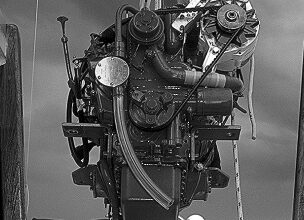
It was a solid, all-American, 300-pound chunk of iron that took form in a heartland foundry perhaps a decade before my own 1951 birth. It bore its identity and origin “Universal Motor Co., Oshkosh, Wis.” proudly on the casting that covered the top of its hefty toothed flywheel. I still miss the friendly cheerful putter of its two cylinders and the musical burble of its galvanized waterpipe exhaust.
That old Blue Jacket Twin (model AFTL) taught me a thing or two, including the values of patience, persistence, and humility (some of us need constant reinforcement on those life lessons). It also gave me a glimpse into the fascinating world of the shadetree mechanic, a self-educated race of hardy tinkerers whose ingenuity, creativity, and problem-solving abilities have not been given nearly the credit they deserve in the making of America back when technology was analog.
When I first acquired Ariel, a 23-foot William Crosby-designed Osprey knockabout, I viewed her near-antique engine with irritation, mistrust, and occasional loathing. I didn’t understand the old cuss, and I didn’t like depending on it. But unlike my previous cruiser, a 19-foot Lightning, Ariel was far too heavy to paddle. Like it or not, old iron and I were in a situation of mutual need. It needed me to keep the boat afloat (not always a simple task with a 40-year-old woodie). I needed it to keep us from bumping into rocks, docks, boats, and other hazards of confi ned water.
Shook their heads
I longed for a nice new diesel for my cruiser. Other knowing sailors shook their heads over the idea of a gasoline inboard, advising me, “You oughta have a diesel — it’s much safer.” I agreed wholeheartedly, but since a new diesel would have cost almost twice what I had paid for the boat, her trailer, and a three-quarter-ton pickup to tow her home each winter, it seemed unlikely that I would acquire one.
So I began a slow and painful acquisition of knowledge about Blue Jacket Twins. One thing I learned was: don’t sit on the fl oat while performing surgery on the carburetor. It will tend to bend, and the carburetor won’t work worth a shuck when reassembled. I also learned there are two kinds of spark plug wires, and Blue Jacket Twins don’t like one kind.
I had noticed cracked insulation on the old wires, so I thought the motor might appreciate a nice new set. I stopped at the neighborhood autoparts store and bought the smallest kit possible — enough to equip at least four Blue Jacket Twins — and went about installing the wires. The job went along smoothly. Luckily I had only two wires to keep track of between the distributor and the plugs. But when I pushed the starter button, the motor was hard to start, and when it finally ran the ungrateful thing sounded terrible. “What can this mean?” I asked. “Bad fuel again?”
As I was peering at my motor in disgust and frustration, one of the neighborhood kids stopped by to see what was up around the harbor that day. He offered his own diagnostic suggestions. I figured his 12-year-old knowledge was at least as good as mine. We decided to see if a plug had fouled, and I got out my trusty wrench and attacked No. 1. Somehow in the ensuing skirmish with the plug, I lost the nut that held the wire onto its top. Down the hole. The ensuing torrent of unladylike language convinced young Danny that it was time to leave. I slammed the lid back on the engine box and left in a rage before I lost it totally and broke a toe kicking the dratted old thing.
Retrieved spark-plug nut
After consultation with a master mechanic the next day, I returned, removed the cylinder head, and retrieved the spark-plug nut from the top of the piston. I put everything back together and put two new sparkplug wires on, ones with copper stranding, not carbon cores this time. The motor was its happy old self again.
The rest of the summer, things settled down, and I began to expect that when I pushed the starter the engine would start. Mostly it did, and on one occasion when the starter Bendix gear jammed, it started on the first pull of the handy crank I had found in the bilge some time before. I still had diesel envy though, even as we settled into a wary truce. Then the Twin won me over.
My little cruiser and I were on our way home across Lake Ontario after spending a restless windy night in a cove with rather bad holding near Kingston. I, like many a singlehander in a similar situation before me, was short on sleep and anxious to get home as we set out with a brisk west wind and 5-foot waves. At first we romped along. But as the day went on, the waves and wind went down. By late afternoon we were rolling in a 3-foot oily swell 10 miles off Oswego under a hot July sun with the boom slamming and the sail slatting. I reached for the starter, and the old engine came to life. She chuggity clicked along for about an hour, then stuttered and died with an apologetic wheeze. Hmmm. I ran through my repertoire of mechanical diagnostics, a process that took about two seconds. One was check the gas. I found a half-inch of wetness on the end of the dipstick. Out of fuel.
Dead tired, I gazed wearily at the twin stacks of the big oil-fired power plant next to the harbor with longing and despair as Ariel wallowed and flopped and floundered under full sail. She made about 3 knots up and down for every quarter of a knot forward. At this rate we’d be a week getting there.
An old tractor
During my extensive diagnostic process I had removed the lid of the engine box. I gazed down at the now familiar square chunk of cast iron with its two spark plugs, the well-known Zenith carburetor I’d dissected more times than I cared to recall, and the flywheel guard with its made-in-Wisconsin stamp. I thought idly about the old tractor we had once that was also from Wisconsin. It wore a decal on the engine block that said something like, “Start on gasoline only.” At that time, the model C Case, a contemporary of the Blue Jacket Twin, operated on kerosene fuel. “Hey!” I thought. “Maybe this thing will run on kerosene too.”
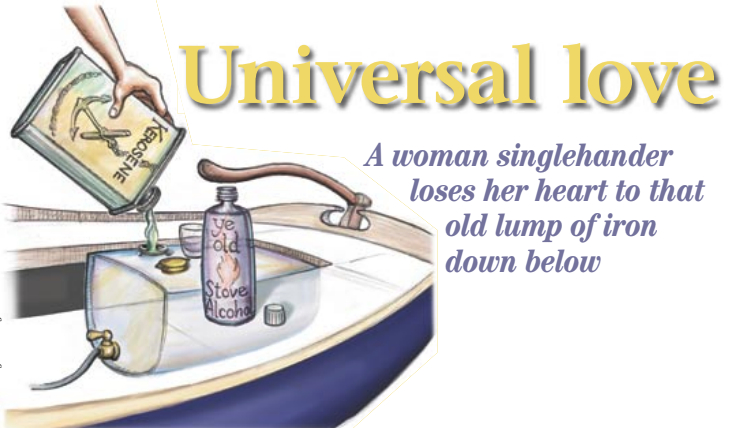
I hauled out my gallon of anchor-light fuel and dumped it into the tank. Then I decided to boost the octane a bit to make it perhaps more palatable to the motor and added a generous dollop of stove alcohol. The still-warm Twin fired up immediately and cheerfully chugged us into the fuel dock, never missing a beat. I filled up with regular and chugged on home, reaching the dock in the wee hours of the morning.
I tumbled into the bunk, a Twin convert. I had begun to realize that many of my engine problems had originated from the lengthy layup of the boat before I bought her and from my own ineptitude and inexperience. The Twin was actually a simple, rugged, and reliable little engine, given half a chance.
Ariel and I sailed for 17 years, and whenever I really needed that little engine, it was always ready to help. I thought more than once of putting it in the front yard, painting it bronze, and attaching a plaque to it reading, “Faithful friend.” These days I’m shipmates with a newer, slightly larger, and considerably smoother-running Universal, a 1968 Atomic 4. So far she seems to have a lot of the same sturdy character of that tough little Twin. I hope she lasts as long.
Thank you to Sailrite Enterprises, Inc., for providing free access to back issues of Good Old Boat through intellectual property rights. Sailrite.com