Eight ways to steer a boat
Issue 36 : May/Jun 2004
When it comes to steering a sailboat, even die-hard wheel enthusiasts agree there is no steering system that is simpler, more affordable, or offers better “rudder feel” than the tiller. Wheel systems, on the other hand, provide power equal to or exceeding that of a tiller and usually take up less cockpit space. Loads imposed on all steering systems can be extreme, and fittings and fastenings should be commensurate.
Wheels can be mounted on bulkheads, consoles, or pedestals. Pedestals merely contain the sprocket, roller chain, and cables and lead them belowdecks. Pedestals are manufactured from non-magnetic materials — such as bronze, aluminum, stainless steel, brass, or fiberglass — and are frequently topped with a binnacle. Engine controls are also often mounted on the pedestal, along with a wheel brake. A brake on any wheel-steering system is a must, since it enables the person at the helm to leave for a short time to tend sail. An A-frame pedestal, instead of a vertical steering column, offers benefits in that the steering cables can be led directly down the legs, sometimes eliminating a set of sheaves and their associated friction.
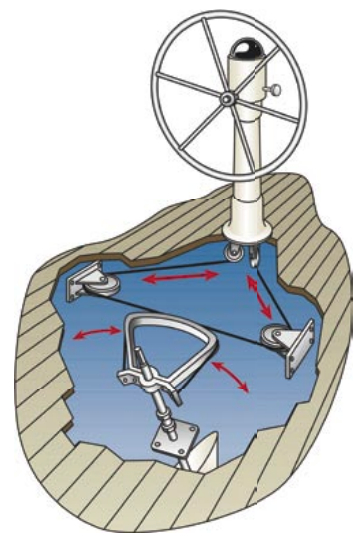
There are several basic types of wheel-steering systems, the most common being the cable-and-sheave. This system employs a quadrant on the steering shaft that is rotated by 7 x 19 stainless-steel cables — type 305 being preferred because it is non-magnetic. These cables are led from the rudder quadrant through sheaves to the wheel location, where they are fastened to a non-magnetic roller chain that is driven by a sprocket on the wheel shaft.
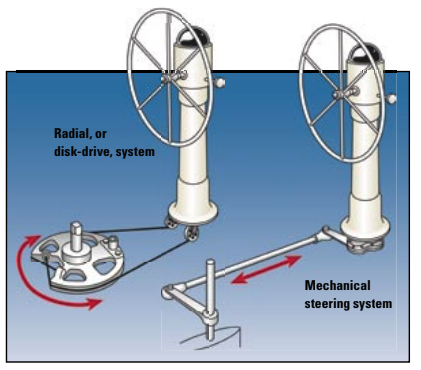
The radial, or disk-drive, system, is a modified version of the cable-and-sheave system. The difference is that instead of a quadrant, the rudder-shaft fitting is actually circular, or disk-like. In boats whose configuration allows it, this can often eliminate one pair of sheaves, which, in turn, increases “feel” because of decreased friction.
The so-called mechanical steering system uses a rod that goes from the base of the steering position to a strut on the steering shaft. This system has excellent feel with precise rudder control and is easily adaptable to accessories such as a second steering station, windvane, or autopilot.
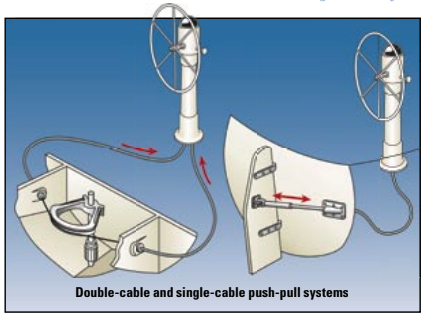
Push-pull steering is available in two configurations: double-cable or single-cable. In the double-cable system, two 7 x 19 cables, contained in a flexible conduit, lead from the steering position to a quadrant on the steering shaft. In this steering system, the wheel can be placed nearly anywhere, and the cables can be snaked around obstructions between the steering station and the rudder. This makes it particularly practical in center-cockpit boats. The relatively high friction in this system, due to bends in the push-pull cable, limits feel and response, however. The single-cable push-pull system is common on powerboats with large outboards as well as on some sailboats. With this system, a single push-pull cable drives the rudder directly. This system requires a wide transom and is not easily adaptable to double-enders.
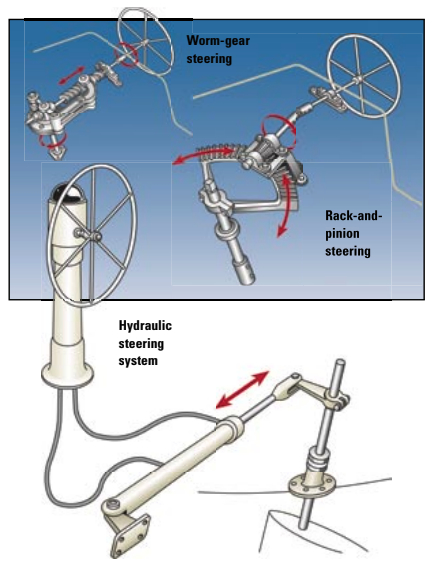
Worm-gear steering provides little feel and is usually used on long-keeled cruising sailboats with heavy rudders, where a large number of turns from stop to stop and feedback from the rudder are not of prime importance. The system is fastened directly to the top of the rudder post. It is extremely reliable, with little to go wrong, and lasts almost forever with just an occasional greasing.
Rack-and-pinion, the automotive steering system, provides the person at the helm with absolute feel — in fact every wave hitting the rudder will be transmitted to the person steering. This system is also best suited to long-keel cruising sailboats.
Hydraulic steering systems offer immediate rudder movement without the slack that is inherent in cable systems and, when properly matched to the boat, provide sensitivity and feel. When the wheel is turned, a hydraulic pump activates a piston in a hydraulic cylinder. The thrust of this piston is then transferred to the rudder through a short arm on the rudder shaft. With hydraulic systems the wheel can be mounted anywhere and more than one steering position can be used on the same system.
No matter what the steering system, provision has to be made for emergency steering if the system becomes disabled (see “Emergency tillers” on Page 26). Since backup systems are usually not provided by manufacturers, it’s up to the responsible skipper to develop his own practical emergency steering system — and to try it out before the dreaded day comes when it has to be used.
Thank you to Sailrite Enterprises, Inc., for providing free access to back issues of Good Old Boat through intellectual property rights. Sailrite.com