Finer dining afloat calls for special table design
Issue 36 : May/Jun 2004
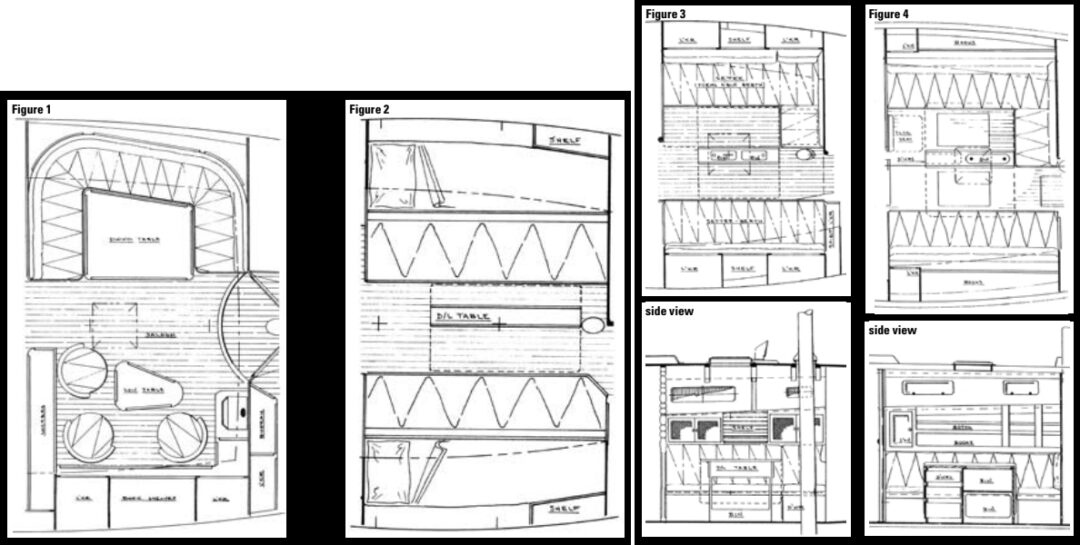
Only the very largest yachts actually have a separate dining room. I’ve been on more than one that did, complete with linens on the table, sterling-silver cutlery, and fine china. It’s all very comfortable and convenient if your checkbook stretches that far. Some larger yachts, in the 48- to 50-foot range and over, are beamy enough that a permanent dining area can be set off to one side of the saloon and the other side laid out with settee, pilot berth, easy chairs, fireplace, or whatever the owner pleases. The Whitby 55 (Figure 1) is one example of this, but I’m not talking about yachts that large.
Then there are the really small yachts where there is simply no room for a dining table and crewmembers eat off their laps. Usually that arrangement is necessary in boats less than 24 feet but not always. Still, I’m not talking about that size yacht either.
I’m writing about the average yacht, the kind most of us know best, where the saloon is also the dining room as well as a sleeping area and a place to have guests over for a gam. The problem in such a design is that the major requirements of the saloon — eating, sleeping, socializing, and relaxing — really do not get along well together. These yachts, the 25- to 45-foot yachts, are the ones that need serious thought. These are the average yachts, those in which one relatively small space has to serve three different purposes: living room, dining room, and bedroom.
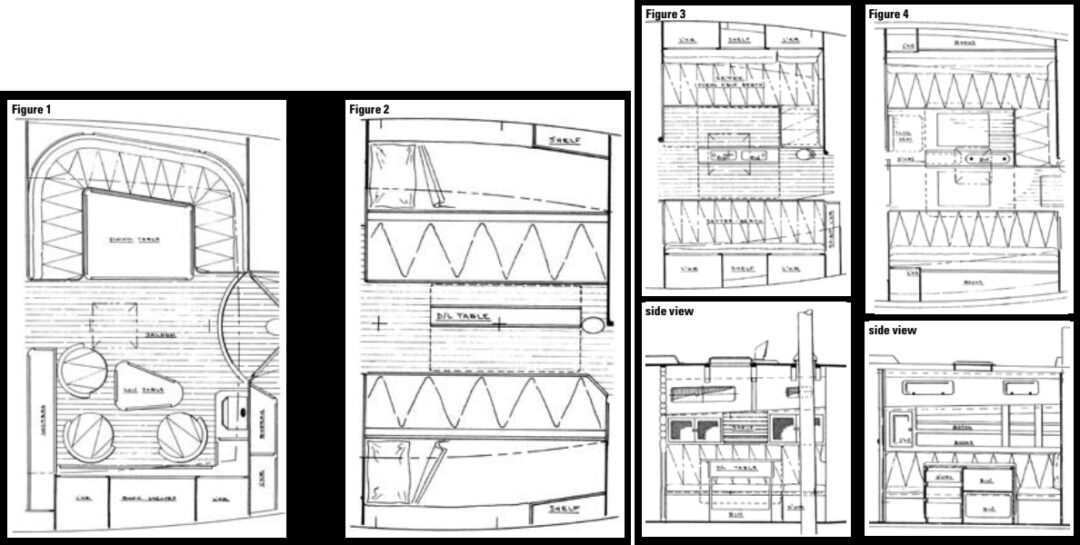
In the past the basic layout called for a drop-leaf dining table on or just off the centerline, with a settee berth either side (Figure 2). This 33-foot yacht is quite typical of the designs of the mid-1960s to mid-1970s, with a narrow drop-leaf table fitted amidships between two settee berths. The table has a narrow base, probably screw fastened to a plywood cabin sole, so it is not very strongly supported. It is definitely on the flimsy side; a husky body thrown against it in a seaway could rip the table away. The table needs to be fastened to the mast or have a vertical post at the aft end run up to the overhead to stiffen things — or possibly have both fastenings.
Also a handhold
The fastening post can be of stainless or aluminum pipe or sturdy wood. It will also double as an emergency handhold in heavy weather. Unfortunately, the table itself is largely a waste of space; it could have been made a bit wider and have storage built into a bin below the table top or a drawer fitted in the aft end. Bottle stowage also could have been arranged in a bin on the sole between the table legs. I blame myself as the designer here, but it is quite typical of all too many saloon interiors of the ’60s and ’70s. The yacht is well set for bluewater cruising with its two pilot berths, but my own preference would be to turn one of those into lockers and bookshelf. There is no such thing as too much stowage space.
Figure 3 is a slight improvement in a yacht of similar size. The table is wider, so it can be more strongly fastened to the sole or to the settee extension. It has decent storage in two top-access bins and a bottle bin at sole level. A post at the aft end would be a desirable feature in rough weather as well. This saloon appears spaciously wide when compared to Figure 2, and there is generous stowage. Although it lacks a pilot berth, the yacht does have a wide quarter berth. This setup might be preferred by many sailors.
Figure 4 rectifies the table situation still further. It can be anchored with a knee to the extension of the settee to strengthen it against flying crew members, and it should be fitted with a husky post at the aft end. The central table contains generous stowage in three drawers, a deep top-access bin, and a bottle bin at sole level. Access to the latter is not possible with the leaves down, of course, so you’ll want to haul out the libations before anyone sits down to socialize. These bottle bins work best if they have a top with openings cut out to fit the skipper’s favorite potions, as that will keep things from sliding around in a seaway and breakage to a minimum. Note that the table leaves actually overhang the settees slightly. This makes dining much more comfortable, as you don’t have to lean so far forward to suck up your spaghetti.
Folding seat
There is also a folding seat for the last-minute guest, although access to it is a bit tight and would rather daunt my Falstaffian figure. I do think this saloon could be improved if the port settee were moved inboard a foot and the space outboard of the settee given over to increased stowage. The port table leaf could then have been narrower, giving better access to the bottle bin.
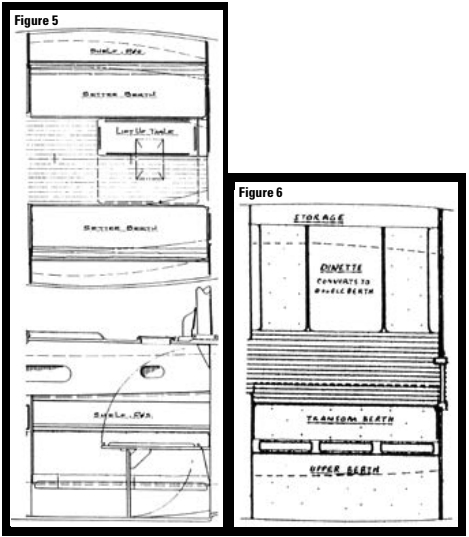
My very unfavorite table is shown in Figure 5, the folding wonder. This one was done at the builder’s request, but I’ve even fitted such tables on yachts as large as 47 feet when the owner insisted. The fold-up table does make the saloon seem larger and more spacious when it is raised out of the way, of course, but do you want a yacht or a dance hall? Even worse, such a table is frail and weakly supported against the loads of flying crew members, so it’s quite useless in rough seas. Plus the storage is minimal. This particular table was hung on a shallow locker that sported a couple of shelves, but it had few other virtues.
A strongly supported, fixed table has much to recommend it for the average cruising yacht and could have been easily fitted in this design. This is only a 27-footer, so the saloon is relatively tiny, but there was a small bureau and locker forward on the starboard side of the saloon. A locker could have been fitted on half of the length of each of the outboard shelves for added stowage as well.
Another of my very unfavorite layouts is the straight-in convertible dinette (Figure 6). It may be fine in harbor, but it makes for poor seating at sea. The diners will be continually sliding out of the seats when the yacht is on a port tack and, conversely, on a starboard tack the outboard diners will be crushed by those inboard of them. Indeed, I scaled the drawing, and the seats on this 11-foot-beam 32-footer are only 3 feet 8 inches wide, so it would be a very chummy fit for four people at anchor. It’s OK for a game of cards, perhaps, but not for a hearty meal with elbows flying.
Narrow berth
Despite the yacht’s generous beam, the dinette would make up into a rather narrow double berth, providing snug and uncomfortable sleeping accommodation for two average persons, particularly in warm climes. This saloon would be better if the dinette were widened 6 to 8 inches to make a better double and to offer roomier and more comfortable seating.
As it does here, the convertible dinette tabletop usually lowers to form a double berth, so there’s rarely any storage below it, and the only way to feed more than four at a time is to have a leaf that either slides out for diners on the starboard side or is hinged on the inboard edge and flipped over to starboard with a removable leg for support. I’ve seen it done both ways, but the straight-in dinette still does not make for a very useful or pleasant interior in my opinion.
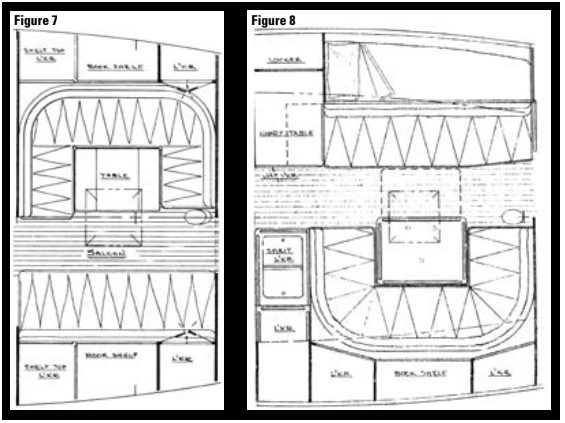
Figure 7 shows a convertible dinette on a 42, but this has the much better U-shape. In rough weather, two diners can be seated outboard and brace against the roll. The dinette is quite wide, so it can seat four or five with less crowding and makes a good double berth with the table lowered. Also the leaves drop fore and aft to open up the area for relaxing or socializing. It is still not the best setup at sea, as it needs either a flip-top or pullout leaf. Otherwise, the starboard diners will have to eat off their laps. Again, there is no storage in the table itself, but a shallow cutlery drawer could be fitted under the top on the central part of the table, if desired. Thanks to wide beam, there is generous stowage outboard of the settees and even room for a pilot berth on the starboard side.
Better dinette
Figure 8 shows an improved U-shape dinette in a 40-footer. The solid-top table has no drop leaves; instead, a slideout extension means that everyone gets a bit of table space to set their salt horse and hardtack down on. This saloon packs it all in: a pilot berth to port, good stowage outboard of the dinette, and a chart table using the port settee as a nav seat. You may also note the proper spirit locker on this design, again with the interior sized to hold the skipper’s favorite brands without clinking or breakage.
I would warn readers against one type of dining table that can pose problems: the gimbaled table. The idea sounds wonderful, a ballasted table that swings like a pendulum and is always level so the plates do not slide around. The problem lies in the fact that at steep heel angles the table is level but the settees aren’t. The weather-side diners have the table below knee level, and the leeside diners have it up under their chin. And heaven help you if you get in the way of that heavy table when the boat takes a sudden knockdown. You could smash a kneecap or bite your tongue off. Neither of those experiences would be fun!
The gimbaled table also requires very substantial ballast to keep it level when a load of food-laden crockery is placed on it. The ballast is simply dead weight and does nothing to improve performance in a small yacht. On the other hand, the Pardeys have a very neat idea on their lovely little yacht. There is a sturdy post at each end of the drop-leaf table with a narrow gimbaled bin fastened above the table between the posts. Thus condiments and drinks can be left safely with no danger of spills even in fairly rough seas. The bin must not be fitted so low that it sweeps plates, sugar bowls, and other articles off the table, of course, and not so high that seated diners can’t see each other or hold a conversation. Indeed, it would be quite simple to make the height adjustable by means of thumb screws or pins.
I do hope these comments and examples will give readers something to consider when they’re planning to rebuild their boat interior or when they’re looking for a new — or newer and bigger — boat.
Thank you to Sailrite Enterprises, Inc., for providing free access to back issues of Good Old Boat through intellectual property rights. Sailrite.com