Bob Johnson both designs and builds this best-selling cruising line
Issue 43 : Jul/Aug 2005
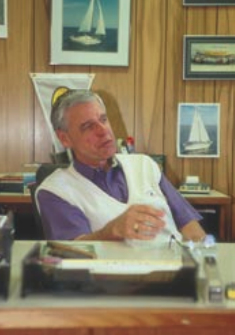
Robert K. Johnson, N.A., Founder of Island Packet Yachts in Largo, Florida, has been committed to the shipwright’s craft all of his life, despite growing up in inland Connecticut. A naval architect trained at the Massachusetts Institute of Technology (MIT), Bob designs all the boats he builds, winning numerous awards such as Cruising World’s Boat of the Year. His designs are notable as production, full-keel cruising boats that are built in the United States, perhaps all the rest having gone to fin keels. But Bob takes exception to that label, insisting that his “Full Foil Keel” is very different from traditional full keels and is more like a long fin.
His unique approach to yacht design is the culmination of a lifetime in boats. “I’ve had the bug ever since I was a boy,” he says. “I did my ninth-grade ‘My Career’ report on naval architecture and marine engineering and wrote letters to Chris-Craft and other companies to find out about careers in the field. It’s been in my genes since I was born. I subscribed to Yachting magazine when I was eight. My dad had a small powerboat in Connecticut that we rebuilt in the garage, but I always wanted to get into sailing. I wanted a pram, but we lived 50 miles inland in Connecticut, and it just wasn’t going to happen.”
In 1957, when Bob was in ninth grade, the family moved to Florida, buying a house on a canal in North Palm Beach. Bob bought plans from Rudder magazine for a 12-foot catboat. It had hard chines and a V-bottom. He says it wasn’t a simple boat to build. His father was a machinist and expert woodworker, who made his own machine tools. Bob says his father was a big help, but it was still very much his own project. “I lofted it on the living room floor and built it in the carport,” he says. “I altered the rig, installed a folding mast, and even changed the shape of the hull while I was building it. Before the rig was finished, my brother and I tested the hull by sailing it downwind with a beach umbrella for a sail. I’d never sailed before in my life. I built the boat first and figured I’d learn how to sail once I did.”
Nuts-and-bolts guy
After earning a bachelor’s degree in mechanical engineering from the University of Florida, Bob attended graduate school at MIT, earning a master’s degree in naval architecture and marine engineering. He thought he would major in physics but decided it was too theoretical. “I’m a nuts-and-bolts, hands-on kind of guy,” he says, “so I stayed in engineering.” His formal education gave him a firm foundation in what he calls “the scientific method.”
He explains, “MIT didn’t dwell much on the subtleties of sailboat design, but you’re completely prepared to apply the information you do learn to sailing boats or high-speed powerboats. That’s naval engineering, not architecture. The architecture is the art aspect of it. The shape of a hull can’t be fully quantified. Computer programming can help because you can do an awful lot of modeling very quickly and mathematical models can help you evaluate hull change. But ultimately you have to go out into the real world and try it. I graduated in 1967 . . . 38 years ago, and there have been a lot of new ideas since then, or elaborations of older ideas, like hydrofoils, surface-piercing vessels, and many others.”
After college, Bob moved to California to work for McDonnell-Douglas in Culver City. His work was on anti-ballistic missiles, for which he devised a process to show loads on critical components using finite element analysis. During his two years at McDonnell-Douglas, he did not forsake sailing. Bob also liked surfing and ended up leaving McDonnell-Douglas to work for the Wave Corporation, which made surfboards at the time. Some of his achievements were to design and patent an adjustable fin system for surfboards and to develop molded surfboards using aerospace materials. This led to meeting Hoyle Schweitzer, who popularized sailboards and registered the name Windsurfer.
Harder still
“He was able to get past the idea that if surfing is hard, if you put a sail on the board it’s harder still,” Bob laughs. “But he had the vision to see that some people would learn how, and he opened up a new market. Hoyle wanted us to make his boards, but we couldn’t see any future in it. Shame on me, and laudits to Hoyle for having that insight!”
Bob’s job at Wave Corporation lasted five years. “Our final boards were very good but very expensive,” he says, “and the market wasn’t really there. The company went public. Karl Pope, an electrical engineer and surfer, was president, and I give him a lot of credit. He’s still making surfboards, and we still correspond, but I wanted to go back into boating and to my family back East.”
In 1974, Bob went to work for Ted Irwin, head of Irwin Yachts in Clearwater, Florida. His first assignment was to modify the existing hulls of the Irwin 30 and 33, as well as the rigs, keels, and rudders. Though Bob was not a keen racer, Ted was, and Bob got involved in developing some International Offshore Rule (IOR) designs for the Southern Ocean Racing Conference (SORC). “I worked on modifying an Irwin One-Ton racer inspired by Terrorist — not a name anyone would pick today,” he recalls. “Terrorist was a beautifully built aluminum boat that came from California and was fitted with twin bilge boards and internal ballast. She was a very fast boat. Ted was very creative. He loved boats, and I loved working with him. There was another designer at Irwin at the time, Walt Scott, and we all became good friends. Ted’s motto could have been, ‘If it won’t break, it’s too heavy.’ I like to make models, so we sent one to Stevens Institute of Technology in New Jersey for tank testing. This eventually became Voodoo (an evolution of Pantera) with hard chines and triple boards; if two are good, then three are better. It had a jibing daggerboard and asymmetrical bilge boards. It didn’t dominate the circuit, but it had its moments.”
Irwin offshoot
“Endeavour Yachts was an offshoot of Irwin,” says Bob, “run by some of Ted’s prior employees. It was just beginning in 1975, and they bought the old abandoned Irwin 32 molds to get started. The two firms were sort of joined at the knee, Endeavour buying materials from Irwin and so on until Endeavour finally became a competitor to Irwin.”
After two years, Bob left Irwin on good terms and went to Endeavour so he could design boats with his name on them and run the plant. He designed the Endeavour 43. Then came the 40, which evolved into the 42, both of which were of “Miami Vice” TV fame. “It was a real home run for the company,” Bob says.
“A lot of people seem to think I designed Endeavour’s 32 and 37 (which preceded the 40), but I didn’t. A fellow named Dennis Robbins evolved them,” he adds. Bob still yearned to be on his own, designing his own boats, so in 1999 he left Endeavour to hang out his own shingle. By now he had a family and two babies. Most of his early commissions were small jobs — rigs, new keels, and an interior and deck for Watkins Yachts. Bigger jobs were two complete boats for Com-Pac — the 19 and (a few years later) the 27. He also did some work for CSY (Caribbean Sailing Yachts).
“They were charterers,” Bob says, “not experienced builders. I helped them out with some manufacturing consulting because they were having trouble. They couldn’t sell enough boats or make money. Basically, I told them they weren’t going to make it; they just weren’t very analytical about running a business.” Boatbuilding can be a tough business, as another of Bob’s friends found out. “George Hahn at Prairie Boat Works was one of my old surfboard dealers and promoters at Wave,” Bob recounts. “He was a delightful guy who started off with one of his own designs, the Prairie 32. Prairie was a model of how a boat company should be set up, but he still couldn’t make it go. He had a beautiful plant, molds, and great new designs by Jack Hargrave, but he couldn’t operate profitably.”
Lightfoot 21
The origins of Bob’s own company can be traced to a New Haven sharpie he designed in 1976 for his own use, the Lightfoot 21. A few magazines wrote it up, drawing attention to it. At first he sold plans for homebuilders working in plywood, but a demand for a fiberglass version prompted him to make a set of molds and manufacture it himself. “I made the first molds in my carport, probably to the great distress of the neighbors,” he says. “Then I rented a garage and called it Traditional Watercraft, working with a lot of fellows in town who were looking to moonlight a few hours a week. I marketed the boat and priced it with a dealer in mind, but no dealer wanted it because it was too unusual.” Still, he sold 18 and was on his way as a production builder.
Next came an opportunity to buy molds for a 26-footer from Bombay Yachts, which was being liquidated. It was founded by two men who left Irwin: Ross James, production manager, and Chris Petty, sales manager. They built the 31-foot Bombay Clipper designed by Walt Scott, then bought a Canadian mold and converted a 44-footer. Their last boat before they went out of business was the 26-foot Bombay Express. They built 16 or 17 of those, and some were sold as unfinished boats because they were winding down. They didn’t go bankrupt but they sold out to an investor who passed away, and the business was liquidated.
“I realized an opportunity was before me,” Bob says. “The Express was a boat I related to, a centerboarder with a barn door rudder. It looked like a Cape Cod Catboat with 5-foot 9-inch headroom. I bought the molds in 1979, and it became the parent boat for the Island Packet line, the Island Packet 26, introduced in 1980. At the time I was still operating out of my house. Two friends, Pete Pastor and Bob Folks, who owned a company called Marine Innovators building the Sandpiper 32 and the Beachcomber 25, were contracted to start production.”
Introducing Island Packet
“But they also were a tooling company and had made the plugs and molds for the Bombay Express,” he adds. “I redesigned the interior and rig, left the rudder as is, put in a different centerboard, and introduced it as the Island Packet. I incorporated formally as Traditional Watercraft, Inc., in the fall of 1979. We built 16 boats over a year and a half. We were able to estimate the pricing fairly well and sold the boats with classified ads in magazines. We sold the first three sight unseen, staged payments, owners never seeing them until they were delivered to their doorsteps.” Despite his considerable experience, Bob still wasn’t exactly a household name, and selling the boats took some work. “I developed a very thorough brochure with beautiful illustrations by my brother,” he says, “and talked to customers a lot on the phone. I knew the boat backward and forward, so I could answer their questions. I guess they were comfortable with who I was although they had no reason to be. God love ’em, I couldn’t have gotten started without them and their confidence in me. Their payments financed the construction.”
Dick Watts of Massachusetts bought the first boat, which Bob built under contract with Marine Innovators. But a year later, when that company’s Beachcomber 25 took off, they couldn’t produce enough of them and were unable to accommodate Bob’s project on top of theirs. “I was selling more and more,” Bob says, “so I realized it was time to take the big step.”
He rented a 4,000-square-foot building, hired five people, and started building. The parts were subcontracted — glass work to one company, the wooden parts to another. Bob’s crew did the assembly. After hull #30 Bob came out with the Mark II, which had more headroom and the first Full Foil Keel (the original 26 was a centerboard and drew 2 feet 4 inches with an outboard rudder). The Island Packet Mark II (not the 26 Mark II yet) was introduced at the Miami Boat Show in February 1982. She was bought and named Bubbles. Bob says she’s still going strong, having won the Miami-Key Largo Race late last year.
Name recognition
The new Island Packet 31 was developed in the spring of 1983 and introduced that fall at Annapolis. Bob was going to call the 31 the Bermuda Packet “ . . . or something similar, the company name being Traditional Watercraft,” he says, “but we went with the name Island Packet 31 because of the name recognition we had achieved. Retroactively, the first two boats became the 26 and 26 Mark II in the fall of ’83. In ’84 we released the 27, which was actually a Mark III 26. The 27 wound up with 6-foot 1-inch headroom by increasing the freeboard.”
He adds, “The 31 was the do-or-die boat. I bet everything on it, financially and emotionally. It was a completely new boat from the ground up, not a modification of an earlier design. We sold a lot of 31s right off the bat. It had an aft cabin with a fold-away door and an articulating chart table. It was a good boat that was both roomy and a good sailer.” When the 31 was replaced by the Island Packet 32 seven years after its introduction, 262 hulls had been produced, more than any other Island Packet design. As a result of its popularity with customers, Bob was able to purchase two acres of land in Largo, Florida, and build his own shop.
Within two years, tooling began for a new Island Packet 38 and a 20,000-square-foot addition was added to the building. By the time the firm celebrated its 10th anniversary in 1989, another model had been introduced, the Island Packet 35, and another 21,000-square-foot facility had been built on an additional eight acres of land across the street. Island Packet was unquestionably in business. Many of these earlier models were offered with a full keel or with a shoal-draft centerboard option. Since the average production run is roughly five years, there are quite a few discontinued models. Today, Island Packet builds four models: the 370, 420, 445, and 485. With the exception of a 40-foot high-performance motor yacht, the Packet Craft Express, Island Packet Yachts currently produces only cruising sailboats. Between 1992 and 1997, the company also launched 41 Packet Cat 35s, luxury sailing catamarans.
Design and construction
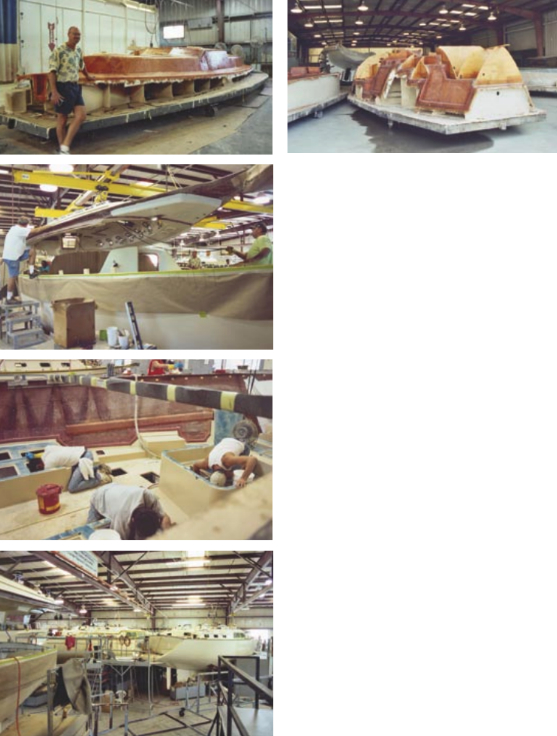
The Island Packet Yachts construction facility is located in Largo, Florida, and consists of several large buildings totaling over 100,000 square feet on both sides of a street in an industrial park. It is clean, well organized, and neatly kept. The yachts are highly engineered. Part of the design process is the extensive use of mock-ups to ensure everything fits and clears and that there will be no surprises during construction — or later when access may be required for maintenance. Each boat is also uniform in concept, not highly varied for different options. However, dealers are encouraged to meet owners’ wishes for special custom touches and accommodations, such as mounting pads for generators or pre-wiring electrical systems for possible later additions. Interior liners have numerous access ports that provide additional storage and offer access for checking and maintaining bonds, which would otherwise be inaccessible. Voids and corners, even those not visible to the eye, are carefully finished; there are no sharp edges or points to surprise one when groping around in the dark in confined spaces. An extensive quality control process is in place that includes a quality assurance log for each boat where key items are checked off during construction by line personnel.
Island Packet boats are constructed in a conventional manner. Each boat is made up of four major fiberglass components: the hull, deck, and the two liners, or pans, that fit inside the hull and deck and which together form the interior of the yacht. Each of these four components begins as detailed drawings for constructing the male plugs out of wood. The plugs must be perfectly fair because they are used to create the female fiberglass molds that are then employed to mass-produce the actual hull, deck, and liners. The tooling department is a year ahead of everyone else in the plant; they are often working on models that won’t be released for years.
Low-pressure gelcoat
The construction cycle begins when each of the molds is waxed and sprayed by hand with gelcoat at low pressure, allowing the operator to control the thickness to an optimum 25 mils. Next, the molds are rolled out on casters to the lamination area and layers of glass and resin are laid in place. The lamination method is straightforward and done by hand. Each layer is done separately, one layer a day. The first layer — called the skin coat — is conventional fiberglass mat with randomly oriented fibers. The hull and deck use one layer of mat and multiple layers of triaxial knitted cloth. This material, which Bob says is one of the strongest fiberglass cloth products available, is twice as strong and puncture-resistant as the alternative, woven roving. Conventional cloth has fiber bundles woven at 90 degrees, while triaxial cloth is oriented in three directions and then sewn together with glass threads. The weave is very dense; getting resin into the glass in the proper proportions and then removing the excess requires the use of squeegees in addition to the usual hand rolling.
As a full-keel design, the hull molding includes the keel. The keel cavity is filled with lead ingots for ballast. (Smaller boats like the 370 use iron and concrete.) These are packed in resin to bond them to the inside of the keel void and are stabilized in place with mortar. Three additional layers of triaxial glass are then placed over the concrete to strengthen the spine of the boat and to provide a double bottom.
Both hull and deck are then bonded to their respective liners. In the former, the liner is lowered in and glassed into place at predetermined points that are made fully accessible by storage-access holes strategically cut into the liner molding. Unlike the majority of boats today, the deck is cored with a proprietary mix of resin and microballoons Island Packet calls Polycore. It is formulated in-house and applied in a 1⁄2-inch- to 3⁄4-inch-thick layer like the frosting in an Oreo cookie. It is an extremely strong and durable composite that is impervious to rot, delamination, and water intrusion. The deck and deck liner are fitted and then bonded together. Polycore is stiff, strong, and ideal for decking but is not used on the hull surfaces because it lacks the puncture resistance of a solid triaxial glass laminate.
Three chainplates joined
In the hull, tanks for water, fuel, and waste are installed just above the keel. Then plumbing and through-hull fittings are put in place. The three chainplates per side are joined by a welded T-bar and interlock with molded hull flanges. They are then glassed in place with a fan of glass fibers designed to help dissipate strains from the rigging across the entire hull. The hardwood cabin sole is then bonded to the liner. While the interior is being built, the deck is assembled in tandem: ports, hatches, cleats, winches, travelers, blocks, and other deck hardware are added at this time.
After completion of the hull and deck sub-assemblies, the two are custom fitted and joined to the interior bulkheads. The deck is bolted to the hull with 1⁄4-inch stainless steel bolts every 6 inches and sealed with a special waterproof gasket and a liberal application of 3M 5200 urethane sealant. On deck, toerails are still formed on a jig and bent and glued by hand.
A visitor to the Island Packet facility gets the impression that this is a very modern, highly automated, assembly line operation. The staff bustles about with an air of motivation and precision. People seem busy and absorbed in what they are doing. Unlike the controlled chaos of most boatyards, the Island Packet facility strikes visitors as being a very smooth and disciplined operation. Total construction time for an Island Packet yacht varies by the model, from 2 1⁄2 months for a 370 to a month longer for the 485. After the boat is shipped, the dealer installs spars, sails, rigging, lifelines, electronics, autopilot, air conditioning, and refrigeration. (Some 2005 models include electronics and refrigerator/freezer systems.)
Roomy and comfortable
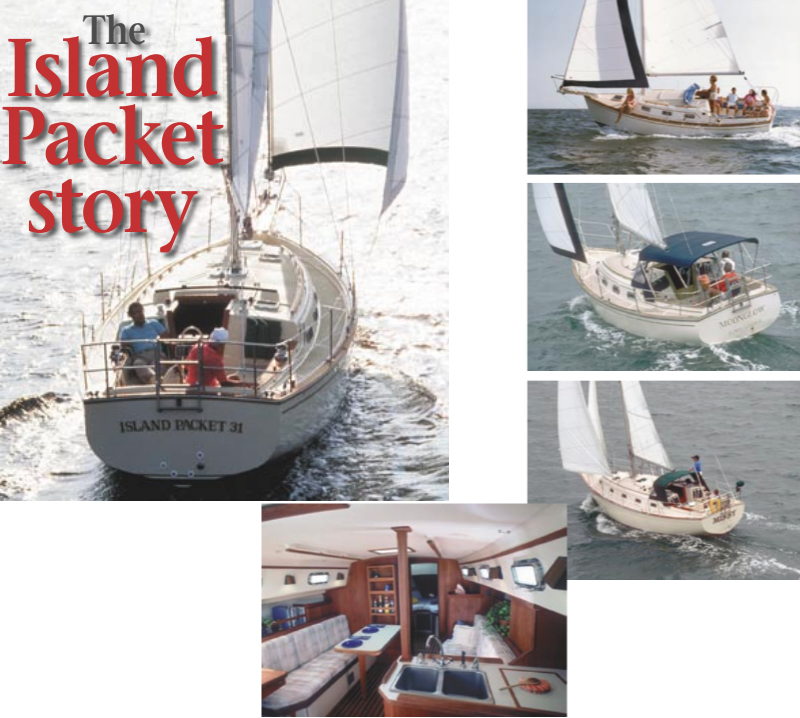
All four of the current models are serious bluewater boats designed to be easy to sail, roomy, and comfortable. Design features common to all include cutter rigs with twin backstays, a patented Hoyt Jib Boom on the staysail that makes the jib self-tending and self-vanging, roller furling on all sails, and the Full Foil Keel with a protected prop and separated rudder driven by rack-and-pinion steering. All models have a swim platform aft. All have at least two staterooms, at least one head/shower, a navigation station, and, of course, a saloon and galley. The 370 starts off at $259,950; the 485, fully equipped, sells at more than twice as much.
Bob and his marketing staff are quick to emphasize that Island Packets are built, first and foremost, as cruisers. “First in Cruising” is the company’s motto and “America’s Cruising Yacht Leader” is the tagline appearing on its literature. Safety, comfort, seakindliness, and stability are given priority over performance. Although every Island Packet is designed to be completely suitable for a daysail on the bay, as well as being a transoceanic machine, no claims are made for it as a racer or even a racer/cruiser.
On the other hand, speed should not be ignored, and it is a quality that can be of considerable value in a cruising boat. The less time one spends on a passage the less time there is for something to go wrong. As it turns out, Island Packet Yachts have been able to more than hold their own offshore against boats that are considered more competitive, taking class honors in events such as the Caribbean 1500 and the Marion-Bermuda Race.
Bob Johnson may very well be the only naval architect who owns the yard that builds his designs. He has been honored with the Sail magazine Industry Leadership Award and serves as a director of several marine industry associations. His boats have won numerous honors from many quarters, including five Boat of the Year, four Customer Satisfaction, and two Best Value Awards. Since the creation of the new European Union certification standards, all his sailing yachts have been CE-certified “Category A, For Ocean Use.” Island Packet was the first U.S. builder to pursue this certification.
After 25 years of not only surviving, but also flourishing, in what is often a volatile industry, Robert Johnson has a lot to be proud of.
Thank you to Sailrite Enterprises, Inc., for providing free access to back issues of Good Old Boat through intellectual property rights. Sailrite.com