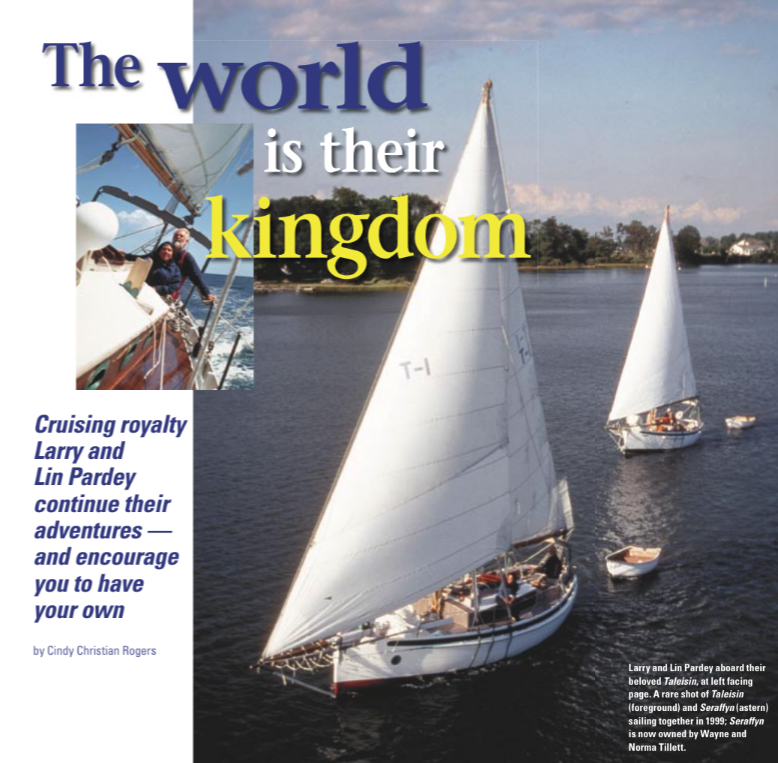
Cruising royalty Larry and Lin Pardey continue their adventures — and encourage you to have your own
Issue 43 : Jul/Aug 2005
Meeting Larry and Lin Pardey can be a bit intimidating for a weekend-and-vacation sailor, awed as you are by the accomplishments of this much-fêted cruising couple. After sailing for more than 35 years and to 72 countries, after describing their experiences in 10 books and five videos, after doing it all in boats no larger than 30 feet with no engines — the Pardeys are arguably the reigning king and queen of cruising sailors. But then you meet them . . . and these venerable cruisers prove to be genuine and generous souls who talk unassumingly about their adventures — and passionately about how you can have some of your own.
Their story remains fresh and inspirational, a tribute to their delight in sharing it. You feel that no matter how many times they have described their exploits, they now are conveying them to you, even if you never intend to set sail for Gibraltar or Bora Bora. They speak swiftly and spiritedly, interlacing sentences in a rhythm born of a long camaraderie: it’s not so much that they complete each other’s thoughts as that they represent two variations of a single voice. When Lin argues, for example, that “the perfect sailboat is the size any single member of the crew can handle alone,” Larry chimes right in: “A 400-square-foot main is probably the largest that any person alone can hoist.” Lin may lead off most conversations, but Larry is hardly reticent, and they tell their tales with an almost tangible energy. You can just imagine them on a boat, undertaking tasks with the same symbiotic zeal.
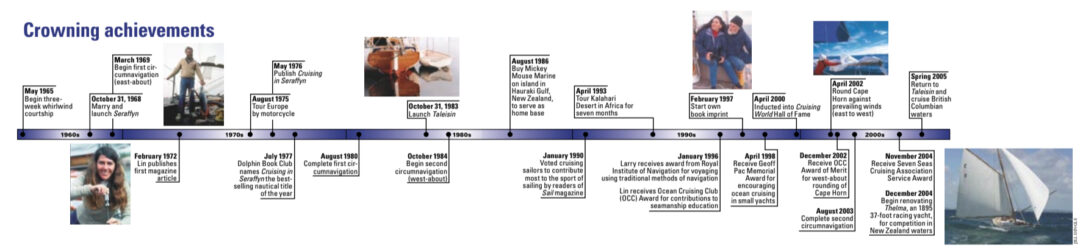
They remain so enthusiastic about the cruising lifestyle that it’s hard to believe they’ve reached their 60s, but a quick check of the math confirms it. They prepared for their first cruise as 20-somethings back in the mid-1960s; in 1968 they married the same day they launched their first self-built wooden cutter, the 24-foot Seraffyn (see “Crowning achievements” on Page 48). Since then, the Pardeys have each sailed more than 170,000 miles, circumnavigating the globe twice, once each way, in Seraffyn or Taleisin, the 29-footer they built over a several-year period and christened in 1983. They have been honored worldwide with awards, featured in newspapers and boating and general-interest magazines, and invited to speak at more than 300 seminars in seven countries. Perhaps their greatest sailing achievement came in 2002, when they rounded Cape Horn against the prevailing winds, for which they received the Ocean Cruising Club Award of Merit.
Other sailors have covered as many miles, charted ambitious itineraries, or achieved feats as impressive, though the number is few. What sets the Pardeys apart is their approach, summarized in their mantra: “Go simple, go small, go now!” They are champions of the concept: they leveraged their original meager cruising kitty to spend a year in Mexico, then set off for the Panama Canal, earning additional funds along the way. They have repeated the process over and over ever since, financing the next leg of their adventures with “freedom chips” from repairing or delivering boats — and, of course, by detailing their experiences and boatbuilding expertise in print. A letter to a magazine editor launched a successful writing career, which decades later has culminated in their own imprint — Larry says they are the “only floating publishers in the world.” Their books have intrigued more than a quarter-million readers, sailors and armchair adventurers alike (see “For further reading and viewing” on Page 51).
Anachronisms or role models?
That Lin and Larry Pardey have made both a life and a livelihood from cruising has enhanced their mystique. So has their insistence — even as the size of yachts has trended upward — that smaller boats are a better choice for extended cruising because they are easier to handle, far cheaper to maintain, and less likely to break down. Smaller, simpler boats may even be safer, they argue, and they advise cruisers to carry less, rather than more, gear. In this age of technological wizardry, Lin and Larry’s list of onboard necessities might strike many sailors as minimalistic, particularly since it contains few electronics (see “Cruising necessities” below). Taleisin does not carry a GPS, radar, or weatherfax; there’s not even a depth sounder, though an EPIRB recently came aboard. Such convictions make the Pardeys role models to some fellow sailors, anachronisms to others.
But whether you accept their counsel or consider it more provocative than practical, you can’t deny that the approach works for them. It is a philosophy emboldened by vast and hardwon experience — and inextricably linked to their quest for a simple lifestyle, a view that can seem especially radical in the consumer-driven United States, as when Larry, for example, refers to credit cards as “chains” or Lin says that “Americans have a gene that costs them money.”
According to Larry, “When we first started building Seraffyn . . . living with her while we prepared to go cruising . . . it was almost Steinbeckian. Now cruising is seen as a lifestyle market. And the market makes it harder to go cruising.” Larry suspects that too many would-be cruisers don’t set sail because they don’t have the “right” boat, the “right” amount of money, or the “right” complement of equipment. “We want to break down the barriers,” he explains. “We want people to enhance their safety onboard through building their skills rather than depending on expensive gadgets. We think it’s better to use the wind and your brain and hands instead of a diesel and checkbook.” Yet even as the Pardeys espouse their views, they refuse to turn the
“Go simple, go small, go now” proclamation into an edict. “Our mission is simply to get you to stop and think,” Lin explains. “We may advise you to buy a boat five feet smaller than you’d been fantasizing about or equipped with a head nearer the companionway, but if you already own a 40-footer with the head by the V-berth, we won’t discourage you from cruising in it.” It’s a stance that can surprise you, given their reputation, until you realize what the Pardeys want most is to inspire you to go cruising . . . however you decide to define it.
An amazingly safe world
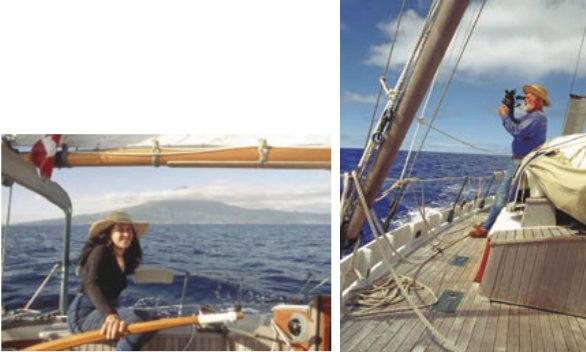
While many Americans have been reluctant to travel in the wake of 9/11, the Pardeys believe that cruising remains a prudent option. “It’s an amazingly safe world if you go out into it with an open heart and a bit of brain,” Lin says, noting that not all geographic areas have been touched by turmoil or terrorism. Her perspective — as a long-time world traveler and dual national (a citizen of the United States and of New Zealand; Larry is Canadian and Kiwi) — is that the significant majority of serious misunderstandings occur at the governmental level, not among nations’ citizenries.
“Most natives welcome Americans because they welcome anyone interested in their country,” Lin says. “It’s Americans who have the tendency to nationalize. People abroad are curious about U.S. cruisers, sure, but to most of them, the flag you fly coming into the anchorage is at least 35th on the list of what makes you who you are.”
She adds, “We find that cruisers are judged by their individuality, not their nationality. People accept you for how you accept yourself.” One of her favorite tips to long-range cruisers is to carry a photo album containing family snapshots and pictures of their hometowns. “When you show it around,” she says, “you’re more likely to become a real person to the locals.” And she recommends spending time with the people who live where you visit, rather than playing tourist or hanging out exclusively in the marina with fellow cruisers.
It also helps to try communicating with the residents in their own language. “Traditionally, though, Americans are one-language folks and are unprepared to interact with speakers of other languages,” she notes, “but it’s not as vital to know a second language as much as it is to try to communicate. At least try some kind of sign language. Or resort to show-and-tell.”
Lin adds that they’ve encountered few problems with officials and had trouble entering only one country. Arriving in Brazilian waters, they learned they should have obtained a visa beforehand; most countries permit you to get a visa after you arrive.
Having said all that, Lin adds that cruisers nevertheless should be cautious. She and Larry avoid known problem areas where piracy and drug trafficking are commonplace. And while they advise against carrying handguns, partly because of difficulties clearing customs and partly because they see guns more as hazards than helpers, they do carry Mace and would readily deploy, if need be, a standard onboard piece of safety gear: “A flare gun is a nasty weapon,” Lin says, “and it looks like a gun if you hold it right.”
One way, Lin observes, for concerned Americans to cruise more comfortably and securely, yet still venture far afield, is to study the routes of Eric and Susan Hiscock. This famed British couple made several circumnavigations from the 1950s through the 1970s, favoring stays among English-speaking cultures. The Hiscocks are symbols of an era of cruising that to many observers represents a safer time, a calmer world climate. Indeed, it is tempting to consider the period between World War II and the advent of production fiberglass boats as the golden age of cruising, a time when the likes of John Guzzwell, one of Larry’s heroes, would take off in small boats like the 20-foot Trekka. Larry, however, points out, “Those people didn’t think of cruising as a lifestyle. They thought of it as an adventure. They didn’t expect the comforts and securities of home while exploring the world.” As for Lin, she says adamantly, “The golden age of cruising is when you go.”
Go for your own reasons
“The big dream is to go to exotic locales,” Lin acknowledges, but she and Larry wouldn’t dream of suggesting you must cross an ocean to have a meaningful cruising experience. Instead, they fret that too many cruisers set themselves up to fail. First-timers, in particular, announce to friends and families that they’re “sailing into the sunset,” she says. “Many of these cruisers will discover that they don’t enjoy cruising as much as they thought they would — or they’ll miss their shore lives and families.” Then, “when they come home early,” Larry adds, “they will have failed in everyone’s eyes.”
“We know of one couple who spent a year sailing to the South Pacific and had a lovely time,” says Lin. “But then they’d had enough and sold the boat. ‘Why did you fail?’ they were asked. ‘You planned to sail around the world.’ But they hadn’t failed. They had had a successful cruising adventure. It just was different from the one they’d projected.”
The Pardeys make it a point not to tell anyone what they’re planning next, not even when they made plans to round Cape Horn the “wrong” way. They gave themselves permission to opt out, and if they had, Lin says, “no one would have been the wiser. We would have had a great sail to Argentina and a fresh batch of stories to show for it.”
Their best advice: go cruising for six months, rather than announce to friends and family that you’re sailing around the world. Choose a cruising ground nearer your home — the San Juan Islands, the Baja Peninsula, the Great Lakes, Down East, Chesapeake Bay, the Intracoastal Waterway, perhaps the Bahamas — especially if you’re concerned by the current world political climate.
“One of our most enjoyable cruises was right along the coast of Maine,” Lin says, noting that it’s possible to enjoy unique cultural experiences within U.S. waters. “We met a local who invited us to Isle au Haut for a church service. It turned out the congregation met only once a month, in a 200-year-old church the community had just finished restoring, with a minister who traveled from island to island much like the ministers on horseback during pioneer days. The whole community came and cooked up a lobster feast afterward.”
What’s important, the Pardeys say, is to choose your own tack. But, as Larry warns, “life is a series of decisions even when you don’t make them,” so you may find that your indecision to leave the dock is a signal to enjoy sailing some other way. He estimates that as few as five percent of cruisers pursue the activity for the sheer love of sailing itself, reminding you that chartering, trailering, racing, and daysailing offer sailing pleasures too.
In fact, the Pardeys are joining the ranks of racing sailors: last winter, while spending the season at their home base on Kawau Island, 30 miles north of Auckland, New Zealand, they launched yet another adventure in their sailing career by buying one of the oldest racing yachts in New Zealand, the 37-foot Thelma, designed and built by C. and W. Bailey in 1895. “Why did we do it? She needed us,” Lin says. “And we needed a good project, an excuse to spend more time at this lovely spot. She was sitting unused with a few small problems that are right up Larry’s alley. We’ll get her back in full sailing condition, get to know her well, and then gradually upgrade her to a state her original builders would be proud to see.”
Following in their wake
Of course, the Pardeys will always be best known for their far-flung travels during a lifetime of living aboard. If you choose to follow in their wake, here is their advice:
Be self-employed. “The key to doing it our way is to be self-employed,” Larry says without hesitation. “Perform small contract jobs. Don’t be afraid to test your skills. Be involved in life. While building Seraffyn, Lin even had a real office job for a while. But we quickly got her out of that and into her own business.” Lin concurs: “Hustling for a living makes cruising more interesting. In one case we found we could live for one-and-a-half years from the proceeds of a single delivery job.” Their list of cruising-compatible careers includes nursing, carpentry, writing, photography, crafts such as jewelry making, and bartending.
Depend on your skills rather than your equipment. “A cruising sailboat is a complex, miniature city,” Larry likes to say. “It’s a restaurant, a hotel, and a bus.” Even though technology has made it possible for larger vessels to be singlehanded, think carefully about how much gear you are willing to take responsibility for keeping up. It may be wiser to invest in your own skills, particularly coastal navigation and sail repair. “Safety is something you learn rather than buy,” Lin insists, noting that first-aid training can prove valuable and that women may benefit from taking one of the for-women-only courses now available.
Don’t cruise exclusively with a group. “We tend to cruise as a couple,” Lin says. “When you cruise in groups you spend more time — not to mention more money — on entertainment and partying with fellow cruisers. We enjoy our times with fellow cruisers, make no mistake, but we also give ourselves permission to stop and just ‘be.’ That’s a key reason we keep having interesting cultural experiences.”
Don’t scrimp. The Pardeys tend to be frugal with their freedom chips, but Lin will tell you, “We don’t scrimp.” And she advises fellow cruisers to not be too stingy: “The reason to go cruising is to get outside of your own world. So do visit local cafés, take inland excursions, and have your laundry done so you’re not devoting time to it. Do buy art and jewelry in the countries you visit. Use them for a while, then give them away, whether to family and friends at home, cruisers you meet along the way, or friends you make among the locals.”
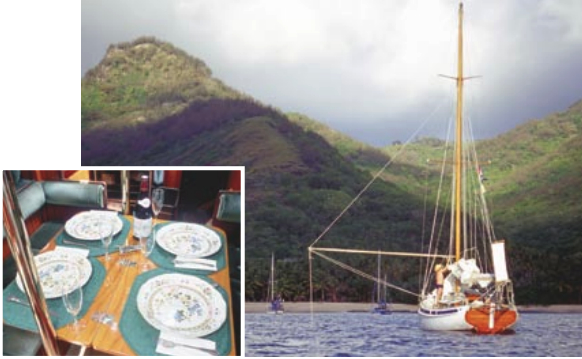
Lin and Larry have not neglected their own creature comforts: Lin insisted on having a sitz bathtub aboard Taleisin, for example, and tales of their land-based respites and inland travels make up significant portions of their Seraffyn books. They still talk excitedly about a seven-month “land cruise” through Africa; they left the boat in good hands, bought a truck, and set out. Larry even installed pipes atop the roof so they’d be able to enjoy warm-water showers.
Share your lifestyle. Some cruisers worry that they won’t see their families or friends, “but we actually see more of our family than we would otherwise,” Lin believes. “We orchestrate family reunions in fascinating places, using the boat to take our guests on daysails. And we invite our nieces and nephews to come stay a while just as their parents are ready to kill them.”
Stay flexible. Cruise as long as you enjoy it and not a moment more. “We always said we’d be doing this as long as we have fun,” Lin says. “If our cruising life didn’t change, it would become the same grind we have been running away from.” Larry adds that they don’t know how much longer they’ll cruise: “as long as we’re able, we’re saying now.” The demands of age — their own and their parents — are starting to encroach; they used to work three months and sail nine, now it’s more likely to be six and six, with time spent at their home base in New Zealand. “We get port fever,” Larry confesses. “We have down days like everybody else. But the freedom still makes up for them. A boat is the only thing I can’t imagine not having.”
Beating the system
Nor, of course, can anyone who’s familiar with the Pardeys’ story imagine them without a boat . . . or without each other . . . or without their attitudes about life. And when you spend time with Larry and Lin, you can’t help but want to expand your own horizons, clichéd as that sounds, and not only as a sailor, but as a human being. You can’t help but marvel at how they whole-heartedly embrace the world, convert strangers into friends, turn the sea into a realm of joy.
When you ask what they consider to be the greatest satisfactions of their cruising lifestyle, Lin credits learning “how competent I can be at a wide variety of skills.” For Larry, it’s “beating the system. I wanted time, time to live my life.” Smiling, he recalls his grandfather, a self-taught builder who crafted the first aluminum RV in Canada: “He instilled in me a positive attitude about building things — and about the notion of individuality. He was quite irritating to the rest of the family because he didn’t work a ‘normal’ job. He lived like Lin and I do.”
The Pardeys now find themselves in Canada, exploring the cruising grounds near Larry’s birthplace. “We have not forgotten our lovely Taleisin,” says Lin. “We plan to spend the northern summer enjoying her graces. If our program works out, we might just have nothing but summers for several years — with two completely different types of sailing to fill our days.” Then, true to form, only they’ll know how next they’ll choose to crown their diverse accomplishments.
Thank you to Sailrite Enterprises, Inc., for providing free access to back issues of Good Old Boat through intellectual property rights. Sailrite.com