It’s not traditional on a catboat but it sure looks salty
Issue 43 : Jul/Aug 2005
Wannabe world cruisers dote on their alter egos, looking for ways to make them ever more perfect, capable of meeting every demand and whim of that dream voyage. Might a boom gallows make your South Pacific odyssey just a bit more perfect or at least enhance that weekend cruise across the big lake?
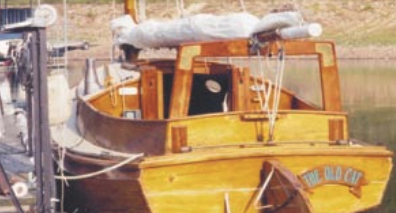
Although my boat will likely never leave her lovely inland lake, she never lacks continuing improvements. One was the addition of a boom gallows. Since she is a wooden one-off Cape Cod Catboat, circa 1963 and finished bright, any addition had to be carefully designed, skillfully built, and lovingly finished.
Before ordering the handsome finished product from my local sailmaker-cum-boatbuilder, I needed to convince myself that The Old Cat needed one. More importantly, did I need one and why?
Fond memories often intrude into rational decisions. I have fine, if faded, memories of my first good old boat, the Maleta, a Matthews Motorsailer, a 1920s or ’30s vintage. About 26 feet long and fully equipped, she was this teenager’s home at night. Each day she took summer tourists sailing on Lake Michigan’s Green Bay, offering quiet relief from the waning days of World War II.
My fondest memories are those of courting a young lovely with long auburn tresses aboard the old motor-sailer. Brave little soul, she never did really take to boating while heeling, but at least she still takes to me after 59 years.

The Maleta had a boom gallows, and the imprinting began. After a lifetime of sailing a wide variety of sailboats, I decided I needed to sail with a boom gallows once again. But first I had to justify all the work and expense.
Nine good reasons
Very well, then. Here are nine reasons for a boom gallows:
1. The basic purpose of the boom gallows is for parking the boom and furled sail (and gaff) when not sailing. A boom crutch does that, but not as well and certainly not with as much class. A gallows is the perfect place. If you plan to trailer your boat, the gallows makes a great place to store the aft end of the spars while on the road.
2. Safety should be a prime consideration for any equipment that is added to a sailboat. A cardinal rule of catboat sailing is to set a reef before you need it, even before you may think you need it. Even then, reefing down 270 square feet of canvas on my small cat can be a demanding task, and a boom crutch isn’t always up to those demands.
3. One of the signature characteristics of Cape Cod Catboats is their very long booms extending well beyond their transoms, a far cry from today’s rule-breakers with booms shorter than their whisker poles. Besides reefing, there is removing and installing the sail and cockpit covers, adjusting the outhaul for varying winds, or altering the boom lacing. Each requires leaning far over the transom, an activity that is not easy with a fully functional balance system. A form of stroke 27 years ago left my balance severely impaired, so I need all the help I can get. The gallows provides physical support when I’m working aft of the transom.
4. My habit when sailing is to sit at the back of the cockpit, facing forward, while leaning against the high cockpit coaming. This habit has already led to the installation of a steering wheel, a device I previously derided as “yachty.” Heck, even those huge, 8,000-hp Mississippi River towboats (pushers) have tillers. With my wheel, I now could sit as I wished, but the back support of the coaming was less than ideal. When inclined aft a bit, the nearly vertical gallows frame makes a fine backrest.
5. I had a boom-supported cockpit cover to keep the sun off the brightwork. Sometimes, when anchored overnight, I put the cover up to extend my cabin space when rain looks likely. A boom gallows broadens the aft end of the covered area, making a more usable foul-weather cockpit. It provides an additional ridgepole for a cockpit awning or Bimini.
6. When motoring into a narrow cove for a night’s anchorage, I sometimes stand on the cockpit seat, steering with one foot, looking ahead for submerged tree stumps. (My sailing area is a Corps of Engineers impoundment; many trees were flooded to make cover for the fish.) The support of a sturdy boom gallows is quite comforting when standing on one foot while steering with the other.
7. World circumnavigators Lin and Larry Pardey’s cutters both have a very functional boom gallows. I suspect one use was for safety. As a youngster already envisioning his ideal boat, one of Larry’s three qualifications was the ability to carry a hard dinghy on deck. Seraffyn’s gallows is high and wide enough to ensure that the boom could never crush her 6-foot 8-inch dinghy stowed over the cabin trunk.
I had a safety concern similar to Larry’s: when either of the two halyards (peak and throat halyards on a cat) is slacked off, the boom will immediately drop. My boom is Sitka spruce, 19 feet 1 inch long and weighs 40 pounds. (The Old Cat is 18 feet 6 inches overall.) If any part of the complex halyard system fails when close-hauled or coming about, anyone sitting under the boom would be in for a rude awakening at the very least. So I agree with Larry: provide an extra measure of safety for gear and crew.
8. Of course, you can’t mount a radar or other electronic equipment on top of the gallows; that area is reserved for the boom. But some boats use the aft side to mount a stern light, a sort of minor eighth reason. To augment that flimsy eighth, I find the gallows very handy when coming aboard after a swim. My 85-pound rudder is hinged to the transom with three heavy bronze pintles and gudgeons. Like many cruisers, I have boarding steps on the rudder and transom. Envision climbing a common house painter’s ladder with your hands at stomach level: it’s awkward. The higher hand-holds of the gallows are great.
9. I could add a ninth reason: gallows look salty. Unfortunately, my cruising area is known for Wal-Mart’s head-quarters, major trucking lines, and massive chicken and turkey farms, not saltwater circumnavigators. But I knew I would appreciate having a boom gallows, and that’s enough to validate that ninth reason for me.
Not traditional
Not all of my reasons apply to every boat, but I had enough to justify my need for a gallows. However, did The Old Cat need one? Boom gallows aren’t traditional on Cape Cod Catboats. The original design was for commercial fishing, and the design has remained virtually unchanged for 150 years. Some pleasure sailors do cruise in catboats, but I’ve heard of only a few with gallows.
I also knew that every coin has aflip side. What are the disadvantages of a boom gallows? Installing a prototype was the only way to find out. The obvious disadvantage is one of additional weight and windage. This might be a consideration for some sailors.
My first model was a length of 1- x 4-inch pine, cut to three appropriate lengths, the top bolted to the uprights and the resulting crude frame clamped to the coaming. A half-circle saddle in the middle of the top was the boom’s home base. The width of the crosspiece was governed by the width of the cockpit coaming, and the height of the uprights was selected to provide the same height of the saddle as with the boom crutch.
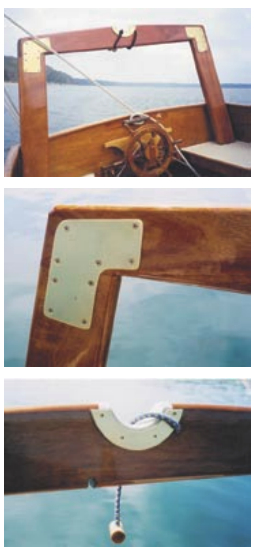
With the sail properly triced up, the boom cleared the crutch as well as the head of anyone sitting in the cockpit by several inches. One of my early “improvements” to The Old Cat was the addition of a nylon strap across the top of the boom crutch. When I lowered the sail or set a reef, the strap effectively held the boom to the crutch. To accomplish this task on my prototype, I ran a length of bungee cord through a hole in the crosspiece and through a short section of 1-inch dowel (see photo on Page 37).
Holds it firmly
With the boom in the saddle, I bring the cord over the boom and down into a notch in the underside of the crosspiece. The tension on the bungee holds the toggle firmly in the notch.
I sailed with it a few months and found I liked everything but the propensity of the mainsheet to foul on the gallows as I came about. Adjusting the location of the forward block minimized that.
In addition, the narrow width (3 5⁄8 inches) didn’t provide as much backrest as I wanted. So I progressed to my second prototype. I used 1- x 6-inch pine this time.
Like on the old Maleta, and the same on Seraffyn, this prototype’s top had three saddles so the boom could be secured on either side of the centerline. This would make it easier to stand at the helm while navigating confined areas under power.
I sailed with this gallows for some months, wanting to be absolutely sure that there were no undiscovered disadvantages to scuttle the project and to be just as sure that eight of my reasons were not rationalizations for the ninth: that a well-designed and built boom gallows looks great.
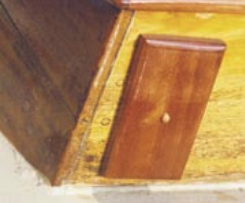
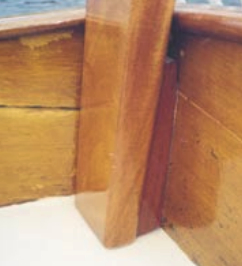
I soon found that I didn’t use the two outboard saddles. Long before this evolution, I had designed a second boom crutch, long enough when installed for the boom to be well above my head while powering into a narrow winding cove for a night’s anchorage. Because the boom crutch fit into brackets on the aft side of the cockpit coaming, I had to be sure my prototypes didn’t lean aft too far to prevent installation of this crutch. As things worked out, the wedges between the bottom of each gallows leg and the coaming, when sized to make my backrest lean back comfortably, were just right to accommodate that long crutch (see photo at bottom left).
Reasons justified
In the end I decided (rationalized is probably more honest) that I really did need a proper boom gallows. My reasons were justified, the disadvantages were minimal, and one would fit and look very nice indeed on The Old Cat.
My sailmaker friend, Matt Ross, had already agreed to build it. With his artistic eye, he refined my plans to make the overall shape harmonious with my boat’s coaming and general shape. Matt still had some of my heavy mahogany 2 x 6s at his shop, leftovers from previous jobs, and he used one to construct the frame. Finished out, the uprights and top are 5 3⁄8 by 1 3⁄4 inches. The crosspiece is 47 inches wide and stands 33 inches above the cockpit seat at its lowest points.
Concerned with moisture entering exposed and open vertical grain and causing rot, he joined the uprights to the top with mortise-and-tenon joints. With his cabinetwork quality, only the change in grain pattern discloses the joint. The resulting glued joint is strong, but Matt knew I would lean heavily on the crosspiece, so he fashioned four heavy brass plates to support the joints. To save money, I had the completed frame delivered unfinished. I sanded, sanded, and sanded it some more until the entire assembly was as smooth as a baby’s bottom. An obsessive number of coats of polyurethane varnish gave the mahogany a beautiful color and mirror finish. The brass plates were likewise polished, then protected with clear acrylic.
Securing the frame to the boat was straightforward. Four 3⁄8-inch lag screws pulled each upright snugly to the coaming, all properly sealed against the elements. To cover the eight utilitarian hex heads and large washers, I made two covers from my scrap pile of mahogany. Hollowed out on the business side, they hide the screws. A single screw holds each cover to the aft side of the coaming, and that recessed screw is covered with a plug that is easily removed, should access to the lag screws be required (see photo at top left).
Fine leather
Well-designed crutches and gallows have sailmaker’s leather lining the saddle to protect the boom’s finish. My ditty bag yielded a fine scrap of leather left over from other projects. I soaked the leather in water and stretched it to cover the saddle, tacking it in place. When the leather dried and shrank, it was tight and wrinkle-free.
The tacks and edges of the leather were unsightly, so I used semicircles of the same heavy brass to cover them. This gave the gallows a shipshape and finished look (see photo on Page 37).
I also tacked a patch of the sailmaker’s leather to the underside of the boom so that if (when, as it works out)
the boom slides along the crosspiece to the saddle, it will not mar that beautiful finish.
One final change completed the job. The short bungee has to serve two purposes: it holds the boom, furled leach, and gaff to the gallows when the full sail is furled. That does not require a strong hold. However, when I’m setting a reef in a blow, the boom must be very securely tethered to the gallows. I added a second toggle to the bungee. The first provides the short section with firm tension, and the second and longer section provides just a moderate tension for the boom, sail, and gaff.
After a couple months of sailing, I had validated all of my reasons except the Pardey/Butler reason to avoid serious damage in case of a catastrophic halyard failure. I don’t look forward to that test.
And so I declared the boom gallows project completed and 100 percent satisfactory.
Thank you to Sailrite Enterprises, Inc., for providing free access to back issues of Good Old Boat through intellectual property rights. Sailrite.com