Four generations of family expertise benefit this Lake Superior boatyard
Issue 43 : Jul/Aug 2005
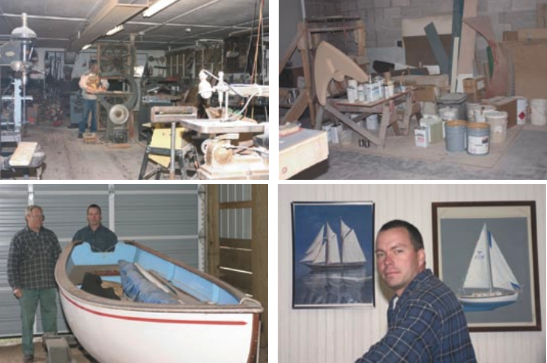
If a time traveler were drop into Bingham Boat Works today, he or she might well wonder what decade it is. The chandlery and many of the boat projects underway definitely speak of “today,” but the wood shop and several other areas speak of “yesterday.”
Bingham Boat Works was founded in 1930 in Marquette, on Michigan’s Upper Peninsula not far from the shore of Lake Superior, and it has grown over the years. But since four generations of Binghams have been operating on the same property, a comfortable sense of yesteryear has settled in. Not much changes if it doesn’t have to. The basic tools and types of skills required have not changed appreciably, although high-tech is the name of the game these days.
In fact, that’s what will impress time travelers the most as they tour the operation: the range of skills needed in order to offer a full-service boatyard. Joe and Thad Bingham (generations three and four), their wives, and a handful of employees possess skills in electrical work, plumbing, canvaswork, metalwork, painting, fiberglassing, woodworking, boatbuilding, boat designing, mechanical work, and other crafts. They must be able to haul, transport, winterize, repair, refurbish, modify, prepare for launch, and launch sailboats and powerboats. Between them, they must also have the skills necessary to run the business side of the operation.
Changing activities
The Binghams keep four people employed full-time all year round, although the activities of each person’s job change from day to day and from season to season. A few additional hands are always welcomed and are cheerfully employed, particularly during the busy times.
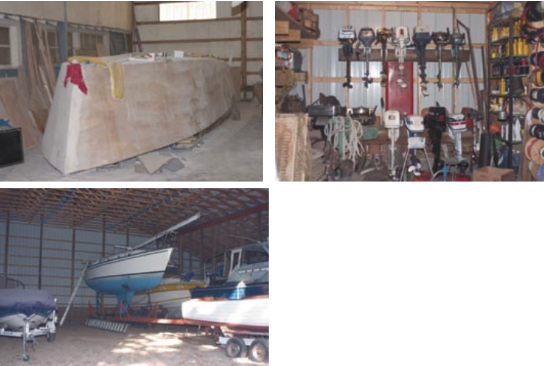
Boaters bring power and sailboats from all over lakes Superior, Huron, and Michigan for the Binghams’ indoor storage and winter projects, such as paint jobs and major overhauls. As boats change hands, the new owners hire the Binghams to add teak decks, repair fiberglass damage, or make modifications to cabinetry or upholstery. “People always change the boats they buy,” Thad says.
Other boaters want the full service that they can get at the Binghams’ yard year after year. “They shake your hand at the dock and they say, ‘Here’s my to-do list. See you in the spring,’” Joe says. Not that he minds. Boatwork that lasts through the winter is the bread and butter of the operation.
Things were different back in 1930 when Joe’s father, uncle, and grandfather started a business they called C. W. Bingham and Sons. His grandfather had a pattern-making shop on New York’s Long Island Sound building bronze patterns. It’s a long story, but both senior Binghams, father and son, wound up in Michigan working first to help build and then to maintain a large vacation lodge. They worked there for 14 years until the wealthy owners of the lodge experienced the devastating stock market crash of 1929 and laid off the staff. The Binghams began offering their skills constructing buildings and wooden skiffs. Their first boats, 14- to 16-footers, were a type of flat-bottomed fishing boat common to the area.
Homework and shopwork
By the time young Joe Bingham was in grade school, he was firmly entrenched in the family business. “I’d do my homework and my chores, then go to the shop and work,” he recalls. He swept the floor and learned the business, as he says, “pretty much from the ground up.”
Later he moved to Florida and worked for Hunter Marine for several years. He began on the production line finishing the trim on the 37-footer until Warren Luhrs’ successful circumnavigation in a Hunter 54 created great public interest in that boat. Joe recalls that the company built two hulls with different interiors to take to the winter boat shows.
Once the orders came rolling in, he was moved to the research and development section to set up the production line for building the interior for the 54 in a third and different configuration. But when his father died, Joe returned to Michigan to take over the family business.
Sometime in the 1950s, the family changed the company name to Bingham Boat Works. The operation remains on the same property, although boat-storage buildings, a canvas shop, and other buildings have sprung up over the years and a Travelift was added to move boats around the property.
These additions were evolutionary. What was revolutionary was the introduction of a new boatbuilding material: fiberglass. “My granddad said he wouldn’t sail in anything that was poured out of a bucket,” Joe says with a wry smile. Time has a way of marching on, however, and soon the boatbuilding family was building fiberglass boats of their own design.
Popular design
Their Sea Flea tenders are a particularly popular design that can be built in several variations. These popular little 8-footers began life as a winter project for the Binghams. The first dozen or so, Joe recalls, were built with the deck and seats as a one-piece mold. But that was heavy. So the next configuration had the seats molded into the boat with a separate deck. These days the boat comes without a deck. One seat is foam-filled, while the rower’s seat is made of wood. The gunnels take advantage of a plastic Trex-like material that looks like wood but requires no maintenance.
Joe notes that the Sea Flea rig also changed over the years due to customer requests. “If enough people are telling you it should be changed, you change it,” he notes. Building what the customers want is a simple business decision.
Joe has built a series of wooden boats for himself and the family, mainly during the slow times in the winter. His first boat was a clinker-built 15- foot Swampscot dory, then came an Atkins gaff-rigged 21-footer and another dory, an open 20-footer. A couple of powerboats followed: a 14-foot outboard and a 21-foot inboard. Most of these boats were sold as another project was begun.
The 28-foot sailboat that came next has remained in the family for years, even in spite of a few recent summers when she was not launched all season due to busy workloads. “We sailed that one for quite a few years. I have a couple of kids who would hang me if I sold that boat,” Joe says. (Ah yes, the family “good-memory boat.”)
Trailerable weekender
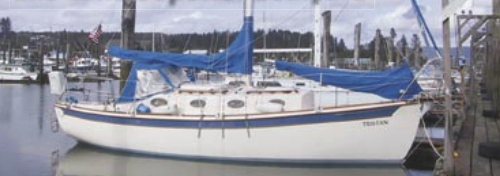
Later Joe was looking around for a project boat, a large trailerable, something large enough for a family weekend. He discovered a design by Fred Bingham (no relation) in one of the magazines of the time. Called the Traveler, it was a full-keel traditional-looking craft with an overall length of 31 feet, a length on deck of 27 feet 9 inches, and a draft of 3 feet 11 inches. He called Fred, who sent him the drawings and study plans. Joe made many interior modifications and a few exterior changes and worked on the boat as time allowed. He built the plug with Seaflex, a stable fiberglass material, and built the molds using that first plug, which was later discarded. Finally he built the first of what have so far been four fiberglass sailboats from the modified Fred Bingham design. The fourth was delivered this spring.
By the time the first was launched, Fred Bingham, well into his 80s, had closed his business. Joe decided to name the modified version created by Bingham Boat Works the Mobile 27.8 Cruiser, emphasizing its trailerability and cruising attributes. He and the family spent parts of one summer testing and enjoying the first of these cruisers on brief vacations before building the next one.
Next Joe and Thad decided to build a larger stitch-and-glue boat. Naturally, they’d built a variety of prams and dories using this method over the years. But this one would be different. They found a Ted Brewer design for a 34-foot powerboat in a copy of Boat-builder magazine and phoned Ted, who sent a drawing and study plans for the boat he named Quiet Time. They purchased the plans and set to work. That boat’s spent a couple of winters in the shop making slow progress; paying jobs have increased to the point that they’re not looking as often for something to fill a few winter hours here and there.
More feasting
“It’s feast or famine,” Joe says, glad to say that it’s been more of a feast the last several years. But it does keep him busy. Still, he says it’s fun. “In fact, I tell people that I don’t go to work,” Joe says. “I just go play all day.” What more could anyone ask?
These days Thad works side by side with Joe, and he’s still using some of his great-grandfather’s tools. When asked if he worked his way up in the business sweeping floors, like his father before him, Thad wonders aloud whether he’s working up or sideways. One thing is certain, he decides with a laugh: as he has assumed more responsibility, “the headaches have gotten bigger,” he says.
The obvious question is whether the fifth generation will be there to carry on the business. Thad has two daughters who do some woodworking and, yes, sweeping up around the shop. “The seeds are planted,” Joe says. And there are other family members who might yet get involved. Who can say?The business will continue to evolve as technology and boater demands change. What the future will bring, only the time traveler knows for sure.
Thank you to Sailrite Enterprises, Inc., for providing free access to back issues of Good Old Boat through intellectual property rights. Sailrite.com