Here’s what makes a boat turn turtle — and recover
Issue 43 : Jul/Aug 2005
A few weeks ago, a relatively inexperienced sailor told me he and his wife were planning to retire. They plan to do some extended cruising in their 30-foot yawl and wanted my opinion and recommendations. He was particularly interested in their yacht’s ability to handle heavy weather and, of course, to avoid or survive a capsize. Those seem to be the main concerns (and for good reason) of many would-be ocean voyagers, particularly those with limited offshore experience.
To my surprise, this sailor’s boat was the same Nimble 30 yawl that I had bought in 1986 and cruised in Northwest waters for seven years. That allowed me to reassure him that one sister ship, at least, had crossed the big pond with no problem. She sailed to England and then returned while taking part in the Singlehanded Transatlantic Race. That does not mean that she ran into extreme weather, of course, or that the boat could not be capsized if she were caught in a real buster of a storm.
Any yacht can be capsized in the mountainous seas that build up in a great ocean storm. The two questions that really matter are, first, how easily can she be capsized? And second, how quickly will she right herself if she is capsized?
The capsize angle
The answer to the first question lies in the vessel’s capsize angle, or range of positive stability (RPS), that angle from which the yacht will not right herself and will continue to roll to a 180-degree capsize once she reaches it. To determine a boat’s capsize angle, you need two things: the height of the vertical center of gravity (VCG) and a drawing (or computer input) of her hull and deck lines. The VCG height can be determined by an inclining test and, with that and the lines information, a yacht designer can determine the capsize angle. With computer lines this can be done quickly; with only a drawing of the lines it can be slow and tedious.
The ocean racing rules called for a minimum RPS angle of 110 degrees, but this is considered to be on the low side by many knowledgeable sailors who usually recommend an RPS of 120 degrees or more for cruising yachts. However, the measurements that are taken to determine the RPS for an ocean racing yacht are of the hull only and do not consider the volume of the trunk cabin or deckhouse. The righting effect of a large cabin structure can be very significant but, of course, only if the ports or windows remain intact and the hatches are reasonably strong. If a hatch fails or a large cabin window shatters under the pressure of the water while the yacht is inverted, the chances of her righting are decreased dramatically, regardless of how high her RPS angle may be.
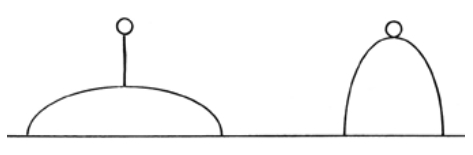
The second question, how long will she remain inverted, depends on beam and displacement to a large extent. The capsize screening factor (CSF) is a very rough guide, but nevertheless it is a guide. The number is simply the maximum beam divided by the cube root of the yacht’s displacement in cubic feet. (To obtain displacement in cubic feet, divide the boat’s displacement, or weight, in pounds by 64.) The CSF does ignore several important factors such as the VCG, the hull draft, and the deck structure. It simply concentrates on the one obvious fact that a beamy boat of a given displacement will be happier remaining inverted than a narrow boat of identical displacement. The figure above illustrates this clearly; both shapes have identical volume and draft, but it’s very easy to determine which will right itself more quickly. The purpose of the CSF number is to try to determine how long a boat will remain inverted before she is rolled back onto her feet by a “friendly sea.”
Two minutes capsized
The thinking is that the boat should not remain in the inverted position for longer than people trapped in the cockpit can hold their breath, say two minutes maximum, and that this would be the case of a yacht with an RPS of 120 degrees. In any case, the boat with a CSF number of 2.0 and lower is generally considered to be reasonably safe offshore. The lower the number, the better.
Even a 65-foot 12-Meter racing yacht, with its relatively narrow 11 1⁄2- foot beam, deep 9-foot draft, and incredibly high 72 percent ballast ratio, could be capsized under certain conditions. But she would pop right back up again, not unlike a child’s dumbbell clown toy, if she were rolled over by a monster sea. Incidentally, the typical 12’s CSF number would be around a very, very low 1.2.
One of my own designs, the 35-foot sloop, Globe Star, did a 360-degree capsize in mountainous seas after leaving Tasmania while on a west-east circumnavigation in the early 1980s. The boat has a CSF of about 1.76. According to her skipper, Marvin Creamer, she was not inverted for a great length of time. Marvin had already rounded the Cape of Good Hope. He went on to round Cape Horn and arrived back in New Jersey, successfully completing an incredible circumnavigation made without any instruments or sextant. The Globe Star had a deck-stepped mast, and the rig was strong enough to withstand the roll. More on this feature later.
A famous capsize was the 26-foot Sea Bird yawl, Sea Queen. She was skippered by John Voss, who, with two young men aboard, was caught in a typhoon in the Sea of Japan off Yokohama in the early part of the last century. His book, The Venturesome Voyages of Captain Voss, is well worth reading for his account of this episode. Also worthwhile is his description of his voyage from Vancouver, Canada, to London, England, in a converted Indian dugout canoe and — much more importantly for would-be ocean cruisers — his very knowledgeable dissertation on storm survival in small sailing craft. I highly recommend this book to all bluewater sailors.
Able at sea
Most sailors think of the 30-foot Tahiti ketch as being a rather sluggish performer but a particularly able small vessel, one that can handle adverse weather conditions in her stride. I have no definite data on the Tahiti design, but these boats are of very heavy displacement, relatively narrow beam by today’s standards, and with a rather short rig. I’d estimate their CSF at about 1.55 to 1.6, based on approximately 20,000 pounds displacement and 10 foot 6 inch beam. That is low for such a small boat. Nevertheless, a Tahiti turned turtle on an autumn voyage from Hawaii to Oregon in the 1980s and, although she righted herself, she did so sans masts and with her interior knee-deep in water. With her engine choked with salt water, no rig remaining, and a very inexperienced crew, she was a wallowing hulk, which resulted in a tragic death before the lone survivor was rescued by a passing freighter.
And then there is the case of Tzu Hang. This husky 46-foot ketch, with 11 1⁄2-foot beam and 7-foot draft, owned by Miles and Beryl Smeeton, was capsized by enormous seas off the coast of Chile. She was running before the seas under bare poles, trailing several heavy lines, when an almost vertical wall of water came up astern and virtually pitchpoled her end over end. She also lost her rig, but her experienced crew — consisting of the Smeetons and John Guzzwell — set a jury rig and managed to reach Chile after a heroic struggle. Incredibly, this happened a second time, with only the Smeetons on board. Tzu Hang was once more enveloped by a tremendous sea, capsized, lost her rig again, and again made it safely to Chile under a jury rig. I expect it was getting to be quite tiresome.
Particularly serious
I mentioned that the Globe Star did not lose her mast in her capsize. A dismasting in wild seas can be particularly serious for a number of reasons. First, the boat has lost a great deal of weight aloft and, while you might think this is beneficial because it lowers the VCG, it is not. Having the weight of the rig aloft greatly increases the boat’s transverse moment of inertia, in other words, its resistance to the kind of snap roll that can occur when hit by another breaking sea. Second, with the mast gone, the boat loses the buoyancy of the air-filled aluminum tube and thus a very important righting moment. Third, and the least of your worries at that moment, you’re now aboard a motorboat and probably a long, long way from shore.
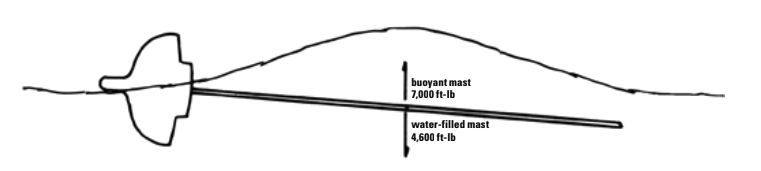
I did a rough estimate on the mast for a 35-foot cutter and came up with some interesting figures. An oval tube about 8 inches by 5 inches with 3⁄16-inch thick wall would handle the rig loads for the yacht. This tube, weighing about 4.26 pounds per foot and extending 44 feet above the cabinroof, would total close to 190 pounds, say, 210 with fittings. Each foot of the mast would contain just over 0.19 cubic feet of air and would provide 12 pounds of buoyancy, a total of 528 pounds. This, minus the spar weight, offers a net 318 pounds of buoyancy, and this buoyancy, centered 22 feet above the cabin, would provide 7,000 foot-pounds of righting moment with the boat lying on her side, knocked over to 90 or 110 degrees.
It is not a tremendous amount of righting moment, to be sure, but it certainly improves on the 4,600 foot-pounds of capsizing moment that a water-filled spar would be exerting (see illustration on Page 15). That is one reason I dislike inside halyards for offshore yachts: there are simply too many holes in the mast where water can pour in when the yacht is capsized. Of course, the difficulty of inspecting the halyards or replacing one at sea is another story yet and simply adds to my dislike.
Heavier rig
In-the-mast furling poses an even greater problem; the whole rig is heavier, there is even less buoyancy than with a normal tube, and that buoyancy can also be lost if the mast has internal halyards. Since stability increases as the cube of the size, large yachts can handle this kind of gear but, in my opinion, smaller yachts — especially those well under 40 feet — should have outside halyards and standard slab reefing.
I’m not even in favor of roller-furling headsails for smaller offshore yachts. They are detrimental to stability due to the added weight and windage aloft. When furled partway in a stiff breeze the headsail is not nearly as efficient as a smaller hanked-on sail, due to the bulge of the rolled cloth on the leading edge. Finally, when 100 percent furled in extreme conditions, it is impossible to lower it to change to a smaller sail or to lower the weight and windage to the deck.
Some readers know I don’t particularly favor deck-stepped spars for offshore yachts either. They need to be considerably stronger than a keel-stepped mast, so the added weight required is one factor. Of course, as I already pointed out, weight aloft does increase the transverse moment of inertia, and that is not all bad. The problem with a deck-stepped mast in case of a dismasting is that it is much more difficult to set up a jury rig than it would be with a keel-stepped mast extending even a few feet above deck.
One other point to note: if the boat does have a deck-stepped mast and outside halyards, by all means plug the heel of the mast to prevent it from filling with water in case of a capsize. A foam or wooden plug or a welded aluminum cap will do the job. Of course, you can foam fill the entire mast, whether deck-stepped or keel-stepped, but the foam for the 44-foot stick mentioned above would add about 45 pounds of weight aloft, and this is never good. Better to use caulking to seal all the holes that would let water in and hope for the best.
Adding stays
One thing the sloop owner can do is strengthen the rig itself by adding a staysail stay and backstays. This helps to insure that the boat will not be dismasted if the worst happens and it also provides a stay inboard of the stemhead on which to set a storm sail. Indeed, if you plan an ocean crossing, every single piece of rigging should be checked, and anything that appears remotely questionable should be replaced.
Sailors whose yachts have relatively high CSF numbers, say over 1.9, should give some thought to adding ballast as low as possible in the hull in order to increase displacement as well as to lower the center of gravity. Of course, any additional ballast must be fitted carefully, and strongly held in place by fiberglassing or other means, to ensure that it will not shift if the boat rolls over. The Tahiti ketch mentioned earlier had hundreds of pounds of loose lead pigs in her bilge that came crashing to the cabin overhead when she was capsized. Imagine how swiftly the water would rush in should one of those heavy pigs break through a hatch or skylight. Imagine how a heavy lead pig could break your bones or crush your skull if it fell on you.
Obviously, if the boat is capsized it is essential to keep as much water out of her as you can by ensuring that sail bins, skylight, lazarette, foredeck, and companionway hatches are as tight as possible. If several tons of water get into a capsized hull through a broken hatch it will drastically alter her VCG and greatly reduce the chance of her righting herself. Gaskets and solid locking catches on sail bins and hatches are necessary in extreme conditions. As well, yachts with large windows should carry shutters of Lexan, aluminum, or plywood that can be fitted when dangerous seas threaten. Solid shutters should have a small window cut into them for observation. Even small portlights can shatter, so yachts should carry several interior shutters that can be quickly fitted in an emergency.
Pros and cons
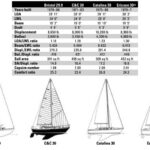
Consider the plusses and minuses of your own boat in light of the table shown on the facing page. This may all be quite scary to the neophyte, I’m sure, but seasoned sailors will know that the chances of being caught out in an extreme storm are relatively low. After all, hundreds of small sailing craft have successfully crossed oceans, from the mini 6- and 8-foot-long record breakers to open daysailers, dugout canoes, and folding kayaks, even a miniature 24-foot three-masted square-rigged ship with two men and a dog aboard. Still, it pays to insure against the worst and then pray that it never happens.
Thank you to Sailrite Enterprises, Inc., for providing free access to back issues of Good Old Boat through intellectual property rights. Sailrite.com