Make a note of all those details you should know, but don’t
Issue 45 : Nov/Dec 2005
My slip mate had a problem with his inboard engine. He had recently bought a Tartan 27 from a friend and thought it did not perform as well under power as it should. He asked my advice. The boat had a relatively new Universal 13-hp diesel engine installed in place of the old Atomic 4. The Atomic 4 apparently performed well, but the new engine did not or could not. What was wrong?
I thought about it and offered the suggestion that when the engine was changed out, the prop probably was not changed to a different size. I knew the engine had sufficient power as I had re-powered a 26-foot Pearson with a two-cylinder Yanmar. It performed well, but I had changed the prop to one recommended by the prop manufacturer. Both boats are of similar weight and dimensions, so engine size could be ruled out.
I asked him what the size of his current prop was. He didn’t know. I suggested he fi ll out a questionnaire from the propeller manufacturer and then see what it recommended. All well and good until the company required such information as “tip clearance” between the propeller blade tip and the hull. Since he had most but not all of the information, he could not complete the form.
He did not know such things as the rated brake horse-power of his engine and at what speed of revolution. Is the engine governed and at what speed? What is the gear ratio, the shaft rotation, the shaft diameter, the current propeller pitch and diameter, and the number of blades? All of this information is available on each boat, but some of it needs to be obtained when the boat is out of the water. He had recently had his boat hauled for a bottom job, but he did not know he was going to need any of this information and had failed to acquire it.
This true story should remind us all of the need to know the details about our boats . . . the details that we need to record but don’t. I’m no better than anyone else in this regard. I try to enter everything in the logbook when I do a job, but it’s not very organized. I’m going to try to set up a system of retrievable information for all of my boat’s systems, above and below water.
Clean bilge system
In my harbor, the dockmaster has decreed that all boats must have a “clean bilge system.” What, pray tell, is a clean bilge system? It turns out that this is a filter that is inserted into the discharge line of the bilge pump to catch any oil that might otherwise be pumped overboard with the bilge water. The idea is good as we have a lot of shrimp boats in the harbor that regularly discharge oil and diesel “inadvertently” in the middle of the night. Could I locate the size of my bilge-pump discharge hose? Of course not . . . not without going into the bilge to find the hose and spending some time upside down measuring it. This is the kind of information I am talking about. None of it is earthshaking or unobtainable, but it sure would be better to be able to look it up in a book and know it’s accurate. I don’t think I’ve ever seen an owner’s manual with all of the information in a concise form. Manuals will tell you that every boat is different, due to options. Since they are correct, this is just another reason why we need a details list of our own.
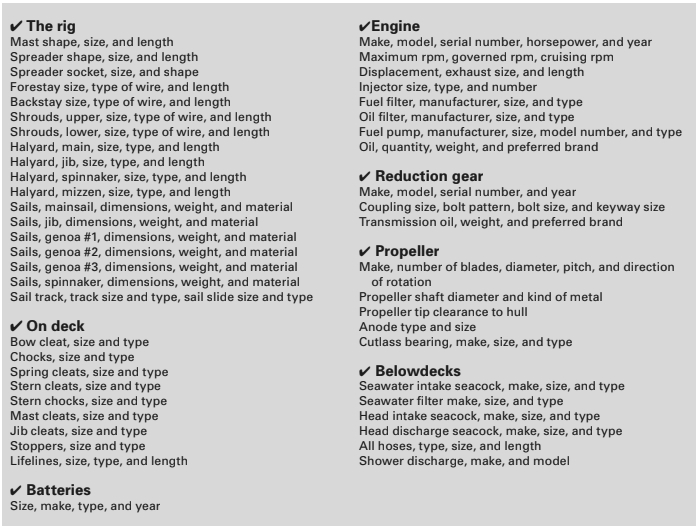
By now you understand what’s needed. I suggest one of those school notebooks as being suited to this task. The information does not have to be acquired all at once, but you need a permanent place to record it as you do various jobs aboard. It’s a lot easier to look in the book than to don scuba gear to check the prop or look in the bilge for the size of the seawater intake for the engine.
Start by defining each system and attempt to record all information for that system as you go along. Leave space to add or change information as it comes available.
The list above is by no means an exhaustive list and is only a suggested place to start for a comprehensive list for your boat. It is especially good to have a list like this for a good old boat, as so much has been replaced over time that any generalization will not apply from boat to boat, even from the same builder.
The reason we love our older boats is their individuality, but this requires a details list to keep up with all of the components. That day you found just what you wanted for your boat but didn’t know if it was the right size, if you would have had your book with you, you would have known and could have confidently taken advantage of the opportunity.
This, in itself, is a good reason for a list. Go at it slowly, and you’ll soon have a valuable document for the upkeep and maintenance of your boat.
Thank you to Sailrite Enterprises, Inc., for providing free access to back issues of Good Old Boat through intellectual property rights. Sailrite.com