How a good old canoe fooled generations of sailors
Issue 45 : Nov/Dec 2005
Ever dreamed of crossing an ocean? Most of us have. And, if you’ve done your homework, you’ll have read about some storm-survival techniques. And you’ll probably have stumbled across the name Voss in connection with sea anchors.
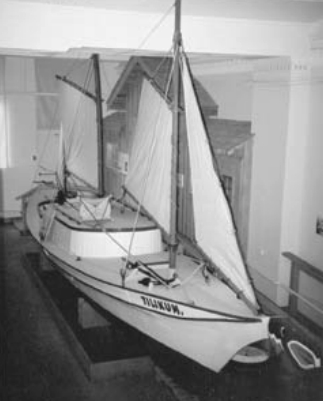
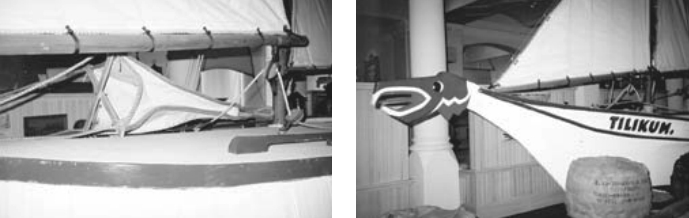
Capt. John Voss set out from Victoria, British Columbia, in 1901 to sail around the world. In an attempt to upstage the newly acclaimed voyage of Capt. Joshua Slocum, he chose a most unlikely boat — a 38-foot dugout Canadian Indian canoe that had been fashioned from the trunk of a giant cedar tree. Her topsides were built up 7 inches and she was rigged in bizarre fashion as a three-masted schooner, with stumpy masts and a tiny sail area of only 230 square feet. She was fitted with decks, a tiny cabin, and a ferocious native figurehead that belied her name, Tilikum, which meant “friend.”
If Tilikum didn’t look friendly, she didn’t look safe either. She was certainly the oddest craft up to that time ever to attempt a circumnavigation, and many people feared that Voss’ intemperate zest for fame and fortune had overwhelmed his considerable nautical knowledge.
But to the astonishment of his critics, Voss managed to sail Tilikum almost all the way around the world. And in a move that was to confuse sailors for decades to come, he credited his success to his sea anchor. During his long voyage he rode out 16 great storms behind his sea anchor. Never once did he ship as much as a bucketful of green water, he claimed.
Surprisingly small
When you look at Voss’ sea anchor on the deck of Tilikum in the Maritime Museum of British Columbia, it seems surprisingly small. It’s hard to believe a sea anchor with a mouth only a couple of feet across would hold a boat of this size head to wind. After all, those latter-day proponents of the sea anchor, Lin and Larry Pardey, used a parachute anchor with a 9-foot diameter to hold their 24-foot sloop, Seraffyn, in a gale.
Voss’ sea anchor was made of heavily roped canvas and wood, weighted at the aft end to make it sink. It had a square mouth, with each side tapering in a gradual triangle to a tiny exit hole. And the only reason it worked was because Tilikum was a dugout canoe with a draft of only 2 feet.
For more than 100 years, amateur sailors have been wondering why the sea anchor doesn’t work for them. The answer is quite simple. Their boats have deep keels and Tilikum didn’t.
A sea anchor will hold a multihulled yacht or any shallow-draft hull in a safe position, head to sea, in a storm. But it won’t work with the majority of deep-keeled sailboats around today. They simply won’t lie head-on to the seas behind a sea anchor of any normal size. But there is another tactic that offers hope.
When you douse all sail and lie ahull during a storm on a boat with a traditional keel, she’ll tend to lie with the bow slightly downwind of broadside-on to the wind and waves. That’s not only because many traditional keels are cut away up forward, but also because the considerable windage on the mainmast is applied in front of the center of lateral resistance, the boat’s pivot point.
Slow ahead
With the bow pointing slightly downwind, she’ll move ahead slowly and forfeit the natural safe haven of her slick. The slick is a tumbling, whirling mass of water spreading out to windward. It’s created by the keel’s being dragged sideways through the water like a barn door. It offers the same sort of protection that a solid reef does. It causes large powerful waves to trip over themselves and break prematurely, spending their energy at a safe distance instead of crashing down on top of you. But it won’t help you if your boat is moving forward at a knot or two.
The ideal position, of course, is dead downwind of the slick. But if you want to maintain that station, you’ve got to bring the bow up into the wind some, so she won’t run off. Some people with sloops try to do this with a deep-reefed mainsail only. Others use a special trysail, which gets a lot of its area way aft and pushes the stern downwind to achieve the same effect of lying exactly broadside-on to the waves and therefore exactly downwind of the protective slick. On some boats, depending on the shape of the keel, among other things, this tactic works well. If you have a ketch or yawl, a mizzen sheeted hard amidships might do the trick.
On other boats, the sails tend to drive the hull forward slowly, so that even if her position relative to wind and wave is now correct, she’ll still sail herself out of the slick.
That’s where people like the Pardeys come in. They advocate setting a sea anchor and adjusting its angle to the bow so the boat can’t move forward. Thus, finally, after a lot of complicated work, you have her pinned down behind her slick.
Wait and pray
Unfortunately, being pinned down means you can’t move out of the way of an approaching ship. You can’t go anywhere. You can only wait and pray. It’s a situation most skippers would be very reluctant to adopt, even in areas supposedly free of shipping. It’s a chance not everybody is prepared to take.
Voss was astute enough to admit that his sea anchor wouldn’t make all types of sailboats ride head-on to the waves. In fact, he said that many small craft rode best with a sea anchor streamed from the stern, with a storm jib set as a riding sail, sheeted hard amidships.
It’s a fact that most modern sailboats will lie quietly stern-on to the wind, either behind an ordinary anchor in shallow water or behind a sea anchor in the open ocean. The problem is that most yachts aren’t designed to withstand large waves crashing into the cockpit instead of riding harmlessly under the bow.
So what to do? All boats are different; no one solution fits all. But here’s a suggested battle plan for when you find yourself experiencing weather that would cause Capt. Voss to launch his sea anchor:
- If your boat has a fin keel, she probably won’t lie ahull safely or comfortably. Your best bet is to keep her moving, so the small keel can disperse overturning energy more quickly into a greater area of water. When your course is downwind, you can run off under bare poles or maybe a scrap of jib. If there are dangers downwind, slow your run with the modern equivalent of a Voss sea anchor, a Jordan series drogue. It consists of a series of dozens of 5-inch-diameter sea anchors threaded one behind another on a substantial nylon line. The advantage over a sea anchor is that you can adjust the degree of braking by paying out more or less line. It’s also much easier than a para-anchor or sea anchor to set in windy conditions from a plunging boat.
- If you have a traditional long keel, your best bet is to take down all sail and lie ahull with the helm lashed a-lee. If you can get your boat to lie downwind of the slick, with or without sail as we have already discussed, you’ll probably be able to ride out most ordinary gales without further ado. If she insists on edging forward, out of the slick, you could try streaming a series drogue in place of a para-anchor to check headway. In a really bad storm, should you find your boat being picked up bodily and flung sideways by violently plunging breakers, it’s time to quit lying ahull. Deploy a series drogue and run off downwind, adjusting the length of the drogue according to your need to move faster or slower.
The message here is that modern boats running off before storm-force winds must be prepared for heavy seas boarding astern. That means watertight cockpits and companionway hatches. It means big cockpit drains and substantial construction of everything aft, from the transom to a high bridge deck.
And it means you’ll need strong fittings to attach your safety harness to. One of Voss’ crewmembers, Louis Begent, was washed overboard in a storm and lost at sea. That’s another aspect of Voss’ voyage you don’t want to emulate.
Thank you to Sailrite Enterprises, Inc., for providing free access to back issues of Good Old Boat through intellectual property rights. Sailrite.com