A thorough discussion of the many causes of metal corrosion
Issue 45 : Nov/Dec 2005
Part 1 of this series in the September 2005 issue took a long look at marine corrosion theory, the galvanic series, chemical factors, physical factors, and types of corrosion.
Ferrous materials
Steel — Steel is primarily an alloy of iron and carbon. Pure iron is a relatively weak material, but when alloyed with 0.2 to 2.0 percent carbon, the resultant material is much stronger. Unfortunately, carbon steel, also called mild steel, possesses an active corrosion potential and exhibits poor corrosion resistance. Interestingly, mild steel corrodes at the same rate in fresh water as it does in sea water; however, the higher dissolved-solids content (electrical conductivity) of sea water results in more severe pitting corrosion. During the corrosion process, mild steel develops a voluminous oxide layer on its surface. However, this oxide is not a passivating film, since it is both porous and loosely attached.
Cast iron — Cast iron belongs to a family of alloys in which most of its carbon content is not in solution in the iron, as is the case with mild steel. There is free carbon in cast iron’s microstructure and, hence, a galvanic couple built right into the alloy. Also as a result of its manufacture, cast iron contains free graphite flakes. This makes it susceptible to degraphitization. The addition of chromium, nickel, or silicon can increase the corrosion resistance of cast iron.
Galvanized steel — By coating mild steel with zinc, passivity is achieved. Zinc is a cathodic coating, which inhibits the corrosion reactions at the cathode and is said to be safer than anodic coatings. Damage to a cathodic coating produces mild, uniform corrosion. Should a rupture occur in an anodic inhibiting coating, however, a highly active anodic site develops and severe pitting takes place.
Stainless steels — The main reason for the existence of the stainless steels is their resistance to corrosion. This is attributable to their relatively high chromium content. To be called a stainless steel, an iron alloy usually contains at least 12 percent chromium. The three general classes of stainless steels are martensitic, ferritic, and austenitic.
Martensitic stainless steels contain approximately 12 percent chromium as their principal alloying element. They make up part of the 400 series of stainless steels. All of the martensitic stainless steels are strongly magnetic.
Ferritic stainless steels are similar to the martensitic stainless steels in that they employ only chromium as their principal alloying element. The chromium content of ferritic stainless steels is in the range of 13 to 27 percent. They are also part of the 400 series of stainless steels and, like martensitic stainless steel, are strongly magnetic.
Austenitic stainless steels have two principal alloying elements: chromium and nickel. They contain a minimum of 18 percent chromium and 8 percent nickel and are often referred to as 18-8 stainless steels. They constitute the 300 series of stainless steels and are generally non-magnetic. Of the three classes of stainless steel, austenitic stainless steels possess the greatest resistance to corrosion and are the most widely used in the marine environment, with 304 and 316 the most common. While both are 18-8 stainless steels, 316 contains 2 to 3 percent molybdenum and affords superior corrosion protection to 304.
Stainless steels rely on the formation of a protective oxide coating for their corrosion resistance. This is accomplished by means of the metals’ reaction with oxygen in the air or dissolved in the water. The mechanism by which this is achieved is known as chemisorption. Clean stainless steels exposed to flowing water containing an abundance of oxygen rapidly develop and easily maintain this passivating oxide film. Should oxygen deprivation occur, such as under a deposit, however, a differential-aeration cell will develop and corrosion will occur. A clean surface is of paramount importance.
Galvanic corrosion of stainless steels can take place when they are in contact with more noble metals, such as copper alloys. Other potential corrosion problems include chloride-induced pitting and stress-corrosion cracking.
Non-ferrous materials
Aluminum — The most outstanding property of aluminum is its light weight and high strength-to-weight ratio. Aluminum is also quite resistant to corrosion, including a significant resistance to chloride ion attack. Aluminum’s passivation results from the thin, impervious oxide layer that forms naturally on the metal’s surface. Because this protective oxide is amphoteric, aluminum functions best in neutral pH environments. Avoid contact with acid-cure silicones. Also, the use of aluminum in multi-metal applications should be carefully analyzed to avoid galvanic corrosion.
Zinc — Zinc finds application on board in three areas. When used as a coating (galvanizing), it adds corrosion resistance to steel. As chrome-plated castings, zinc makes fine low-strength hardware for belowdecks, such as light hinges, decorative trim, caps, and housings. Most important, being near the top of the galvanic table and second only to magnesium, zinc is highly active. As such, it is commonly employed as sacrificial anodes, providing protection for the more noble metals aboard ship.
Titanium — Titanium has the highest strength-to-weight ratio of any metal. It is extremely noble and can form a highly resistant protective oxide film. In seawater applications, it is superior to most other metals. Because it is expensive, marine applications are limited to specialized fittings on high-performance racing sailboats.
Copper and its alloys — In its pure form, copper exhibits excellent corrosion resistance, mechanical workability, and conductivity. Except for electrical wiring and as an additive to some antifoulant paints, copper doesn’t see much use in the marine environment. However, its alloys often do.
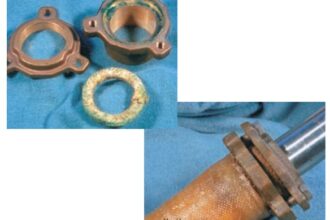
The most common copper alloys are the brasses. These contain from 15 to 40 percent zinc as the principal alloying element. As such, they are extremely sensitive to certain types of corrosion, most notably dezincification and, to a lesser extent, stress-corrosion cracking. Brasses can be used belowdecks for decorative trim and fittings but not topside where they can be exposed to salt air, spray, or immersed in sea water. Since they are a noble metal, they can cause severe attack when coupled with aluminum or steel.
Another class of copper alloys is the bronzes. These materials contain varying amounts of tin, aluminum, silicon, or phosphorus. True bronzes are extremely resistant to corrosion, including the pitting, stress, weld, and crevice types. Although they do technically corrode (forming a passivating, oxide film), they do so very slowly and uniformly. When compared to stainless steels, the bronzes are as strong, can be more easily cast, and are more ductile. They are an excellent marine metal. Fasteners made from silicon bronze are probably the most widely used and most satisfactory. For most underwater applications, bronze is the metal of choice. Like all noble metals, when coupled with less noble metal, bronze can promote galvanic attack.
Nickel and its alloys — Nickel, alloyed to a level of 30 percent with copper, provides excellent corrosion resistance, even in saltwater applications. It is as strong as mild steel and exhibits similar fabricating and welding characteristics. Due to the microbiocidal qualities of the copper, copper-nickel is non-fouling. However, since it is costly, copper-nickel applications are limited to centerboards, grounding shoes, and the like.
In general, as nickel content of the alloy increases, the overall resistance to corrosion increases.
Monel is an alloy comprised of almost 70 percent nickel, 29 percent copper, and 1.4 percent iron. By alloying iron into the metal’s matrix, resistance to erosion corrosion is dramatically increased. Monel makes first-rate pump shafts. Unfortunately, Monel is not easily polarized and, if involved with a galvanic coupling, it will accelerate corrosion of the less noble metal, such as steel. Like all the nickel alloys, Monel is pricey.
Two other well-known marine nickel alloys are trade-named Inconell and Hastelloy. Inconell is an alloy of nickel, chromium, and iron. Hastelloy is a combination of nickel, chromium, iron, and molybdenum. Like Monel, both are high-strength and corrosion-resistant alloys. Unlike Monel, Inconell and Hastelloy offer an attractive passivated surface due to their chromium content. This also makes them easily polarized and less active in galvanic couplings with less noble metals. Inconell and Hastelloy perform exceptionally well in high temperature and acidic conditions, such as are found in engine-exhaust components. These are the most costly of the nickel alloys.
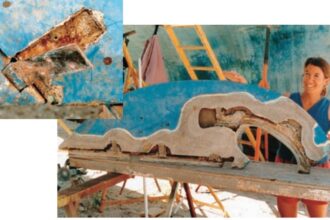
Lead — Lead’s primary application aboard ship is as ballast. It is a relatively noble metal, and the corrosion-inhibiting oxide film that forms on its surface is very effective, even in salt water. Because it is more noble than steel, when in a galvanic couple (for example, steel keel bolts in a lead keel), lead will accelerate the corrosion of steel.
Avoiding corrosion
Avoiding corrosion begins with the design process, continues with construction, and is followed through with good inspection and maintenance practices. While corrosion can never be entirely eliminated, it can be reduced to such a low level that its impact will be minimal over the life of the boat’s various components.
Material selection — Proper material selection is the simplest and most foolproof way to ensure satisfactory corrosion resistance. Applications below the waterline dictate the use of bronze or one of the cupronickel alloys. Stainless steel and marine-grade aluminum are good candidates for above the waterline.
Galvanic couplings should be avoided. If a fitting is to be in contact with another metal, materials that are as close as possible in the galvanic series should be used. Pay particular attention to fasteners. The metal lowest in the galvanic series will be the one that corrodes and, if smaller (cathode-to-anode ratio), it will fail quickly. Use stainless-steel screws in aluminum fittings, not the other way around.
Insulation — It may be nearly impossible to eliminate the use of dissimilar metals. In these instances, corrosion from galvanic attack can be avoided by eliminating the electrical contact between the dissimilar metals. This is accomplished through the use of an electrical insulator.
Rubber, Mylar, plastic electrical tape, and plastics can be used as insulators. They are commonly available in sheet or strip form and are easy to cut to shape and use. Silicone, polysulfide, and polyurethane are also insulators and are available in squeeze tube form. In addition to their insulating properties, silicone, polysulfide, and polyurethane also provide sealant/adhesive properties.
Coatings — Coatings are the most widely used method of protection. Some common coatings follow:
- Galvanizing — In galvanizing, a coating of zinc is applied to the metal’s surface (usually mild steel). This results in a tightly bonded coating that is impermeable to moisture and oxygen, while being corrosion- and abrasion-resistant. As an additional benefit, this cathode-covering coating is electrically anodic. It protects the cathodic mild steel electrochemically, should small holidays occur in the coating.
- Electroplating — Chromium is one of the most widely used materials in electroplating found in the marine environment. In its application, electroplating is a controlled form of corrosion, where the chromium is corroded and its ions are deposited (plated) onto the piece that is to be protected. In addition to corrosion protection, electroplated coatings also afford wear-resistance and, in most instances, are decorative.
- Anodizing — While anodizing is not a coating in the true sense, it is an electrochemical process that greatly thickens the natural oxide layer of aluminum. Prior to sealing this enhanced oxide (the final step in the anodizing process), a dye may be added to impart color.
- Painting — Painting is the major technique employed to combat corrosion. Paints consist primarily of pigments, binders, and solvents. Upon curing, the solvent evaporates, leaving behind a film of pigment and binder. The primary function of this film is to protect the metal’s surface from moisture, oxygen, chloride ions, and so forth. As a secondary benefit, the pigment adds a decorative touch and allows a means by which to judge the presence/absence and relative thickness of the film.
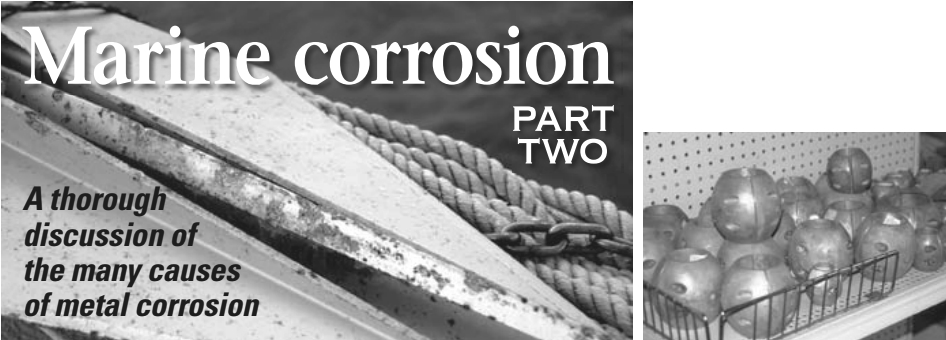
Cathodic protection — While all submerged materials used in boat construction should be of the noble variety, this may not be structurally or economically feasible. In order to afford protection from galvanic corrosion below the waterline, it is a common practice to install sacrificial anodes. Sacrificial anodes are generally castings made of zinc, aluminum, or magnesium. These anodes should be bolted in direct contact with the metal that they are to protect. They should be left exposed to the water and not painted. In operation, sacrificial anodes guide the destructive current flow to themselves and away from metal components essential to the boat’s construction or operation. This technique is called cathodic protection.
The amount of a sailboat’s metal that is exposed underwater is the principal factor in determining the weight/ number of the sacrificial anode(s) required.
On fiberglass and wooden boats, sacrificial anodes are employed to protect the underwater metal fittings from each other. In order to accomplish this, the sacrificial anodes and fittings must be bonded (electrically connected) to one another.
On metal boats, sacrificial anodes are there to protect the hull from the underwater fittings, as well as from itself. In this instance, the sacrificial anodes are mounted directly to the hull and bonded to each other. If the fittings are of a metal dissimilar to that of the hull, they must be insulated from the hull. To protect these fittings, they must be bonded to each other and to a separate set of sacrificial anodes that are also insulated from the hull.
Maintenance and inspection — This area of corrosion control is one where the boatowner has complete control. Most indicators of corrosion are in plain view.
Once a year, give the rigging a close look. Pay particular attention to turn-buckles, swaged fittings, chainplates, spreader tips, and the mast heel. Wash aluminum spars with fresh water inside and out to remove dirt and salt deposits. Allow them to air-dry thoroughly and then wax them.
Inspect metal fuel and water tanks. Rub a hand over all surfaces that can be reached. Any corrosion felt or seen suggests further investigation:
- Keep a dry, sweet-smelling bilge.
- Do not allow electrical wiring to stray into the bilge.
- Check the condition of wiring insulation and connections.
- Inspect keel bolts.
- Check the propeller and shaft and/ or lower end of an outboard motor.
- Renew sacrificial anodes annually.
- Inspect through-hulls. If bronze, lightly scratch them. If yellow in color they are OK; if reddish, corrosion is taking place.
- Check out the anchor, its chain rode, and the locker. Signs of rust suggest that the galvanizing may need to be renewed. Any deposits or debris should be removed from the locker as well as from the ground tackle itself.
- Run the engine and inspect the exhaust system components for leaks.
- Monitor the engine temperature to determine if the heat exchanger is fouled, which is the precursor to under-deposit corrosion.
- Avoid the use of graphite-impregnated packings or lubricants containing graphite. Graphite is more noble than most metals and will promote attack along its lines of contact.
In addition to maintaining the cleanliness and beauty of a boat, periodic and routine washing, waxing, and painting are the first lines of defense against corrosion.
Thank you to Sailrite Enterprises, Inc., for providing free access to back issues of Good Old Boat through intellectual property rights. Sailrite.com