Keep your batteries topped up with a slow but steady charge
Issue 46 : Jan/Feb 2006
On a bright, sunny day, with the sun directly overhead, the sun supplies about 1,000 watts of energy per square meter. If all the energy across the sun’s electromagnetic spectrum could be collected, it wouldn’t take a very large solar array to supply all our needs on shore and on the water.
To convert a portion of this energy into electricity, we use photovoltaic cells (photo, meaning light, and voltaic, pertaining to electricity). But these systems are usually less than 15 percent efficient at the most, since, in the wide range of wavelengths that reach us from the sun, only a very limited range can be converted into electricity by these cells. In addition, the necessary grid on top of a photovoltaic cell can block some of the incoming light, and the solar panels are made from highly reflective silicon-based semi-conductors.
The cells used in a solar panel are generally constructed of one of several types of impure silicon, and each of these individual cells has a maximum output of about 0.5 volt. When light — in the form of photons — strikes a cell, it knocks electrons loose. These electrons are directed so they create a current flow between the metal contacts at the top and the bottom of the cell and, combined with the cell’s electric field, create a voltage from which the cell can produce power.
Types of solar panels
There are three basic types of solar panels available:
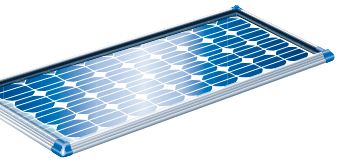
- Monocrystalline panels are recognizable by their black, round, or semi-circular cells, connected by silver wires. The use of these has dwindled in recent years.
- Polycrystalline cells use a different type of manufacturing process. These panels can be recognized as black, rectangular cells, closely packed together, resembling a tiled wall. Polycrystalline panels can reach about 11 percent efficiency and are a common product in the solar-panel marketplace. Solar panels of monocrystalline or polycrystalline cells consist of 30 to 36 individual cells (for a 12-volt system) wired in series.
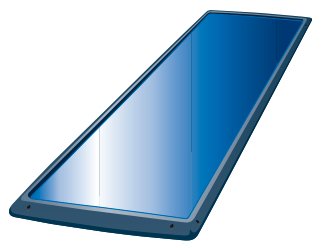
- Amorphous panels are built up as a single unit with combinations of parallel and series cells and conductors linking them. Amorphous panels, as the name implies, have a uniform surface with no apparent individual cell structure. Electrically, they are a combination of series and parallel cells and typically incorporate numerous by-pass diodes, which give them a distinct advantage where shadows are present. But, since amorphous panels only reach 6 to 7 percent efficiency (about half that of monocrystalline and polycrystalline panels), they need to be bigger for a given output.
Amperage available from any solar panel is proportional to the area of each cell. The cost-per-watt of the three panels is about the same, and a rough estimate is that a solar panel system aboard a boat will run about $6 to $8 per watt, with amorphous panels at the high end of the price range. The space required is vastly different, though. For a given power output, the space required for the less-efficient amorphous panels is about twice that of the monocrystalline and polycrystalline panels.
All three types of panels — when properly cared for — have a life expectancy of more than 20 years. Typically, these panels will give about 80 percent of their rated output when they’re 20 years old.
Panel mounting
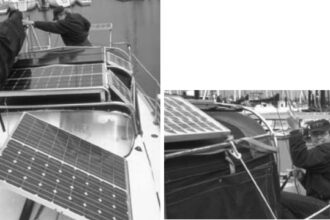
Panels should not be in a location where they might be walked on, and they must be firmly attached so they can’t be dislodged by wind or waves.
The performance of a solar panel is highly dependent on the panel’s orientation to the sun, the latitude it’s operating in, the season of the year, cloud-cover, time of day, shadows, and temperature. For maximum efficiency, it should be oriented at right angles to the rays from the sun.
Shadows on these panels are a big problem aboard sailboats. With monocrystalline and polycrystalline panels, a cell with a shadow on it not only doesn’t contribute power, it also blocks the power generated by the other cells. The cells in these panels are wired in series, much like a string of Christmas tree bulbs, so when one bulb (or cell) is out, the whole string goes dark.
In mounting solar panels it is best to use framed panels with glass overlays. Particular attention should be given to possible corrosion where the electric wires exit the panels. Panels facing south, toward the equator (or north, toward the equator in the Southern Hemisphere) should be tilted at an angle to the horizon equal to their latitude for best overall results. Modifying this angle, due to the changing declination of the sun throughout the year, is also helpful. There are solar-panel-tracking devices available that perform this function automatically.
Sailboats on a mooring must take into account the direction of the prevailing winds when selecting the best position for a panel.
Electric hookup
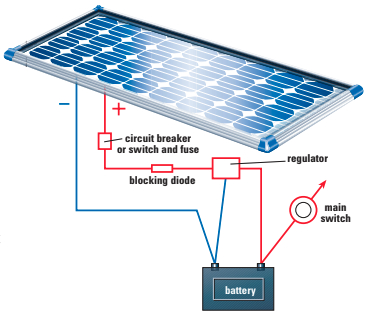
The energy from solar panels on boats is stored in batteries. These batteries will last much longer if they aren’t overcharged, so a regulator between the solar panels and the battery is necessary. Some panels are described as self-regulating, which is done by decreasing the number of cells in the panel from 36 to 32 or 30. Nevertheless, many batteries have been ruined by this rather crude method of preventing overcharging. Blocking diodes in the circuit are also necessary to prevent the panel from draining the battery at night or from a boat’s alternator feeding into the panel and burning it out. The downside of using blocking diodes is that they reduce the charging voltage to the battery.
A solar panel’s output voltage reduces with a rise in temperature. This is a paradox, since you want the most sunlight possible but, at the same time, the least heat. Thus, solar panels are at their most efficient on cool, sunny days.
Thank you to Sailrite Enterprises, Inc., for providing free access to back issues of Good Old Boat through intellectual property rights. Sailrite.com