Available fuel choices for cruising sailboats
Issue 47 : Mar/Apr 2006
The selection of the best galley stove for use aboard your sailboat depends on the size of the boat, the layout of the galley, and the type and amount of cooking you plan to do. Your selection will also depend on your budget as galley stoves run from $40 to $4,000.
There is a wide variety of galley stoves and fuels: non-pressurized alcohol, pressurized alcohol, small liquefied propane or butane canisters, liquefied propane using large pressure tanks, compressed natural gas, kerosene, diesel, electric, ceramic-glass electric, and microwave. Galley stoves are also available as combinations, such as an alcohol/electric combo or an electric burner/microwave-oven combination.
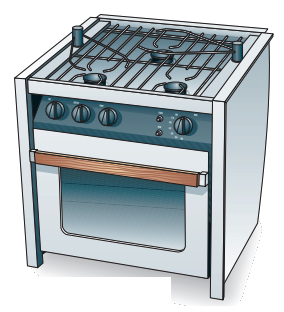
These stoves come as a simple single-burner or as multi-burners with ovens. A galley stove that is gimbaled has a distinct advantage and is usually mounted facing athwartships so level cooking can occur when the sailboat is heeled. Gimbaled stoves should also have a method for preventing the stove from gimbaling — usually a barrel-bolt. The pivots for a gimbaled stove should be at the level of the bottom of the cooking pan. Fiddles around the edge of the stove-top with adjustable arms that encircle the pots should be high enough to prevent pots from moving. Galley stoves should be corrosion- resistant, preferably made of stainless steel.
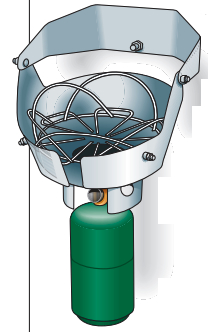
Liquefied petroleum gas (LPG)
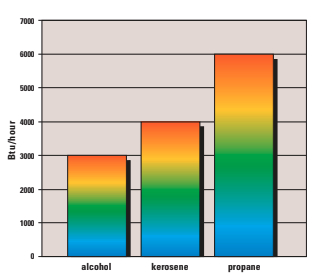
Most boatowners select LPG for their galley stoves, since these stoves operate much like home stoves and provide about twice the heat of alcohol. LPG can be butane, propane, or a mixture of the two. These gases become liquid under pressure and must be contained in specially designed tanks, with aluminum the preferred tank material. When pressure is released, the liquid becomes a gas that burns hot and clean but is very explosive. Both butane and propane are heavier than air, which means that the gas can collect in the bilge, so the strict safety protocols established by the American Boat and Yacht Council (ABYC) must be observed in the installation and operation of an LPG stove. Gas detectors, or “sniffers,” should be part of the installation. LPG is available worldwide, however outside the United States metric adapter fittings are necessary to refill a tank that has American threads. Small camping-style LPG stoves use canisters that are discarded after use. These canisters are usually available in hardware or camping stores. They should be treated like large tanks used for LPG. When not in use, they must not be stored belowdecks.
Alcohol
Other than the small, camping-stove-type canister LPG stoves, alcohol stoves are the most inexpensive type of galley stove available, but their heat output is less than compressed natural gas and only about half that of propane and butane. Alcohol vapor is heavier than air, so alcohol — which was once proclaimed the safest of fuels — is now also considered dangerous when improperly or casually used.
Non-pressurized alcohol stoves — those containing a material saturated with alcohol and operating much like a Sterno stove — are much safer than pressurized alcohol models. These non-pressurized stoves require no preheating, which can sometimes be a hazardous operation.
The pressure for pressurized alcohol stoves comes from a tank that has to be pumped up with air. Alcohol is expensive in the United States and very expensive and difficult to obtain elsewhere in the world.
Compressed natural gas (CNG)
The main advantage of CNG fuel (primarily methane) is safety since this fuel is lighter than air and will not accumulate in the bilge. Nevertheless, one should apply the safety standards of LPG to CNG. The tanks should not be stored in the cabin, although many installations ignore this admonition. As with LPG, ABYC recommendations should be followed in the installation. These tanks are leased, not purchased. When refueling, the empty tank is exchanged for a full one. CNG is more difficult to obtain than LPG and has a higher cost, mostly due to a more limited distribution infrastructure. CNG has lower Btu-per-pound than LPG. In any installation, a CNG tank cannot be substituted for LPG or vice versa.
Kerosene
Though kerosene is universally available and relatively inexpensive, kerosene galley stoves are seldom seen, except aboard some older boats. Pressurized kerosene stoves burn kerosene vapor and have a blue flame similar to an LPG stove. However, just as with pressurized alcohol stoves, the burners must be pre-heated with alcohol to vaporize the kerosene before use. The pressure for kerosene stoves comes from a pressure tank that has to be pumped up with air. In some cases pressure is supplied by a gravity feed.
Electricity
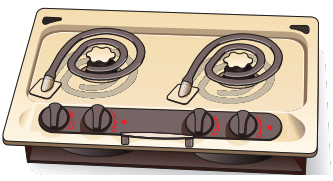
Only sailboats with very high-output generators will have enough power to operate an all-electric galley since the power needed can be in the multiple thousands of watts. On small sailboats, however, a single-burner electric hotplate can be useful in a marina when you’re connected to adequate shorepower. For the ultimate in electric cooking tops, ceramic-glass electric galley stoves are also available, as well as 12-volt DC or 120-volt AC microwave ovens.
Diesel
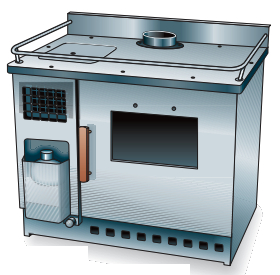
Diesel stoves are seldom seen on recreational sailboats, except on large boats operating in very cold climates where the stoves double as cabin heaters. Diesel stoves, which are usually quite heavy, provide a very hot flame. In a boat with a diesel engine, the fuel can be supplied from the engine’s fuel tanks. Often the fuel is pumped from the engine’s tanks into a small overhead tank, using a gravity feed from there to the stove. Pre-heating the burner is necessary, and diesel stoves must be vented through a Charlie Noble on deck.
Thank you to Sailrite Enterprises, Inc., for providing free access to back issues of Good Old Boat through intellectual property rights. Sailrite.com