Make your own sacrificial strip for the genoa
Issue 48 : May/Jun 2006
It was time to replace the sacrificial sun cover on our 150-percent genoa. It wasn’t worn out or damaged, but I was getting tired of looking at that particular shade of blue. It seemed that everywhere I looked, the previous owner had used that same color on everything: dodger, Bimini, sail cover, canopy, winch covers, seat covers, and so on.
Since purchasing the boat I had made several changes and upgrades. Most of them were functional. However, a few were made for aesthetic reasons. Replacing the sacrificial sun cover was to be an aesthetic move. It was time to add personal touches.
At the end of the season I contacted my favorite sail loft. The owner and sailmaker, Bilgewater Bill, gleefully informed me that the job would be simple, quick, and only cost about $350 . . . that is, assuming that he didn’t run into any snags. While I liked hearing the words “simple and easy,” I didn’t much care for the $350 part of his proposition. There had to be another way.
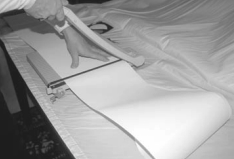
According to the Sailrite catalog, there are two materials that work well as sacrificial sun covers. The most common and durable is Sunbrella, a solution-died acrylic fabric. This material is available in a rainbow of colors. However, it’s a bit on the heavy side at 9.5 ounces per yard. The second choice is Dacron insignia cloth impregnated with a UV inhibitor. While it’s much lighter, at 3 ounces per yard, it’s only available in white. Fortunately, that was the color I was leaning toward. Even though sewing is required for both materials, the Dacron insignia cloth has an adhesive back, which makes installation very easy. Also, unlike the Sunbrella that has to be cut down from 46- or 60-inch widths, the insignia cloth comes conveniently slit into 10-, 14-, or 18-inch widths. I was sold.
Choosing the width
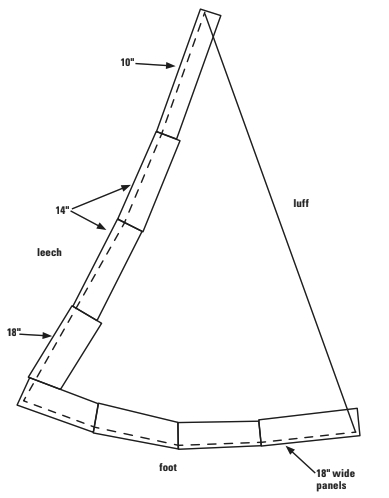
The first step was to measure the foot and leech of my sail. Then I had to determine what width cloth to use. I chose 18-inch cloth for the foot and, since the current sun cover gradually tapered as it rose along the leech, I selected a combination of 18-, 14-, and 10-inch cloth. In all instances, I would be covering the previous thread holes with the new sun cover and then sewing it onto undisturbed sailcloth.
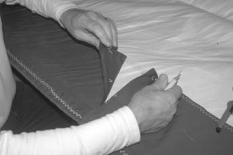
While the material was on the UPS truck headed my way, I removed the old sun cover. Since it was only sewed on (not glued), this process was pretty straightforward.
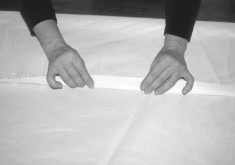
My genoa is a fairly large sail and the foot curves a bit, so after the material arrived I divided the length of the foot by 4 and cut the 18-inch cloth into four sections plus 3 inches for overlap. I loosely positioned the panels along the foot so they could be folded around the edge of the foot such that they would overlap each other by about an inch to an inch and a half. At the overlap of each panel, I angled them to follow the sail’s contour, making sure to leave a 1 1⁄2-inch strip to fold over the edge. Once I was satisfied with how it looked, it was time to begin the installation.
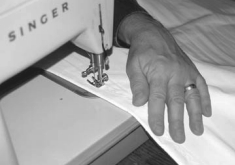
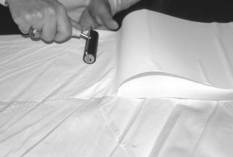
Starting at the clew, I peeled the paper backing away from a small portion of a panel and began smoothing it down as I continued to remove the backing. Once the panel was stuck in place, I folded the 1 1⁄2-inch strip over the edge and against the other side of the sail. I continued this process with all the remaining panels, including the leech, which was also divided into four sections. To ensure that there were no trapped air bubbles, I used a wallpaper seam roller to smooth the cloth, especially around the edges and seams.
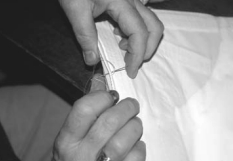
Using a zigzag stitch placed within 1⁄4 inch of the panel’s edge, I sewed the adhered panels to the sail with Dacron thread. I sewed all edges, including the overlap. I took particular care at the leech’s edge not to damage or sew the leech line. Because of the reinforcement at the tack, clew, and head, I hand-sewed these areas.
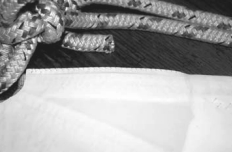
The entire process was relatively easy and took the better part of a Saturday. Best of all, the cost for cloth, thread, and instructions was less than $150.
Thank you to Sailrite Enterprises, Inc., for providing free access to back issues of Good Old Boat through intellectual property rights. Sailrite.com