Coil and stow that line following British tradition
Issue 48 : May/Jun 2006
Any time we crew for another skipper, I think most of us take a look around and try to acquaint ourselves with how things are done, asking the occasional question just to make sure. It’s not that we might bring bad habits with us — no doubt our own vessels are as smartly run as many — but introducing some unexpected variant can cause big problems.
Knots can be vexatious, not only the Gordian tangle anticipated of the tyro but the quirk that maybe I tuck my bowlines and the skipper doesn’t, so if he grabs it in the dark it won’t feel anything like a bowline, and he has every right to bawl me out for not telling him.
Aboard my little ship, how cordage is coiled and stowed is not negotiable. One fellow who used to sail with me insisted that he knew how it should be done. He would take the unsuspecting rope, wrap it Biblically in cubit turns around the elbow and thumb, gritting his teeth while the impromptu Spanish windlass hauled those two parts of his anatomy inexorably closer to each other, finally dragging the murderous seizing from the cold white digit just before gangrene set in. He would then clap on a multitude of turns around the kinked-up coils, shove a bight through, over the end, another bight through the first bight, round the other way, over, under, through, and haul taut. The finished heap of knitting would then be held aloft, the perpetrator massaging life back into his thumb while the ghastly object twitched and groaned with the continued parting of tortured fibers deep within its labyrinths. That is a mean way to treat a piece of rope.
Do it gently
Rope should be coiled gently, stretching each length between the outstretched hands and introducing a slight twist between thumb and index finger to counter the reverse twist otherwise caused by simply coiling regardless. The first sign of this twist is that the coils want to form in figure-eights. The coils should be gathered in the left hand, the right forms the coils clockwise and as each coil drops over the palm of the left hand, the right-hand finger and thumb twist the rope also clockwise, as when tightening a nut on a right-hand thread. All coils should be the same size; this comes with a little practice.
Few elements mark a well-run ship more than how her cordage is coiled and stowed. Call me a patriot (and a British one at that) but the neatest and simplest method I know to secure the coil and stow it is the admiralty hitch.
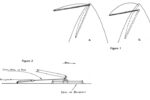
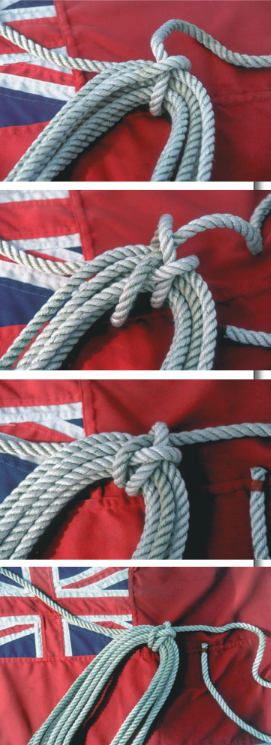
Still holding the coils, now clenched firmly in the left hand, take the end section of the rope, the last few inches that went onto the coil — we’ll call that the standing part — and pass it around the coils, away from yourself over the top (and over your extended left index finger) and back under toward yourself through the coils, then up and under the standing part (through the tunnel prepared by your index finger) and around again, parallel to the first turn on the side nearer to your left hand, this time wrapping over the standing part then under itself to form a constrictor knot. How to tie a knot defeats my ability with the written word, but the admiralty hitch is really pretty simple. The series of illustrations will make sense of the convoluted description.
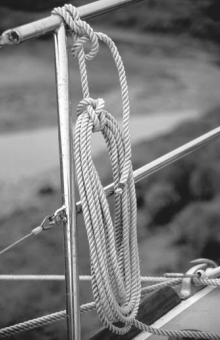
This leaves a short tail of rope at right-angles to the coil. The neatly and securely coiled rope can thus be stowed by hitching it to a rail, or a bowline can be formed in the end to hang it on a hook.
This stow works well for a heaving-line; it’s seldom difficult to separate into the necessary double coil. It’s simple, efficient, and (dare I say it?) traditional.
Thank you to Sailrite Enterprises, Inc., for providing free access to back issues of Good Old Boat through intellectual property rights. Sailrite.com