A high-tech substitute for the bowline knot
Issue 48 : May/Jun 2006
Steve Brennan was up in a bosun’s chair during a race some years ago, trying to free a spinnaker-halyard splice that had jammed in the sheave, when he told himself in frustration that there had to be a better way. It wasn’t until 1998, while the aeronautical engineer was working on the design of a nuclear submarine, that the answer came to him. The result is the SplicingNut, a patented device intended to replace bowline knots and splices in many, but not all, applications on a sailboat (and in tents).
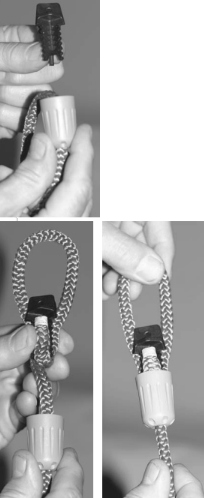
The SplicingNut is a two-piece, glass-reinforced-polymer device that creates a loop to which a sail, a ring, a shackle or a fender can be attached. Available for four line sizes (3⁄16, 1⁄4, 5⁄16, and 3⁄8 inch), Steve says the SplicingNut has some real advantages over a knot: the line will “never back out,” the shape of the SplicingNut means it is unlikely to snag on anything, it won’t pull through a sheave, and it can be undone under load.
Despite its virtues, Steve doesn’t recommend the SplicingNut for anchor and mooring lines. And the SplicingNut doesn’t work especially well with high-tech line. But for most single- and double-braid polyester, Steve says the SplicingNut is “the right one to use 85 percent of the time.”
The SplicingNut can be thought of as a Sta-Lok fi tting for line. But while a mechanical fitting like a Sta-Lok will create a connection as strong as the wire rope itself, the SplicingNut does decrease the breaking strength of the line, just as a bowline or any knot does. Any bend in a line reduces the strength of a line, Steve says, and the SplicingNut uses two bends. While he has test data on his instruction sheet and website, Steve says it’s best to think of the SplicingNut as a substitute for a bowline: if you wouldn’t trust a bowline for the job, you probably shouldn’t use the SplicingNut.
Bought two
I bought a pair of SplicingNuts for 3⁄8-inch line at the Annapolis Boat Show. When I read the directions, it wasn’t terribly clear to me how the product would work. But when I had it in my hand and followed the directions using a piece of line, all fell into place . . . until I tried to tighten the nut. The SplicingNut is supposed to work without tools (except for the 1⁄4-inch size, which is bit small to get a grip on), but I couldn’t tighten it properly even using two wrenches.
I called Steve and he talked me through an easy fix, which the written directions didn’t adequately explain. To evenly compress the line as the nut is tightened, you have to take two turns forward and one turn back as soon as you can’t tighten it by hand any further. This seemed counter-intuitive to me, but it worked quite well and closed a SplicingNut that defied two wrenches. Steve, who runs an industrial design firm and sails a Wylie 34, promised to revise the directions. In fact, he said it was important to read the directions carefully, because, as noted, the SplicingNut is not the right tool for every job; it is important to understand its limits as well as its strengths. The SplicingNut is currently available from Steve’s company, InoDesign Inc. http://www.SplicingNut.com.
The SplicingNut won’t change your life, but it is an elegant and attractive product. And, Steve notes, it’s a patented device that isn’t priced like one. That alone makes it an innovation in the sailing world.
Thank you to Sailrite Enterprises, Inc., for providing free access to back issues of Good Old Boat through intellectual property rights. Sailrite.com