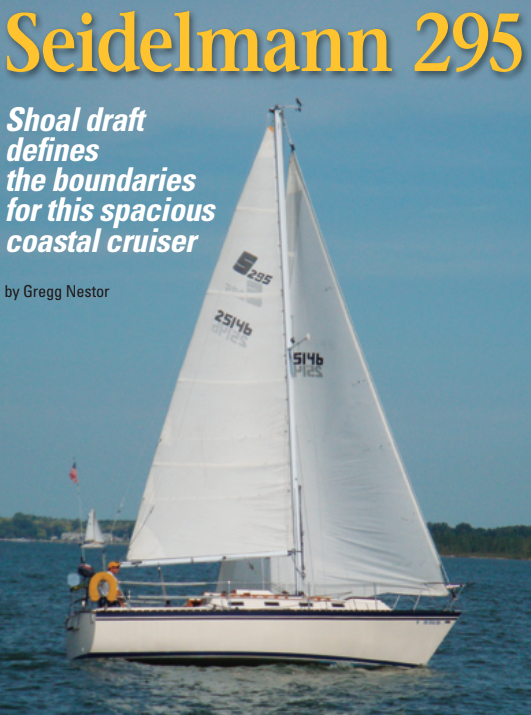
Shoal draft defines the boundaries for this spacious coastal cruiser
Issue 75 : Nov/Dec 2010
J. Robert (Bob) Seidelmann was recognized as a champion one-design sailor and won top honors in Lightnings, Comets, Dusters, and several other classes. In 1961, along with his father, he founded Seidelmann Sails in New Jersey. Boats with their sails soon began garnering national and world championships in numerous classes ranging from Penguins to E-Scows.
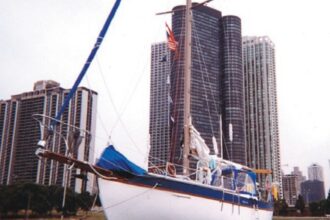
After a decade or more of sailmaking, Bob started Seidelmann Yachts. He had studied engineering at the Drexel Institute of Technology and was an accomplished composites engineer. In fact, he designed and manufactured all of the fiberglass tooling for his Berlin, New Jersey, manufacturing facility. Most of his boats were of his own design and ranged in size from 24 to 37 feet. Initially, Bob concentrated on producing boats for racing. These early boats were of sound construction, did acceptably well on the racecourse, but were tender. He expanded the line rather quickly and with this growth the quality seemed to suffer. Seidelmanns developed a poor reputation, which tends to limit resale value, even if a boat is in premium condition. However, our review boat, Windquest, a 1986 Seidelmann 295 owned by Thomas and Rebecca Maund of Sullivan, Ohio, seems to contradict this impression and appeared reasonably well-built.
Seidelmann Yachts acquired Pacemaker Yachts, a powerboat builder, around 1984. Bob immediately redirected his focus and began building powerboats under the Pacemaker name. The last Seidelmann sailboat left the factory in 1986. The production of powerboats continued until the fall of 1992, at which time the family business closed. During the course of his career, Bob Seidelmann built over 1,700 boats. He passed away in 2004.
Design
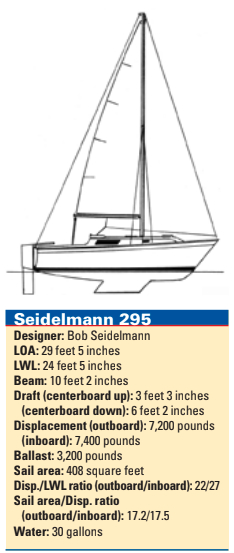
Introduced in 1982, and in production until 1986, the Seidelmann 295 was the last sailboat design to come from Seidelmann Yachts. While most of the early boats were developed with racing in mind, the 295 was conceived, designed, and marketed as a cruiser.
The Seidelmann 295 has a strong sheer, raked bow with long overhang, and a traditional counter transom. Unfortunately, the boat’s generous freeboard often dominates other design elements.
To offset the boat’s high topsides, Bob drew a long, low, cambered coachroof. With more than 6 feet of headroom, and the boat’s 10-foot 2-inch beam and full midsection, the interior is spacious. Carrying the beam well aft led to flatter hull sections. This can result in higher speeds off the wind but also means the boat will have more of a tendency to round up and be more likely to pound than one with more deadrise.
The transom-hung rudder and fin keel with centerboard give the boat plenty of maneuverability. While the 3-foot 3-inch shoal-draft keel allows the 295 access to shallow water, dropping the centerboard improves windward performance.
Construction
The hull of the Seidelmann 295 is a solid hand-laid fiberglass laminate. The deck is also hand-laid fiberglass (with all horizontal areas cored with end-grain balsa) and has an effective molded-in non-skid. The hull-to-deck joint is an inward-facing flange arrangement, bedded in butyl rubber and chemically bonded with a urethane adhesive. It’s also through-bolted with stainless-steel bolts that secure a T-shaped black-anodized aluminum toerail. Seidelmann finished the hull with a boot top and sheer stripe painted with linear polyurethane.
The cast-lead shoal-draft keel incorporates a recess that houses the non-weighted, fiberglass centerboard. It’s attached to the hull with stainless-steel bolts and bedded in epoxy. The rudder is hand-laid fiberglass.
Unlike many of its contemporaries, the Seidelmann 295 is not constructed with an internal fiberglass pan or liner. Rather, the boat’s interior is “stick-built” using solid teak and marine-grade plywood faced with teak veneer or an off-white plastic laminate. In the accommodations, the overhead and hull are covered with padded vinyl. All of the bulkheads are single-tabbed to both the hull and the deck. The quality of the joiner work in Windquest was above average.
All of the deck hardware is of good quality and properly through-bolted to backing plates. There are proper seacocks and double hose clamps on all below-waterline through-hulls.
Deck features
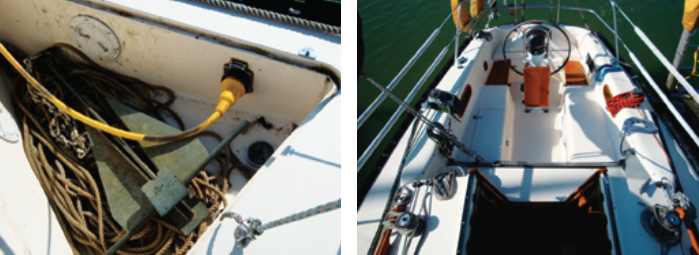
A pair of 8-inch cleats and their accompanying chocks are fitted on the foredeck, which is also furnished with a voluminous anchor locker. As a factory option, our review boat’s shorepower inlet, potable water fill, and waste pump-out were installed inside this locker instead of at various locations on the deck.
A stout stainless-steel bow pulpit and dual lifelines secure the deck’s perimeter. The sidedecks are 18 inches wide and, with their molded-in nonskid, make for easy and reasonably safe movement from cockpit to foredeck.
On the cabintop forward is a large 25 x 25-inch acrylic hatch and, aft of it, a smaller 20 x 20-inch hatch over the saloon. Originally, a pair of cowl vents was fitted between the two hatches. On our review boat, these vents had long ago been removed and replaced with watertight deck plates. A fiberglass sea hood covers the companionway slide and four sections of teak handrail add to security.
The Seidelmann 295 originally left the factory with nine fixed portlights, eight on the cabin trunk and the ninth serving the quarter berth. As a factory option, our review boat was fitted with all opening portlights.
The cockpit is T-shaped and comfortable. Access to the steering gear is gained under the humped helm seat. Forward is a 16-inch-deep bridge deck; aft, a pair of 1 1/2-inch scuppers provide drainage. A shallow locker is located beneath the starboard seat. The cockpit seats measure only 44 inches in length. With the addition of wooden leaves to span a portion of the cockpit’s T, their lengths can be increased to more than 6 feet, but this restricts access around the steering pedestal. The coamings are 12 inches high and house a pair of cubbies, the engine controls, and a manual bilge pump. A pair of 8-inch mooring cleats is mounted aft. The centerline swim ladder is a separate structure. Using it requires climbing over the stern pulpit, which is awkward.
All of the exterior wood is teak and consists only of the four handrails, the hatch boards, and an eyebrow trim over the cabin’s portlights. This small amount of brightwork makes for minimal maintenance.
Accommodations
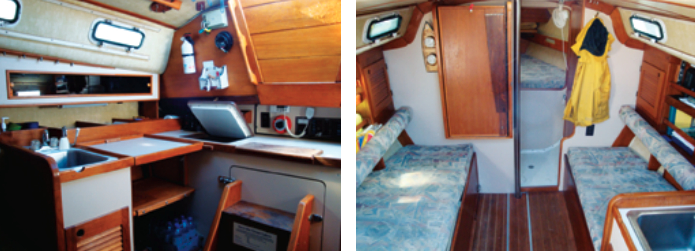
The layout of the Seidelmann 295’s accommodations is very straightforward, with a couple of subtle twists. Forward is the traditional V-berth, above which are port and starboard shelves with integral handholds. A simple curtain provides a little privacy.
Directly aft of the V-berth is the head compartment. To port is a centerline-facing toilet and hanging locker and to starboard a vanity with a stainless-steel sink. A fiberglass shower base in the passageway completes the suite. Gray water from the shower drains to the bilge and head waste is stored in a large polyethylene holding tank located beneath the V-berth. A foot pump was standard equipment and delivered cold water to the sink. Our review boat was upgraded at the factory with pressurized hot and cold water. Potable water capacity is 30 gallons.
A solid teak door separates the V-berth and head compartments from the saloon and is flanked on either side by plywood bulkheads covered in a white plastic laminate and trimmed with solid teak. The saloon has opposing settees with a bulkhead-mounted table to port and stowage cabinets and bookshelves above and outboard. On the bulkhead, behind the table, is a series of shelves. Only the port settee is long enough to be used as an adult-sized berth. Normally it’s a single, but it can be quickly converted to a double. The starboard settee is only 48 inches long and can possibly function as a small child’s berth. Stowage is available beneath the starboard settee; the water tank and a pair of batteries are housed beneath the port settee.
Aft and to starboard, the L-shaped galley is fitted with a single stainless-steel sink, a 7-cubic-foot icebox with a manual pump-out draining to the sink, a dedicated trash bin, a compartment for a cooktop or stove, and several cabinets and cubbies. Because of the galley’s configuration, a portion of the countertop serves as one of the companionway steps.
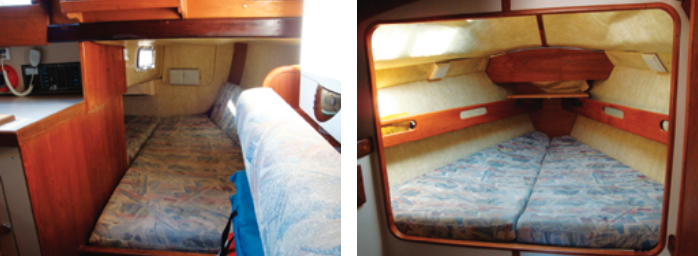
Headroom is 6 feet 3 inches. The sole is teak and holly.
Aft of the port settee is the narrow opening to a rather unusual quarter berth. When used fore and aft, as a conventional single berth, it has the potential for a decent sea berth and leaves a cavernous stowage area available to starboard, beneath the cockpit sole. The berth can also be used for sleeping athwartships. While a tad claustrophobic, this does make it a reasonably sized double, although it would work best when dockside or at anchor.
The rig
The Seidelmann 295 is rigged as a masthead sloop and has a sail area of 408 square feet. Both the mast and boom are aluminum extrusions from Kenyon Spars that have been painted white with linear polyurethane. The mast is stepped on deck and is fitted with a single set of airfoil spreaders. It’s supported by a pair of cap shrouds, dual lower shrouds, a headstay, and a split backstay. The chainplates are mounted inboard and bolted to six structural members that include the forward bulkhead and wooden knees glassed to the hull. Underneath the mast is a stainless-steel compression post.
The mainsheet is attached near the end of the boom and leads to a traveler mounted on the bridge deck. The halyards, outhaul, and both jiffy-reefing lines are internal. All lines are led aft to a pair of #16 Lewmar winches mounted aft on the cabintop. Genoa tracks on the sidedecks permit close sheeting of large headsails. Two #30 Lewmar two-speed self-tailing sheet winches are located on the cockpit coamings.
Under way
The Seidelmann 295 is a bit tender and heels readily. The boat does not point well, most likely because of its shoal keel. When beating to weather it also makes noticeable leeway. While performance is not its forte, according to Tom Maund, the boat can take weather quite well. The boat’s best point of sail is off the wind, especially a broad reach.
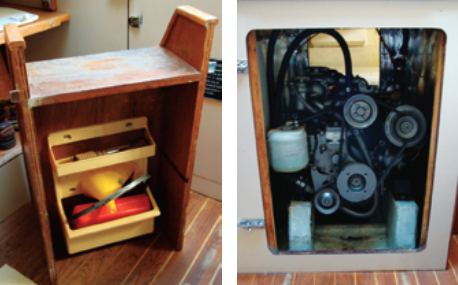
Two options for auxiliary power were originally offered: a 10-hp outboard (and capacity for 6 gallons of fuel) and a 16-hp diesel inboard with a 12-gallon fuel tank. Windquest is powered by a Yanmar 2GM20F. Fair to good access can be had to the engine by removing the companionway stairs or an aft panel in the quarter berth. A pair of wooden bins mounted to the backside of the companionway stairs keep tools, oil, and routine spares close at hand.
Things to check out
As you would with any boat of this vintage, sound out the deck, especially around deck fittings. Delamination of balsa-cored decks is a common problem and, if extensive, can be a deal breaker. Check for compression damage beneath the deck-stepped mast. Remove the padded-vinyl panels and inspect the tabbing on the bulkheads and chainplates. These were originally single-tabbed and may require attention. Inspect the centerboard’s mechanism and pendant. Repairs to these components are difficult if not impossible to accomplish once the boat is in the water.
Conclusion
The Seidelmann 295 is a roomy craft and might make for an inexpensive first cruising boat. Although it’s the newest of the Seidelmann sailboats, it’s still close to 25 years old. Add to this Seidelmann’s so-so reputation and the prudent buyer will exercise caution before opening the checkbook.
Have the boat surveyed by a professional. If it’s found to be in solid condition and you’re pleased with its looks and the way it sails, that’s what counts. Asking prices range from a low of $9,000 for an outboard model to a high of $13,000 for one equipped with a diesel. Many owners of Seidelmanns of all sizes have posted information at the Seidelmann owners’ website.
Gregg Nestor, a contributing editor with Good Old Boat, has had a lifelong interest in all things aquatic. This past June, he and his wife, Joyce, took delivery of a 1994 Caliber 35 and spent the next two months refitting, upgrading, and addressing some neglected maintenance issues so they could go sailing.
Thank you to Sailrite Enterprises, Inc., for providing free access to back issues of Good Old Boat through intellectual property rights. Sailrite.com