A sailor and photographer recalls a dream assignment
Issue 77 : Mar/Apr 2011
Every once in a while a boat comes along that captures your heartstrings. Thankfully, it usually happens at a dock or marina, where — when the good angel on your left shoulder finally gets through to you — you can walk away before flipping head-over-heels in love.
Such was not the case with Gazelle.
At the time, I was an aspiring young photojournalist. During that agonizing period in my life when I never knew where the next paycheck was coming from or when, the phone rang. And it wasn’t just any old corporate client, magazine, or newspaper. It was Time magazine.
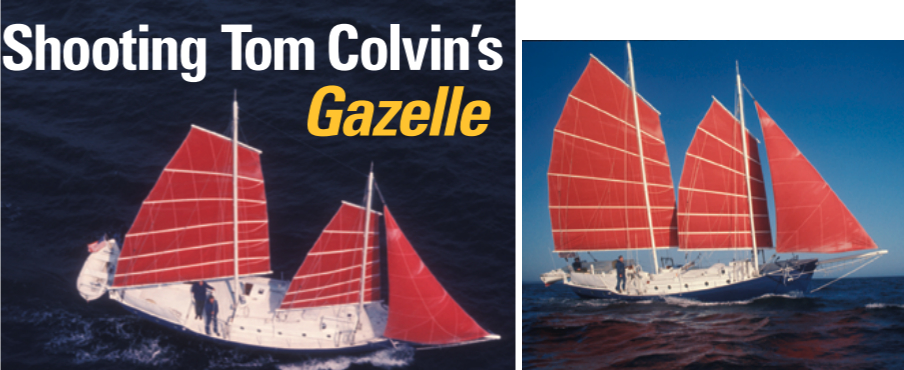
“We’re doing a story on people who are buying boats, selling their houses, and taking off around the world,” said the magazine’s picture editor, John Durniak. “Why don’t you head down to the Chesapeake and spend some time taking pictures of a guy who really did it? The boat’s unusual-looking, too, from what I know about boats. The assignment sheet says it’s a junk-rigged schooner. We’ve got another guy covering a boat called the Westsail 32 but this schooner really sounds interesting. The guy who designed and built her also sailed around the world with his family. His name is Tom Colvin. Here’s his phone number, somewhere out in Virginia. Give me a call when you get there and we’ll talk some more.” Click.
Today, a young photographer would have spent at least a day Googling before heading off on an assignment, but things were blissfully different then. I simply threw a few cameras, lenses, and flash units in my bag, grabbed a plane for Richmond, Virginia, rented a car, and before long was knocking on Tom’s door in the wilds of Virginia.
Surprises galore
I was expecting to meet up with Sterling Hayden or Jack London. You know, the kind of guy who walks with a swagger and total confidence. Tom, however, turned out to be mild-mannered, quiet, and reserved. Small in build, he spoke carefully in measured words. We agreed to meet at his dock the next morning.
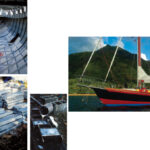
As the ethereal morning mist was still lifting, we piled into the dink and rowed out to Gazelle. Wow! I hadn’t known what to expect and this certainly didn’t mesh with anything I knew, having grown up on a Marconi-rigged sloop on Long Island Sound. Gazelle was 42 feet on deck, but with her hefty bowsprit and davits she probably took up a lot more than 52 feet when pulling into a marina for the night (which hardly ever happened in the history of this vessel — a concrete sea wall in St. George, Bermuda, maybe, but seldom a proper marina). And she was made of steel.
She also had no cockpit, per se. Where I thought there should be a cockpit, the deck simply went from one gunwale to the other, with high bulwarks and big scuppers to let out green seawater, should it make its way aboard. And the sheer was, at that point, pretty low to the waterline, making it look like that just might happen more often than not. But what did I know? As I said, Gazelle was unlike any boat I had ever seen and my point of reference was getting pretty distant by now.
Tom pretended there was absolutely nothing different about Gazelle. We were simply going out for a daysail. Or around the world, in my mind. What was stopping us? Let’s just get some more groceries and go, eh? Next stop, the Azores!
A memorable adventure
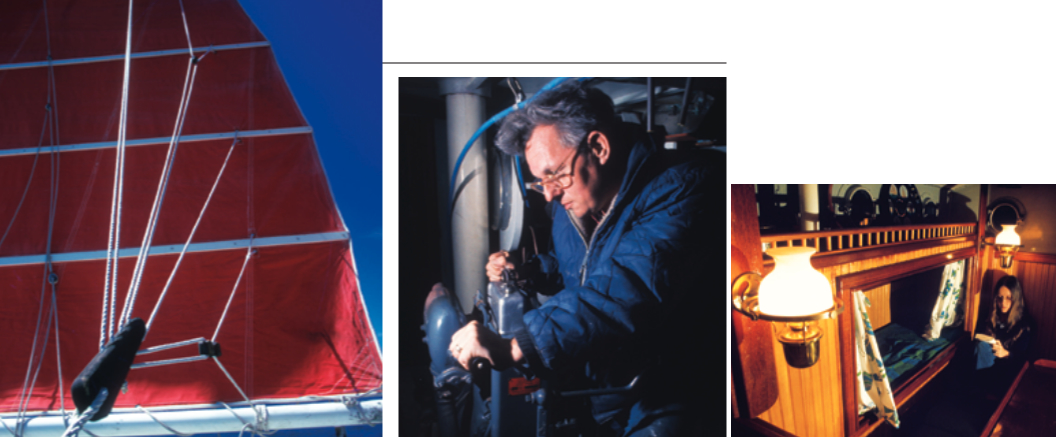
Well, back to reality. I was working on an assignment that paid real hard cash. So I rolled up my sleeves. For the next week, I shimmied up the mast in a bosun’s chair (with a little help from Tom), set up lights in the engine room, bobbed around in the dink getting my Nikon wet and drying it out under the kerosene lighting in the saloon, renting an airplane for aerial photos, and walking the deck from stem to stern in search of the best angles. I was in heaven.
It was a photographer’s and sailor’s dream, all rolled up into one adventure. You couldn’t buy that experience for all the tea in China, the land that invented the junk rig.
The rig was totally unusual for me and at first I didn’t know what to make of it. But, as we sailed around the waters off Mobjack Bay in winds varying from whispers to 20- to 25-knot breezes, the beauty of the junk rig became obvious. No matter where we pointed the vessel, she was perfectly balanced. You could let go of the wheel and she’d steer herself like a perfect lady. When the wind piped up, Tom simply lowered the halyard and, bingo, the sail shortened. And still she was perfectly balanced. Another reef? Simple, just like a Venetian blind. Down came the top boom another few feet and we were ready for anything. Bring on the gales. And tack? Simple. Ready about, hard a-lee. Turn the wheel. Gazelle did have a jib that required that we pull on the sheet but, other than that, tacking or jibing was simply a matter of turning the wheel.
The article and photos turned out great. My pictures illustrated the story, along with those taken by the photographer covering the Westsail 32. We were both hoping for a lead photo, since it was billed as a “major story,” but someone neglected to tell me the art director had purchased a Westsail 32 for himself. You’ll never guess which boat graced the opening spread of that memorable issue.
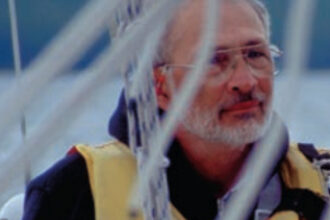
Gary Miller is a cinematographer/producer/writer/editor whose real fun comes from sailing with his wife, Ann, in their restored 35-foot Pearson centerboarder named Viridian, out of City Island, New York. See Gary’s work at www.wordsandpixels.com.
Thank you to Sailrite Enterprises, Inc., for providing free access to back issues of Good Old Boat through intellectual property rights. Sailrite.com