. . . against its cruising contemporaries
Issue 77 : Mar/Apr 2011
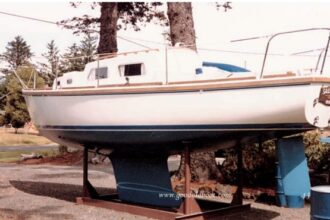
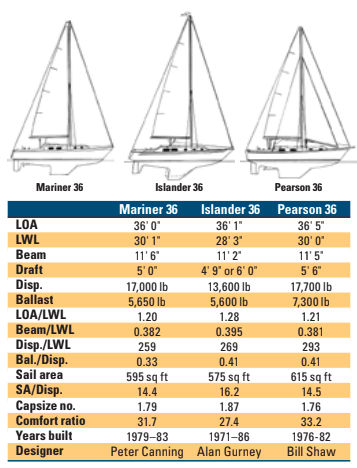
The long waterlines, moderate draft, husky displacement, and modest sail area of both the Mariner 36 and Pearson 36 are a solid indication that their designers intended these two yachts as family-oriented cruisers for coastal and bluewater voyages.
The Pearson was built as a true cutter, complete with staysail stay and running backstays, and her cutter rig has definite advantages offshore.
Alan Gurney’s Islander 36, with her lighter displacement and good draft, fits more into the “performance cruiser” category, as one would expect of the designer of the famous, record-setting 73-foot ketch Windward Passage. Islander Yachts did offer an optional 4-foot 9-inch draft on the 36, and this might be the better choice for the shallower waters of the East Coast and Gulf of Mexico. Even with the reduced draft, the Islander would still be a very good performer in light to medium weather due to her ample sail area/displacement ratio.
The Mariner 36 should have good form stability, given her 11-foot 6-inch beam, but the ballast ratio is on the light side. This is probably due, in part, to the fact that Mariner built heavy, solid yachts, as I know well from experience with their work on my Mariner 47 design. Still, if I were heading far offshore in a Mariner, I would be tempted to add another 600 to 700 pounds of ballast deep in the bilge and well strapped down, just for the peace of mind.
The Pearson promises to be the stiffest of the three yachts, having ample displacement, good beam, and greater draft than the Mariner and a generous 41 percent ballast ratio. The deep-draft Islander should be fairly close to the Mariner in stability, but the shoal-draft model — with even less draft than the Mariner, a narrower beam, and lighter displacement — appears to be the least powerful of the three yachts, although still quite capable of offshore voyages.
It’s rather surprising that the Mariner and Pearson have such modest sail area/ displacement ratios. Given their beam and displacement, they are somewhat under-canvassed and, to my way of thinking, could easily carry as much as 60, or even 70, square feet more sail. Being slightly under-canvassed is not a major fault in a yacht intended for family bluewater voyages, of course. Still, in many of our coastal areas where light summer breezes are the norm, it could leave the skipper whistling for a wind and firing up the iron breeze while he waits for Aeolus to answer his prayers. The Islander, with lighter displacement and undoubtedly less wetted area, given her beam and waterline, should slip right by the others when the breeze turns soft.
Things are different at sea, of course. Having a moderate, easily handled rig is a very handy thing on a short-handed cruiser. In her day, the Islander 36 was designed as a serious cruiser/racer. For racing sailors, taking an extra day to get from A to B was simply unacceptable, but an extra day on a long voyage is rarely a major problem for the average cruising skipper and crew. There, the primary concern is to get from A to B in safety, regardless of wind and weather. That is where the stronger and more versatile cutter rig of the Pearson stands out.
Both the Mariner and the Pearson show very well in the motion-comfort department due to their husky displacement. Both have comfort ratios approaching those of many larger boats, including my Whitby 42 design. Surprisingly, the Islander is not all that far behind them, thanks in large part to her shorter waterline.
I know that at least one Islander 36 has completed a circumnavigation . . . solo! I am not aware if either a Mariner 36 or Pearson 36 have circumnavigated but I feel certain that, given a knowledgeable skipper and crew, they are both quite capable of cruising the seven seas in safety and comfort. These are three fine designs, all well suited to their intended purposes.
Ted Brewer is a contributing editor with Good Old Boat. He is one of North America’s best-known yacht designers and over the course of a long career he has imparted his knowledge and love of sailboats to a great number and variety of designs, from pocket cruisers to ocean greyhounds. Many of them may now be older, but they are still good.
Thank you to Sailrite Enterprises, Inc., for providing free access to back issues of Good Old Boat through intellectual property rights. Sailrite.com