A well-built, IOR-inspired racer/cruiser
Issue 79: July/Aug 2011
As with many boat companies, the Clark Boat Co., maker of San Juan sailboats, evolved from humble beginnings. It all began with Robert Clark’s passion for sailing. In 1960, he convinced his wife and family to move from their home in Toledo, Ohio, where he worked in the automotive industry, to the Seattle, Washington, area. Soon after relocating, Bob set up shop in the town of Kent, where he began building fiberglass boats. The first boat built under the Clark Boat Co. name was a Lightning, and the company’s product line soon included OK and Optimist dinghies, Thistles, International 14s, 505s, and Stars.
The company’s first “big boat” was the San Juan 21, a trailerable keel/centerboarder introduced in 1970. It was designed by Bob’s son, Don, a degreed engineer who had also studied naval architecture. It was an immediate hit and eventually more than 2,600 were sold.
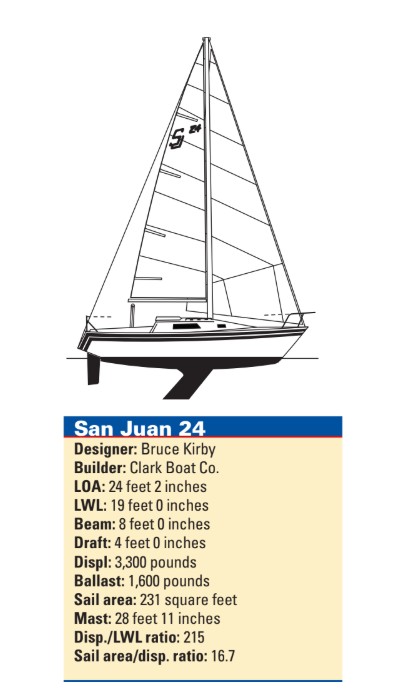
Capitalizing on the success of the San Juan 21, the Clarks set out to build a larger boat, and contracted Canadian Bruce Kirby, who had drawn considerable attention for designing the Laser, to design a keelboat that would be competitive under the International Offshore Rule (IOR). The result was the San Juan 24, which achieved great success racing as a Quarter Tonner and was the most-measured IOR boat in the world by far, with hundreds having IOR certificates. More than 1,000 San Juan 24s were built during its production run from 1972 through 1981.
In the years that followed, the company produced performance-oriented pocket cruisers ranging in size from 21 to 34 feet. Unfortunately, after growing rapidly in the 1970s, the sailboat market lost momentum in the 1980s. After building 6,000 San Juans and 2,000 dinghies, the company was sold in the spring of 1984 to the newly formed San Juan Manufacturing.
After a couple of years, that company went bankrupt, and the molds and rights were subsequently divided between a group on the West Coast and another on the East Coast. The eastern group produced a few boats in the Tanzer factory in Edenton, North Carolina, and both groups ceased operations in 1988.
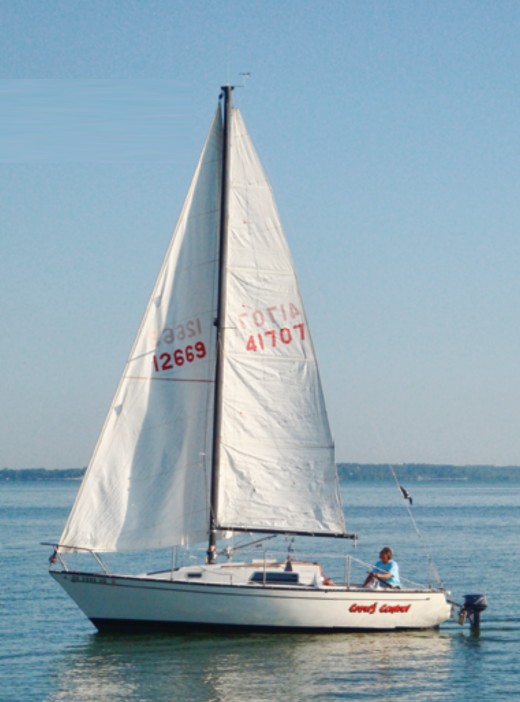
Crew’s Control, our review boat, is a 1977 San Juan 24 owned by Brad Hite, who sails on Lake Erie out of Sandusky, Ohio. He’s constantly working on the boat and has made several upgrades. He has added shorepower and LED lighting, installed Garhauer blocks and a custom vang, replaced the fixed portlight lenses (while also buffing out the aluminum frames and adding weep holes), installed roller furling and lazy-jacks, and refinished all the interior wood and exterior brightwork.
Design and construction
When the IOR became popular in the late 1960s and early 1970s, the Clarks were set to get in on the action. Don wanted the boat to be trailerable, like the San Juan 21, so he told Bruce Kirby that he would have to design it with a maximum beam of no more than 8 feet and draft no greater than 4 feet. While Bruce felt that these restrictions would limit the boat’s potential performance, history proved that they had a marginal effect on the boat’s popularity, much of which was due to its shoal draft and trailerability.
Bruce, who had designed a few dinghies but had not yet had a keelboat design launched, kept the San Juan 24’s dimensions within those Don had set and designed a boat that would measure in for an IOR rating of 18. The result was a relatively beamy, moderate-displacement boat with a narrow entry, a pinched stern, and a tiny transom — it displayed all the design elements associated with the IOR in that period. To make up for the limited draft, he specified a heavy lead keel to gain the needed stability.
Throughout its production, the San Juan 24 underwent a series of minor design changes. Early models, sometimes referred to as the Mark I version, had a flat transom with a track for an outboard-motor mount. The later Mark II had a molded wedge on the transom that allowed a scissors-type motor mount. About midway in the boat’s production, the rudder was made deeper to provide more control when the boat was under spinnaker downwind. Among other changes, the forward fiberglass hatch was replaced with smoked acrylic and the round-tube spreaders were dropped in favor of tapered airfoil-shaped spreaders.
The Clarks took great pride in the construction of their boats. The hull of the San Juan 24 is hand laid with fiberglass mat, woven roving, and cloth. Sandwich construction stiffens flat surfaces such as the deck, which is cored with balsa.
Unique for the time, the Clarks employed a vacuum process to eliminate voids when bonding the liner into the hull. After applying a resin-based putty to one part, they set the liner in the hull and applied a vacuum to the assembly until the resin had cured.
The hull and deck were glued together with epoxy, after which the aluminum toerail was bolted in place. This combination of chemical bonding and mechanical fastening resulted in an extremely strong and watertight hull-to-deck joint.
Deck features
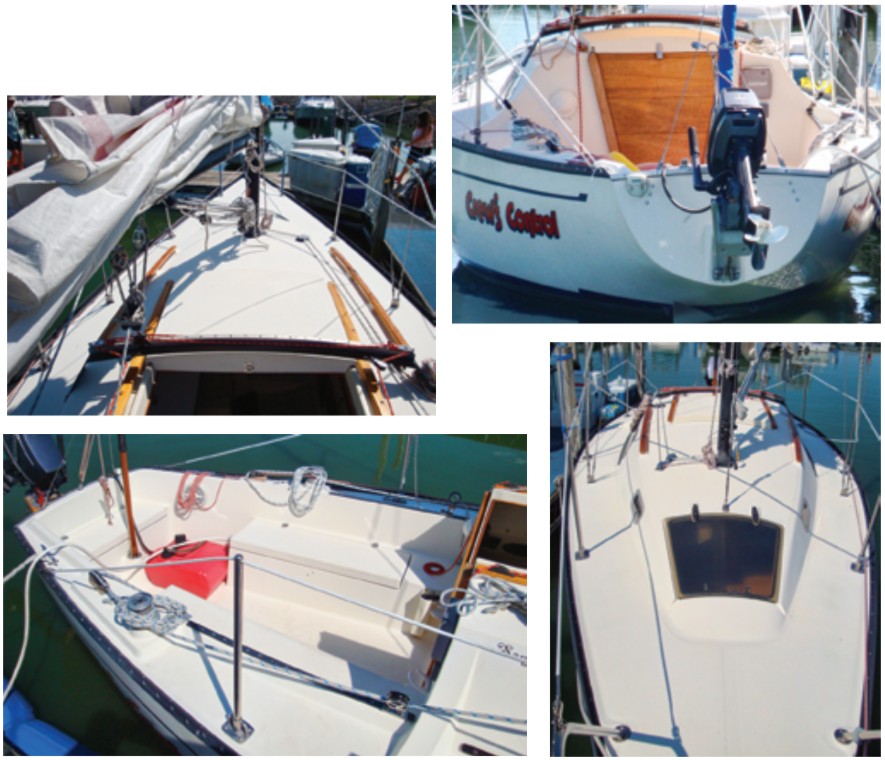
The foredeck of the San Juan 24 is obstacle free, allowing the crew to move about easily when making sail changes, anchoring, or docking. The forward portion of the cabintop slopes toward the stemhead fitting and the forward hatch is located on this sloped area. On each side of the cabin trunk are two fixed portlights, a small oval one forward and a much larger one aft.
The self-draining cockpit can comfortably seat a crew of four. It has a deep footwell that’s narrow enough for good bracing and reasonably high coamings that provide adequate back support. A cavernous locker to port and a bona fide lazarette give the skipper and crew ready access to all the boat’s safety equipment and other gear required on deck.
The companionway opening is rather large and the sliding hatch lacks a sea hood. Should the cockpit get pooped, there’s no bridge deck to keep water out of the cabin. In foul weather or rough seas, it would be prudent to keep the lower hatchboard in place.
Along with a black-anodized aluminum toerail, a stainless-steel bow pulpit and single lifelines secure the deck perimeter. The relatively narrow cabintop makes for functionally wide sidedecks. Molded-in nonskid is incorporated into all horizontal surfaces. These features, combined with the cabintop handrails, make for easy and reasonably safe movement from cockpit to foredeck.
Brightwork and its corresponding maintenance is kept to a minimum. Early San Juan 24s had a laminated tiller and teak handrails, companionway trim, and hatchboards. The teak handrails were replaced on later models with anodized aluminum.
Accommodations
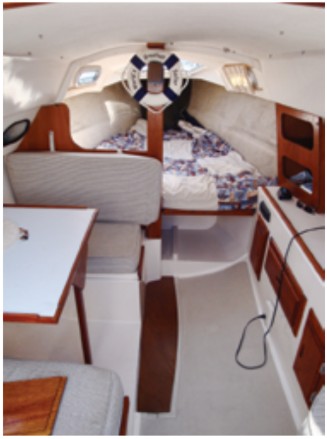
A large chain locker occupies the San Juan 24’s narrow bow and the V-berth, immediately aft of it, has reasonable foot room at its forward end. Beneath the berth is a storage area and a place for a portable toilet. The forward hatch and a pair of portlights deliver plenty of light and ventilation into this forward cabin and a partial bulkhead to port and a curtain provide privacy.
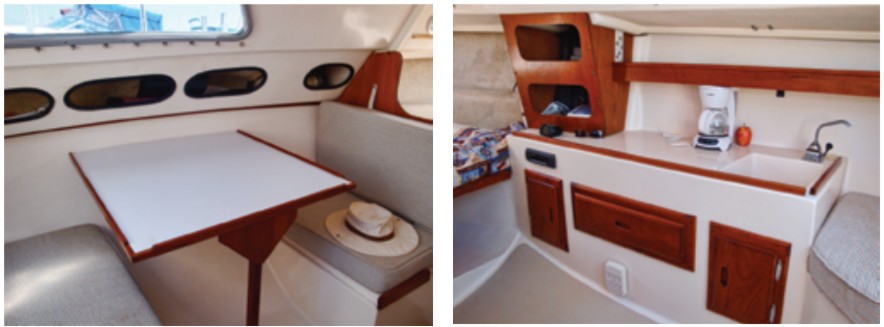
The saloon is designed in what naval architect Bob Perry calls the “California layout,” with the galley running longitudinally down the starboard side of the main cabin and a dinette opposite. The advantage of this configuration is a big galley; the disadvantage is that all the crew are crammed into a small dinette for meals and relaxing. Nevertheless, it’s a very popular layout.
The very basic galley consists of a molded-in sink with hand pump, a countertop, and associated lockers, shelves, and cubbies. The dinette seats four, and the laminate-topped table can be lowered and the cushions rearranged to convert it to a double berth. Outboard and above the dinette is a series of stowage cubbies. The large smoked portlights provide light and eliminate the need for curtains.
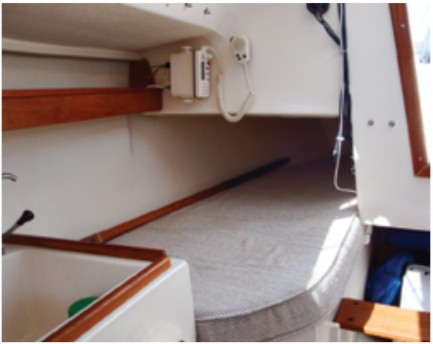
A single quarter berth, with bin stowage beneath, is aft of the galley. Additional stowage spaces are provided beneath the cockpit sole and under the fixed companionway step.
The partial forward bulkhead and the white liner give the San Juan 24’s interior a bright and airy openness. Headroom is 5 feet 2 inches. With the exception of the teak-veneered bulkhead, almost all interior surfaces are low-maintenance fiberglass. The only non-fiberglass surface is in the V-berth cabin, where the hull is lined with a foam-backed fabric.
The rig
The San Juan 24 is rigged as a masthead sloop with a deck-stepped mast, single spreaders, internal halyards, and jiffy reefing. Standard hardware includes Barlow #16 primaries and a #14 halyard winch. Harken blocks are used throughout. Full-length headsail tracks are situated well inboard for close sheeting. The mainsail is sheeted mid-boom to a traveler that spans the cabintop.
Under way
The San Juan 24 has a reputation for sailing very well in light air and also in winds above 20 knots. It is very close-winded and handles well upwind. Dead downwind under spinnaker, however, it exhibits the erratic behavior typical of many IOR designs of the period and often attributed to narrow sections in the aft underbody.
For comparison, in fleets around the U.S., the San Juan 24’s PHRF rating is between 216 and 222 seconds per mile, virtually the same as the Catalina 25 and a little faster than the C&C 24. The J/24, however, rates 171, which shows you the extent to which boats have become lighter, shallower, and faster over the years.
For auxiliary power, a 6-hp outboard is sufficient to propel the San Juan 24 during periods of calm and for maneuvering in tight quarters.
Things to check out
While well built, the San Juan 24 isn’t perfect. The newest are 30 years old, so expect some deficiencies due to age and, possibly, to poor maintenance.
Balsa-cored decks are always a potential source of problems. If deck fittings have not been periodically rebedded, water will have seeped into the core. This rots the balsa and leads to delamination of the fiberglass skins. Sound out the deck, especially around all the fittings, including the mast step. Also spend some time sounding out the cockpit sole. Softness underfoot or a cracking sound suggests that the sole’s core is rotten.
Inspect the entire length of the compression post, which can crack under the stress imposed by the rig. In particular, examine the base of the post where rot can set in if water has collected there when the boat has been left unattended.
Carefully check out the chainplates and the wooden bulkheads to which they are attached. Discolored wood indicates water ingress, which could result in weakening of a bulkhead and corrosion in a chainplate.
Conclusion
The San Juan 24 is a great little trailerable pocket cruiser that has been extremely popular for many years. Owners keep in touch through an active owners association at http://groups.yahoo.com/group/SJ-24. For a couple or a family with small children, it’s suitable for long weekends on protected waters. For those interested in performance, the San Juan 24 is a particularly strong competitor. A check of the used-boat market shows a price range of $3,000 to $10,000, with age, condition, and equipment being the determining factors.
Gregg Nestor, a contributing editor with Good Old Boat, has had a lifelong interest in all things aquatic. He and his wife, Joyce, are currently refitting, upgrading, and sailing a 1994 Caliber 35.
Thank you to Sailrite Enterprises, Inc., for providing free access to back issues of Good Old Boat through intellectual property rights. Sailrite.com