A revived cutter teaches her owners and aspiring cruisers a few lessons
Issue 54 : May/Jun 2007
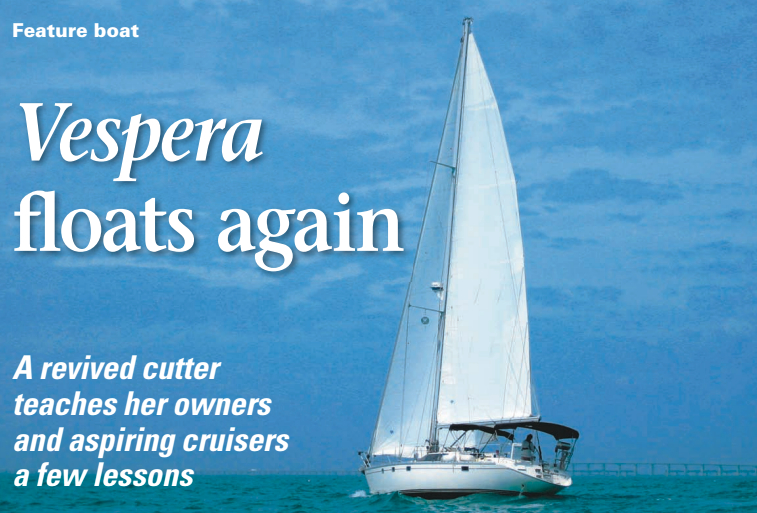
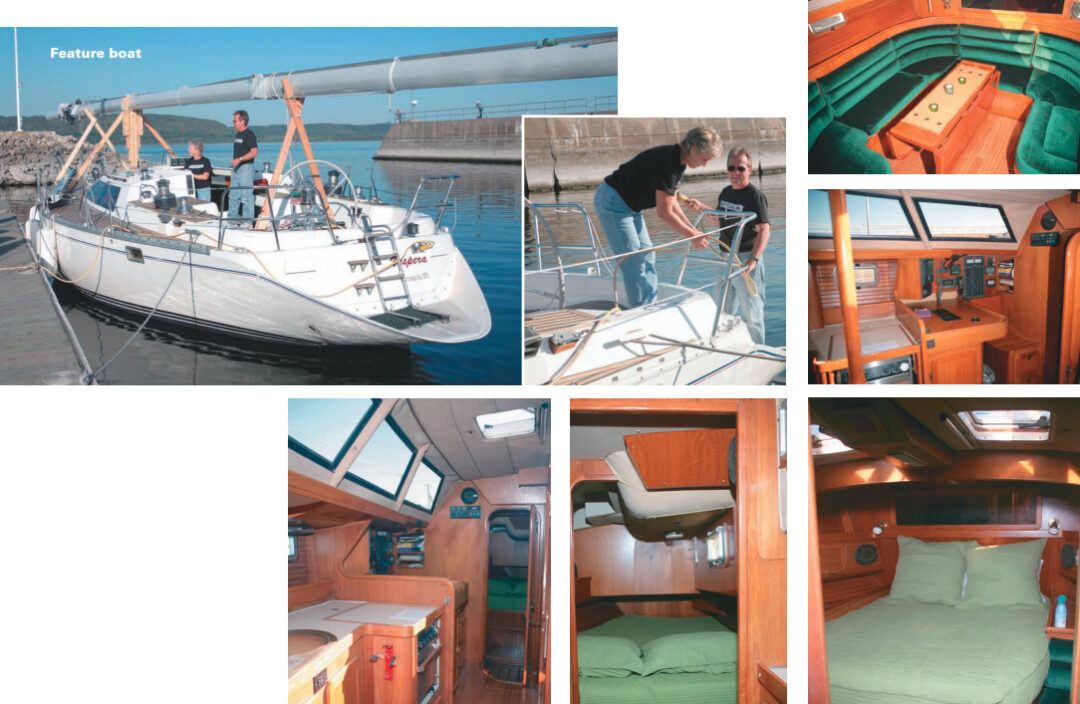
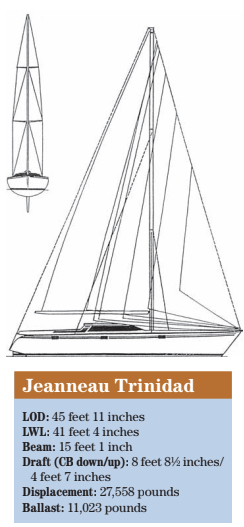
Vespera is not your typical good old boat. But then, sailors Stan and Kathy Sroga aren’t your typical good old boaters. Vespera is 51 feet overall, including her bowsprit and swim platform, and is sometimes referred to by this length. However, her deck is 46 feet and she has a waterline of 41 feet. No matter how you measure her, this is a cutter outside of the range of boats normally covered by Good Old Boat. Her better-known sister, Crédit Agricole, won the first BOC Challenge race in 1982, captained by Philippe Jeantot. (Crédit Agricole is the name of the French firm that sponsored Jeantot.) Vespera, unlike Crédit Agricole, is a centerboard model.
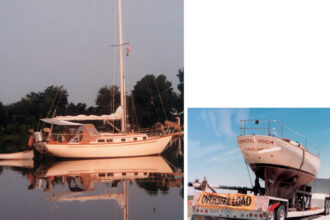
We all know how large any boat looks when it’s out of the water. A 51-footer is a formidable sight to behold, particularly if it is a prominent feature next to a small home along the highway in the middle of rural Minnesota. Yet this is exactly where Vespera spent the past five years of her life. During this time, Stan Sroga’s project boat became a local landmark.
Once you’re on the outside looking up at any boat, you know how endless the bottom-painting job seems and how huge the topsides buffing project becomes. Now consider how these jobs and all the others become proportionately larger with additional boat length. A 51-footer is a lot of boat to maintain if it’s in good condition. If it’s not in great shape, it becomes a major project.
A major project is indeed what Stan took on back in 2001. You read about his star-cracked gelcoat in our January 2007 issue. That was the most problematic of the projects he took on. But there were others, such as a leaky teak deck and a waterlogged bilge. It was Stan’s innovative solutions to these problems that led us to expand our definition of a good old boat to include Vespera. More about these innovations will follow. But first a bit about the evolution of a sailor who thinks outside the box.
Began with Hobie Cats
Stan discovered sailing on a vacation in Nassau. These days he is surprised that the folks there would rent a Hobie Cat to a non-sailor. No training was offered in that easy-going vacation-land, so it is an understatement to say that Stan learned a lot that day. The most memorable of the lessons learned in Nassau was that he had to have a Hobie of his own. “I bought one as soon as I got home,” he says.
“We’d tent camp on that Hobie Cat on Lake Pepin [a wide spot in the Mississippi River, south of Minneapolis, Minnesota],” Stan says. And looking back, he adds, “That was one of the neatest times of our lives.”
Kathy laughs, “He’d look at his watch to see if he had time enough to capsize it. He liked to hear me scream. When I stopped screaming, he sold the boat.”
The scream-factor may have been part of the reason for selling the boat. But with three children, they needed something with a bit more room: a little cuddy cabin, a head of some sort, and more . . . every sailor knows how one thing leads to another. The next boat was a King’s Cruiser, a wooden, slightly larger, cousin of the Folkboat.
Stan jokes about his level of seamanship in the early days, saying he didn’t realize that sailboats swung from anchors at night. He thought they were to be pulled up on shore. After all, that had worked for the Hobie. “I
dragged it up on shore along with all the powerboats,” he says.
He wound up getting advice on this fine point of sailing from a more experienced sailor. “He was really polite,” Stan recalls. “He told me, ‘Umm, most sailboats, well, they don’t pull ’em up on shore. They anchor ’em,’ ” And with that revelation, Stan, the cruiser, was born.
Needed much work
Stan, the project boat fixer, had already been born. That first King’s Cruiser may have been affordable, but it needed a lot of work. While sweating over that one, he saw another that was stored in a warehouse and offered for sale cheap. “I had worked and worked and worked on mine. This boat was beautiful. I realized I could have worked until eternity and never would get my project boat to that point,” Stan says. “The owner was selling it for the price of what he’d just paid for a new set of sails.”
There was a reason for the low sale price. “Every rib had snapped,” Stan says. “But I knew how to fix that. I had just done that with the first King’s Cruiser.” So Stan practically gave the first one away and took on the second King’s Cruiser.
They say necessity is the mother of invention. A little previously acquired knowledge about the maintenance required by wooden boats caused the birth of Stan, the innovator. “I could have made a wooden boat out of it,” Stan says. But I used Allan Vaitses’ theory and built a fiberglass hull over it.”
Kathy notes that all three kids could fit in the V-berth at that time. The head was under a cushion in the V-berth. It was cramped in some ways, but it was just right in more ways. Over the years, looking back at all the boats they’ve owned, Stan still says without reservation, “That was my favorite boat. I loved that boat.”
The family sailed on that King’s Cruiser for two years and might still be sailing it on Lake Pepin if it weren’t for a separate theme that was playing simultaneously in Stan and Kathy’s lives. They had started a software company that had grown to the point that it was demanding too much of their time. There were no vacations. Stan was always on call, with a pager going off a dozen times a day. So they sold the business and went sailing.
They bought a 32-foot Columbia. Stan spent two years fixing it up, and then they went on what they call a sailing sabbatical for a year-and-a-half, exploring the western Great Lakes and traveling down the Tennessee-Tombigbee Waterway as the northern summer season drew to a close. The children were small yet: 6, 4, and 2. They returned home via the same river system in the spring.
A dream is born
A Hunter 34 and charter vacations on other boats followed. And there was another software business for Stan, while Kathy went on to a position in research administration with an area university. The kids became teenagers and didn’t want to go sailing anymore. Somewhere in the daily hubbub of grocery stores, mowing the lawn, and routine family events, a dream coalesced for Stan and Kathy. They wanted to go cruising once more. But they wanted to be more engaged than they had been as cruisers the first time. Cruising for the sake of cruising would not be enough to keep them interested.
“We learned while cruising that we needed to have a purpose. We wanted to be meeting interesting people and have something to do, but not 365 days a year. We need time off also,” Stan says. They agreed to start a sailing school that would operate half time during the winter months. During the summer they would take their boat north to the Great Lakes via the Intracoastal Waterway or the Mississippi and Tennessee river system. Because they’d have a sailing business, some of the boat-related expenses could be absorbed, and they’d be having fun at the same time.
So Stan earned his captain’s license and was certified as an American Sailing Association (ASA) instructor. He’d been training people to use his software for years. He felt confident with his training skills. Now they needed the boat. They traveled to Fort Lauderdale, Chicago, Miami, Milwaukee, and Detroit — some more than once — in search of their dream boat, which would become the base for their new business, Sail Training, Inc.
“The mission was to find a boat that could go through waves. It had to sail well. It had to sleep six to eight people,” Stan says. “I figured out that I couldn’t find a new boat that sailed well that I could afford. It would have to be a fixer-upper.”
They learned about the Jeanneau Trinidad from a passionate owner who said it would self-steer in 35 knots of wind. So they spent three weeks sailing with that man, all in relatively calm conditions. “But finally we got the conditions he had described,” Stan gloats. “And the boat was stable. The waves vaporized. In those conditions I would have needed a football helmet with a teethguard in my Columbia.” They bought Vespera, a somewhat newer Trinidad model, in the Chesapeake, sailed her there for three weeks, and then trucked her home to the outskirts of Minneapolis, where she spent the next five years as a landmark.
Boatless in Minneapolis
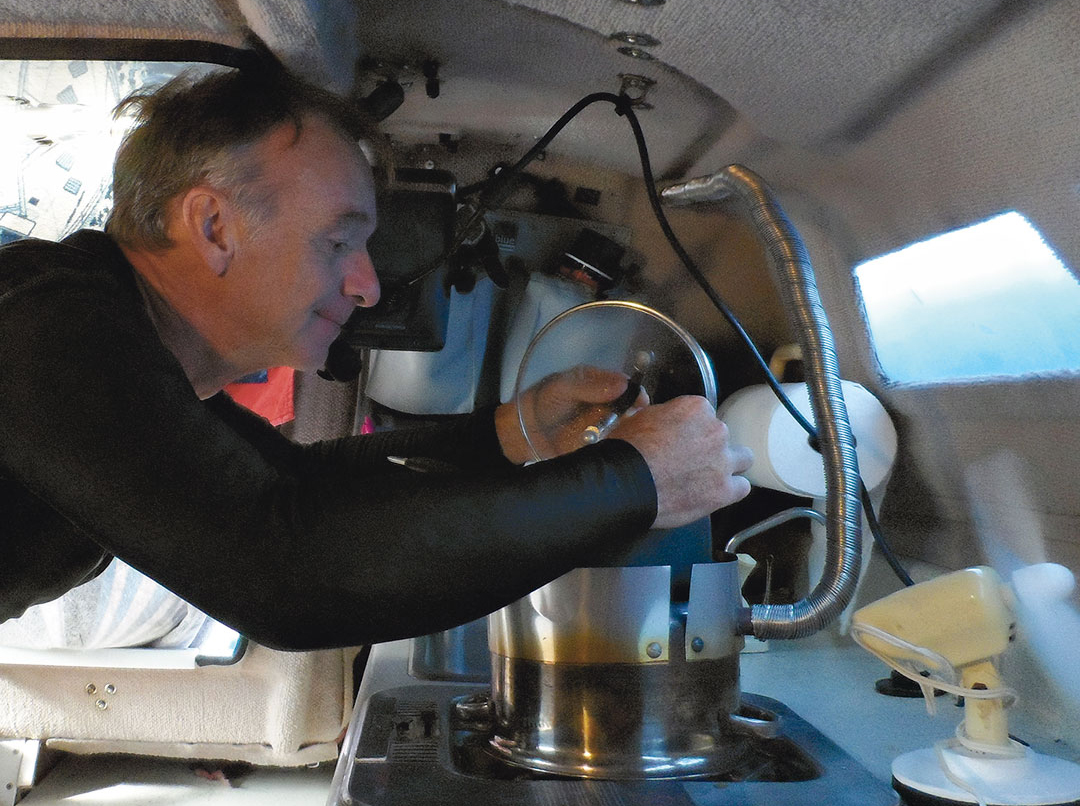
But she wasn’t idle during those five years. Stan was working half-time at his software business and half-time on the boat. The Hunter had been sold. He was boatless by one way of measuring, but by any other measurement system he had a boatload of projects. “We were boatless,” Stan agrees, “But that wasn’t a negative for me. I loved working on the boat. I’m healthier than ever. Nothing is square on a boat. You’re working in corners lifting things in awkward positions. It’s a very healthy lifestyle.” He says he feels younger than he did when he started. There’s no denying it: at 60, Stan looks fit and trim and healthy.
During this time, his mind was active also. Stan has devised some very intriguing cures for some rather vexing problems. He was confronted with five major projects, along with many smaller projects on Vespera. The teak deck leaked at the fasteners and around the deck fittings, and the balsa core under the deck was wet. The engine beds and hull stringers had plywood cores that were wet and some had rotted to mush. Bulkheads were wet and, in some cases, rotten where they joined the hull in the bilge, and the gelcoat on the outside of the hull was cracked with wet laminate under those cracks (described in the January 2007 issue). Because of the sheer size of this boat and the scope of the work needed, Stan felt obliged to think outside the box.
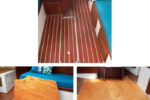
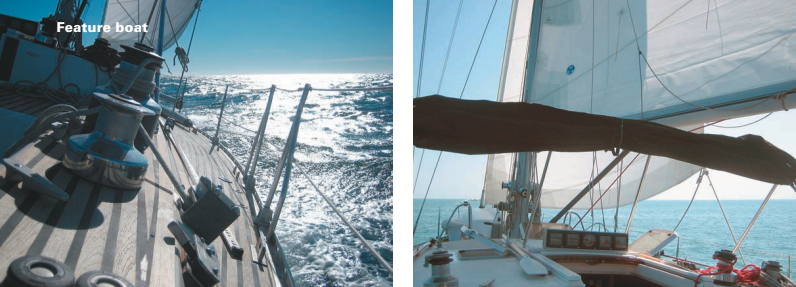
He removed all 2,000 screws from the teak deck and from below in the cabin and drilled holes in the cabin overhead to dry the core. He did this wherever his moisture meter showed that it was wet. When it was dry once again, he resealed the holes with urethane sealant driven in under pressure with a grease gun. Abovedecks, he resealed all 2,000 screw holes with urethane sealant and replaced the narrow teak hold-down strips between the wider teak planks with wide beads of caulk. Where the core had gotten wet under deck fittings, he gouged out the wet material and filled the space with urethane sealant. The teak planks were glued in place during the original construction. There were no holes in the planks, and they were left in place.
Added skidplate
He dried the hollow-core rudder and injected urethane sealant into the void and then added an aluminum skidplate to the bottom of the rudder. Notice that, in the case of the wet deck and leaking rudder, he retained the original shapes and much of the original structure. This saved him a lot of time.
Rather than replace the engine beds and hull stringers with plywood-cored glass, as the boat had been originally built, Stan elected to use a modified version of ferroconcrete boat construction. He cut the tops off the beds and stringers and gouged out the wet and, in some cases, rotten plywood, leaving behind the heavy glass-laminate outer skins. He lined the cavities with urethane sealant and filled them with reinforced concrete. As in the case of the deck, by leaving the laminate in place and replacing the cores with concrete, he saved a lot of time.
Rather than tear out all the bulk-heads and replace them, Stan cut the wet and rotted bottoms off and set them in ferroconcrete footings. The hull in this area was coated with urethane sealant, as were the bottoms of the wooden bulkheads. Thus Stan avoided the problems of bonding concrete to glass laminate and wood. He also avoided having to remake the bulkheads.
On the outside of the hull below the waterline, Stan ground off the starcracked gelcoat to expose the underlying wet laminate. He air-dried the laminate and re-faired it before he epoxied glass cloth over it. He stretched the cloth over the hull with wooden battens and bungee cords so it would conform to the curvature of the hull. In this way he avoided a massive refairing as the last step of the repair. He finished the job with a moisture barrier. In all these repairs, Stan performed a satisfactory, but minimally invasive repair, which allowed major elements to stay in place. The use of a very thin urethane sealant and ferroconcrete allowed him to work fairly quickly and still make sound repairs.
The story that Stan and Kathy got when buying Vespera was that a fellow traded her for a new boat. “But,” Stan says, “there were problems [that no one mentioned]. This boat was designed to have a bone-dry bilge. It is supposed to be 98 percent dry. The builder ran wiring through the bilge. Even the mast had a separate keel sump. But it wasn’t dry, and there must have been too many problems [for the previous owner]. By the time I came along, they had cut the price almost in half.” After a moment’s consideration, he adds, “And I still paid too much.”
He continues: “Before I bought the boat they let me remove the headliner and most of the floorboards. I knew what I was buying. I’d done enough with our previous boats to think I got it all. The biggest surprise was the hull. That was a miserable job,” Stan recalls.
“Working on the teak deck wasn’t so bad. I was covered from head to foot with a snowmobile suit,” Stan says. “I had to remove 2,000 teeny retainer screws. About 10 percent of these were leaking. “The headliner looks like a map for a lake bottom.”
Test-bed for training/repairs
All in all, Vespera is a traditional boat with non-traditional repairs. In some ways, she’s a test-bed. How well each new idea will turn out remains to be seen, but the odds of success are good. Even the sail training that Stan and Kathy started earlier this year is a bit non-traditional. They know that students can’t absorb everything in a week when it’s presented in a new environment and jam-packed with facts that must be understood and absorbed. Instead, Stan plans to give people a chance to experience the cruising lifestyle and the decision-making process aboard a sailboat, learn the basics that they really need, and go home with individualized plans for further study.
Their first season was in Maration, Florida, because, Stan says, “The Keys are a good place to learn to cruise due to numerous hazards. Yet the Keys offer natural wonders, such as snorkeling, and a unique, almost foreign, flavor that comes with a laid-back island chain. The cruising hazards are what we teach people to deal with. We have reefs, fickle winter weather, ocean currents (the Gulf Stream), tidal currents, lots of shallow water, narrow winding channels leading to tight anchorages with poor holding ground, and wind . . . lots of wind.” For more about this training program, visit their site at http://www.sailtraininginc.com.
Vespera has the accommodations to make it possible for two couples to take a one-week course. Stan and Kathy’s master cabin is forward. Two aft doubles are arranged side-by-side. Each of these suites has its own head, shower, and dressing area. In a pinch, there are two very simple bunks just behind the anchor locker, which can be accessed only through a forward hatch.
“For use as a training vessel, we like the way six to eight people can sleep in dispersed areas and still have a central gathering place in the saloon,” Kathy notes. “And we like the windows.” Stan adds, “There’s a feeling in sailboats in general of being in a whiskey barrel, but not with Vespera.”
We spent time with Stan and Kathy in that roomy and bright saloon on one of the prettiest days of September, 2006. Vespera had just been launched the week before. Stan and Kathy were rushing to finish all those vexing last-minute details before heading south down the river the following week. The mast was strapped on deck, but neither their boat nor their lives seemed to be in disarray as they began a new chapter together.
Thank you to Sailrite Enterprises, Inc., for providing free access to back issues of Good Old Boat through intellectual property rights. Sailrite.com