More power to you!
Issue 79: July/Aug 2011
The forces we have to contend with when sailing a boat are greater than we can handle with our unaided physical strength. To cope with them, we make use of a physical principle known as mechanical advantage. This is the factor by which a mechanism multiplies the force applied to it.
Mechanical advantage is often necessary when managing centerboards and swing keels and when adjusting traveler cars, boom vangs, halyards, and sheets.
The great mathematician and engineer Archimedes, who was born in 287 BC, first demonstrated and quantified the principle of mechanical advantage by using a multiple-part block and tackle to move a heavy ship to the water for launching.
Calculating MA
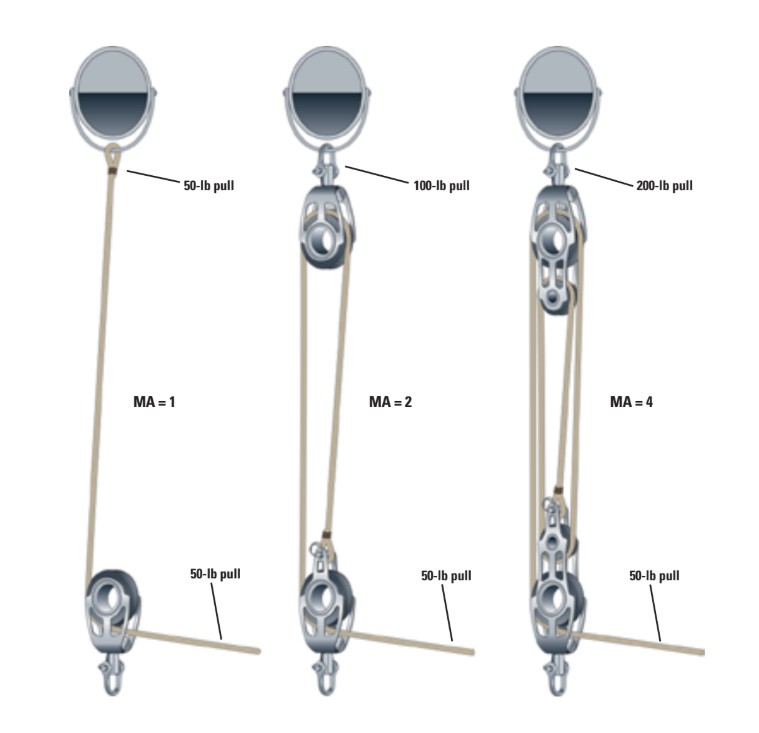
The theoretical mechanical advantage (MA) of any system can be found by comparing the distance the effort moves (the hand pulling the mainsheet, for example) to the distance the load moves (the boom).
• MA = distance the effort moves/distance the load moves
The mechanical advantage can also be found by comparing the force applied to the load to the force applied by the effort.
• MA = force applied to the load/force applied by the effort
For a system in which the mechanical advantage is 4, the ratio would be written:
• MA = 4:1
This theoretical, or ideal mechanical advantage (often abbreviated as IMA), neglects friction and other factors, such as the weight of the blocks when using a block and tackle. To overcome friction and weight, more force is needed than would be required for the ideal mechanical advantage. This extra force must be accounted for to deter-mine the true or actual mechanical advantage (AMA).
MA through a block and tackle
The old Gloucester fishing schooners had no winches on board (except for the windlass) and the huge forces on the sails were controlled with multiple-part block-and-tackle arrangements. A block and tackle provides an easy way to create mechanical advantage and nearly every small to medium-sized sailboat still uses one to control the boom.
As stated above, to produce an increase in force using a simple machine, the applied force must move through a proportionately greater distance. This principle leads to the main disadvantage of the multiple-part block and tackle, which is the long length of line involved and the problem of stowing that line.
On my 32-foot schooner, the block and tackle for the main-sheet has an MA of 4. Although the end of the boom, to which the mainsheet is attached, only travels a distance of 15 feet when the mainsail is swung out on a run, the sheet itself is about 60 feet long. When the boom is amidships, we have to contend with about 50 feet of extra line in the cockpit. To solve this problem, I installed a belaying pin rack on the boom-gallows stanchion. It’s not for belaying, but rather to serve as a handy spot to store the coiled-up mainsheet.
Just as the sailors on the Gloucester fishing schooners did, I use block-and-tackle systems on the main boom, the fores’l boom, the gaff halyards, and the boom on our club-footed jib.
MA through a winch
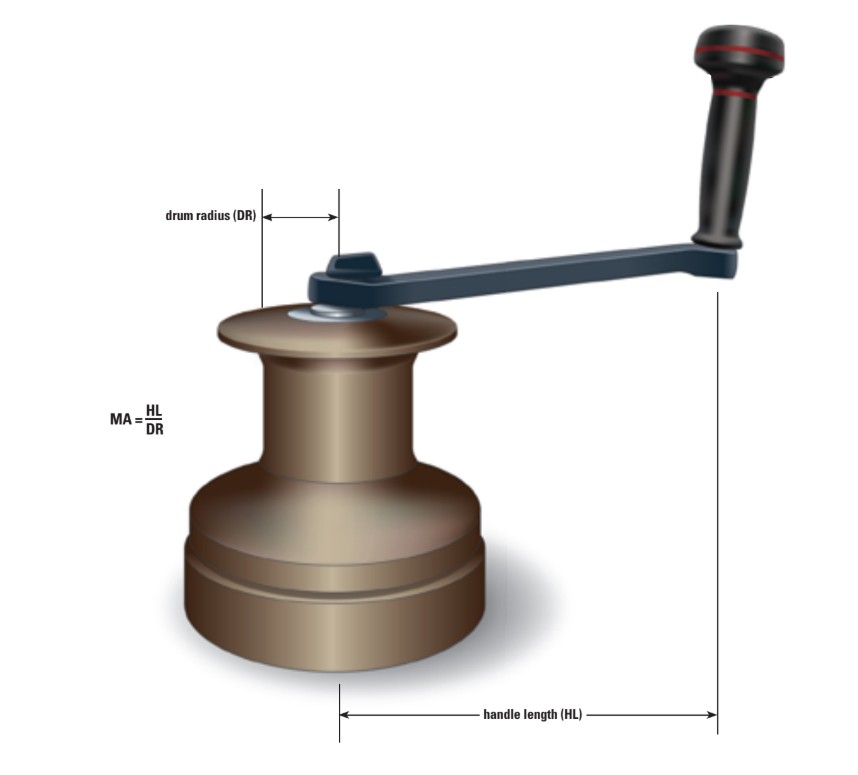
A small winch enables us to exert great force on a line. It does this by means of a long winch handle turning a small-diameter winch drum while a ratchet mechanism prevents the drum from reversing direction when the force on the handle is released. Larger winches gain even greater mechanical advantage through internal reduction gears. Some operate at multiple gear ratios (or speeds), which are usually engaged by changing the direction of rotation of the handle.
The average sailor can exert about a 30- or 40-pound horizontal pull on a line. On larger boats this is just not enough — sheet forces in the thousands of pounds are common on large cruising or racing yachts. By means of leverage (a long winch handle turning a small-radius drum) and reduction gears (the number of revolutions of the handle that turn the drum through one revolution), high mechanical advantage or “power ratios” can be developed.
This power ratio is simple to calculate: it’s the handle-to-drum ratio multiplied by the gear ratio.
If you have a 10-inch handle and a 5-inch-diameter drum, then the handle-to-drum ratio is 10/2.5 (2.5 being the radius of the drum), and the mechanical advantage is 4.
If, in addition, the winch has a 5:1 gear ratio, the handle-to-drum MA multiplied by the gear ratio (5) gives a power ratio of 4 x 5, or 20:1.
Winches are given numbers that approximate this power ratio, so a #8 winch has a mechanical advantage of 8:1. This 8:1 figure is, of course, a theoretical figure — the ideal mechanical advantage — since friction between the internal winch parts will reduce this ideal number some-what. With small winches that have no internal gearing, the power ratio, or ideal mechanical advantage, is simply the handle-to-drum ratio.
Don Launer, a Good Old Boat contributing editor, built his two-masted schooner, Delphinus, from a bare hull and has held a USCG captain’s license for more than 34 years. He has written several books, including Navigation Through the Ages and The Galley: How Things Work.
Thank you to Sailrite Enterprises, Inc., for providing free access to back issues of Good Old Boat through intellectual property rights. Sailrite.com