Against fellow cruisers with clipper bows
Issue 79: July/Aug 2011
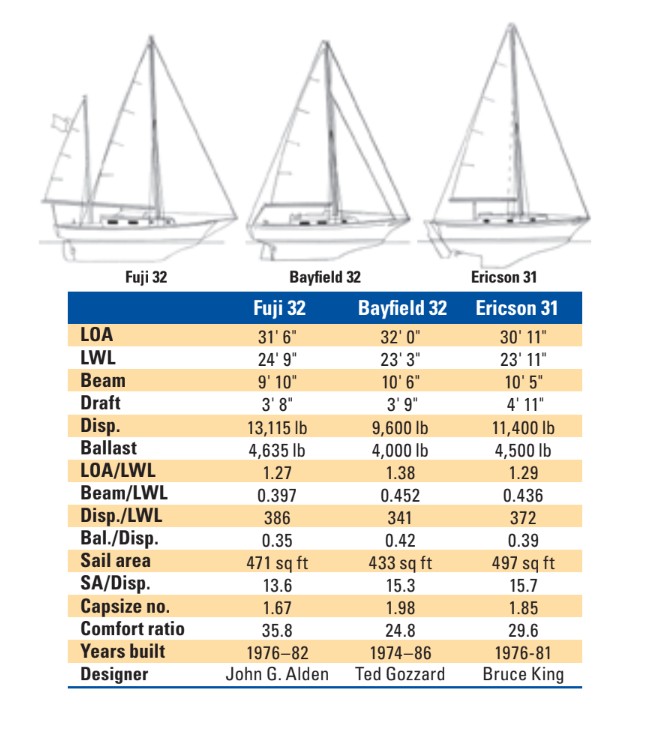
This is an unusual group as clipper-bowed small boats have been fairly rare in mass production. Aesthetically, I can see the problem, as a proper clipper bow is not simple to design. L. Francis Herreshoff, who was perhaps the master, laid down some design rules for clipper bows but none of these yachts obey them. The bald-clipper bow of the Fuji 32 appears to have too little reverse and really needs some nice trailboards to set it off. The Ericson 31 is a little better, but her funky “trailboards” lack traditional appearance and she needs a bowsprit to really carry it off. I found one photo of an Ericson 31 Independence with a double-headsail rig and a short sprit and she did look quite handsome. The Bayfield’s exaggerated clipper bow seems badly overdone and quite out of proportion. She would look much better with a shorter overhang combined with a short sprit to obtain the desired foretriangle length. But, as I said, a clipper bow is not easy to design, and I still look back at some of my own and wince a bit. For good examples, go on the Internet and check out the Cherubini 44 and 48 and the Luders Clipper series.
Well, on to more important things such as performance. I think we can honestly say that none of the three yachts here will set any records for speed or weatherliness, but in a race between the three, the silver cup would undoubtedly go to the Ericson 31. Her deeper draft, cutaway lateral plane, and taller rig would give her quite an edge around the buoys. The Fuji 32, with the highest displacement, the greatest wetted area, and a ketch rig with the lowest sail area/displacement ratio, will certainly be the slowest of the group in light to medium air. She will only come into her own offshore in a brisk breeze. There, with a good mizzen staysail and a following sea, she might well be the steadiest and most pleasant of the three for a couple to handle. Certainly her long shoal keel, like the Bayfield’s, will keep her tracking steadily. Those two could be trimmed to sail themselves for long periods . . . always a nice feature in a small yacht.
I have seen a few reports that show the Bayfield as having 525 square feet of sail. That is not what scales out on the drawings, so I believe they are using the area of the two headsails rather than just the 100 percent foretriangle. I also read that some of the boats were built with 7-foot-higher masts, and others with 4-foot-higher masts, to improve their sluggish light-weather performance. That would be useful in many areas of our lakes and coasts due to the 32’s large wetted area and small rig. I do like the double-headsail rig of the Bayfield and would recommend it to both the others for offshore use and even for the Great Lakes. A small staysail and a reefed main can take you through some heavy weather with confidence.
The capsize figures show that all three fi t under the 2.0 that is considered the maximum number for offshore cruising. The Bayfield is just slightly under due to her much lighter displacement. Because of their shoal draft, I might be tempted to add a bit more ballast to the Fuji and Bayfield if an ocean voyage was in the plans. However, a ketch-rigged Bayfield 32 has crossed the pond to take part in a singlehanded transatlantic race and I have no doubt the other two could handle blue water as well, given proper equipment and seamanship. Indeed, the Fuji’s CSF number of 1.67 is unusually good for a small yacht. Apart from bluewater voyages, their shoal-draft hulls make both the Fuji and Bayfield good choices for quietly cruising our coastal waters and exploring the many snug coves along our shores.
There is no way that one will be truly comfortable on a small yacht in truly heavy seas. Still, the comfort ratio of the husky Fuji is unusually high for a boat her size, so she will certainly handle heavy weather better than the others . . . but it is a matter of degree. The lighter, beamier Bayfield will be considerably corkier and the Ericson somewhere between the two. Each of these three cruising yachts has its own particular advantages and the choice will be up to the individual skippers, depending on where they want to sail, how they want their boats to perform, and in what degree of comfort.
Ted Brewer is a contributing editor with Good Old Boat and a well-practiced and respected authority on the art of yacht design.
Thank you to Sailrite Enterprises, Inc., for providing free access to back issues of Good Old Boat through intellectual property rights. Sailrite.com