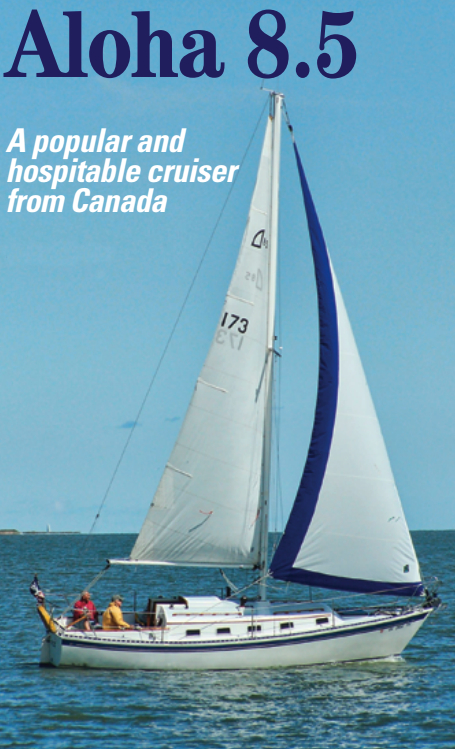
A popular and hospitable cruiser from Canada
Issue 80 : Sept/Oct 2011
In the late 1960s, a Chinese immigrant by the name of Ti Ouyang founded Ouyang Boat Works in Whitby, Ontario. His first offering, the Matilda 20, was an overwhelming success. The company flourished and additional Matilda models soon followed.
Mao Kang, one of Ti’s three sons, joined his father in the early 1970s and provided the fledgling company with much-needed management direction as well as the name for the company’s new line of cruising boats: Aloha. (While in college, Mao Kang dated a girl from Hawaii . . .)
Several naval architects, including Robert Perry and Mark Ellis, contributed designs to the company’s new line, and the design for Aloha 8.5 was a collaboration between Ted Brewer and Robert Wallstrom.
Although the Aloha boats were very popular, the under-financed Ouyang Boat Works ran out of money. Ti and Mao turned to a family friend and dealer, Canadian Yacht Charters, for a much-needed cash infusion, but the partnership was rocky from the start. In 1986, Ti sold the company for $100,000 and retired.
Aloha Yachts continued production for the balance of the 1980s and, all in all, built approximately 700 Alohas. Like so many of its contemporaries, the company had closed its doors by 1990.
Design
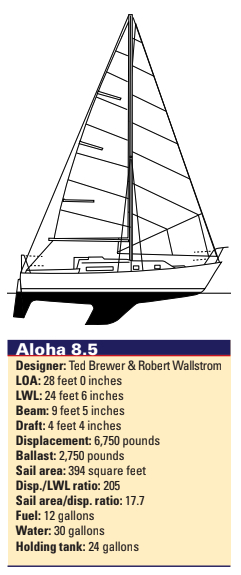
In their design for the Aloha 8.5, Ted Brewer and Bob Wallstrom created a cruising sailboat of a more “yachty” style than many boats of a similar size being offered at the time. The classic lines of the Aloha 8.5 show a sheer with a strong spring to it, a straight stem with a pronounced chin, and an upright transom. The beam is quite full and, carried well to the waterline, results in fairly firm bilges that contribute some stability and enhance cruising comfort.
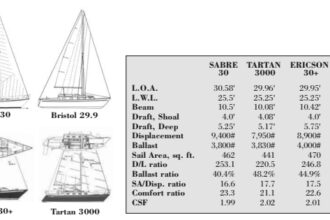
Below the water, the Aloha 8.5 has a shallow swept-back fin keel that gives the boat gunkholing possibilities. The transom-hung rudder, which is also supported by a skeg, is at the end of a longish waterline, reflected in the moderately low displacement/LWL ratio of 205. While the skeg is unusual with a transom-hung rudder, it’s a sensible, arrangement. It protects the leading edge of the rudder from damage in the event of a grounding and improves tracking when under way. Another benefit of a transom-hung rudder is that it’s comparatively easier to jury rig than a rudder with a through-the-hull stock in the event it does suffer damage.
The cabintop is cambered and a slight step at the mast lowers the cabin height forward, preventing that “boxy look” when viewed in profile. The wide cove stripe accentuates the boat’s sheer and the cabin’s teak eyebrow trim visually reduces the cabin’s height.
Deck features
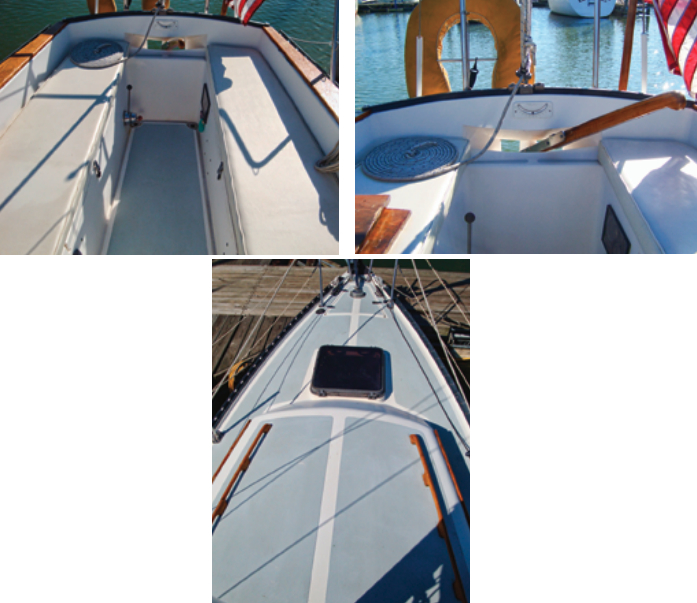
The foredeck of the Aloha 8.5 is relatively spacious for a 28-footer. A cast-aluminum stemhead fitting incorporates a single anchor roller, and two chocks lead docklines to a pair of 8-inch open-throat cleats. A deck pipe is fitted in the lid of the anchor locker.
The forward hatch is located on the foredeck and not on the cabintop, which has a tidy look to it thanks to a minimum of fittings: two sets of teak handrails along its outboard edges, port and starboard Dorade vents with bronze cowls, and a sea hood. Ten opening portlights, five per side, provide plenty of light and cross-ventilation in the cabin.
Good-quality non-skid is molded into all horizontal deck and cabin surfaces. Its non-reflective gray-blue color is easy on the eyes and gives the deck its two-tone appearance. Brightwork is limited to the cabintop handrails, companionway trim and hatch boards, cockpit coaming tops, and the eyebrow trim. Other deck features include bow and stern rails, dual lifelines, the slotted toerail, and a pair of 8-inch stern cleats.
The cockpit is moderate in size, with seats measuring 80 inches long. Its coamings are carried well aft and the footwell is properly sized for good bracing. Any water that gets into the cockpit drains through a pair of 1 1/2-inch scuppers, and a proper bridge deck helps keep it out of the cabin. Two seat lockers provide stowage as well as access to many of the boat’s systems. The aft end of the engine, the stuffing box, the aluminum fuel tank, and the batteries can be reached from the port locker. The starboard locker is primarily for stowage but also houses the polyethylene water tank.
While wheel steering was an option, most Aloha 8.5s came with the standard tiller steering. Rather than extending over the transom, the relatively short tiller enters the cockpit through a slot in the transom and angles slightly upward. This arrangement does not allow the tiller to be swung out of the way and somewhat complicates the removal of the rudder from the boat.
Construction
The hull is solid hand-laid fiberglass and was molded in two halves — port and starboard. The halves were bolted together and the centerline was sealed and glassed over. Once the hull was complete, lead ballast was lowered into the keel cavity and encapsulated.
The deck is a sandwich comprised of fiberglass skins on either side of a core of end-grain balsa. Stress points are reinforced with plywood. The hull-to-deck joint is chemically bonded and through-bolted to incorporate a black-anodized aluminum toerail. All deck hardware is through-bolted to proper backing plates.
The 8.5’s mast, chainplates, and backstay are all electrically grounded for lightning protection. The chainplates are located outboard and bolted to solid mahogany knees glassed to the hull.
Ouyang Boat Works milled all its lumber at the factory, and the woodworking crew carefully matched the teak used in each boat for uniformity.
To form some interior components, as well as to add some structural support, a partial fiberglass pan was bonded inside the hull.
Belowdecks
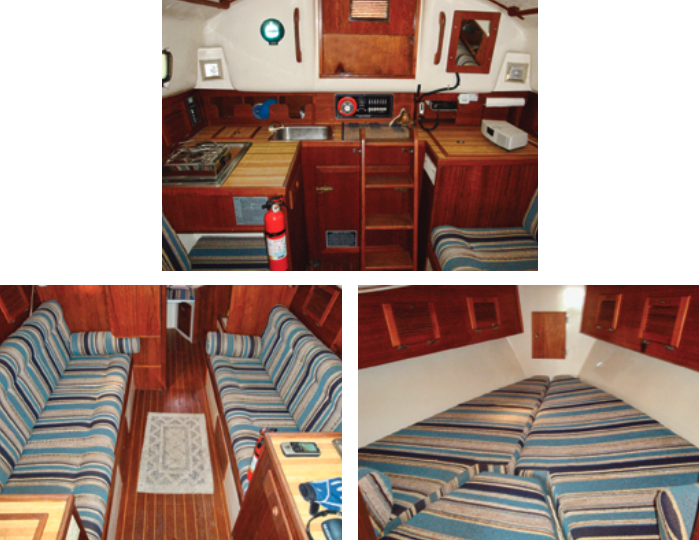
The V-berth with insert measures 6 feet 2 inches long and is of reasonable size, particularly at its head end. The forward cabin has plenty of stowage with lockers outboard port and starboard, a forward locker, and bin stowage beneath the berth. Other amenities include a pair of opening portlights, the forward hatch, and a pair of reading lamps.
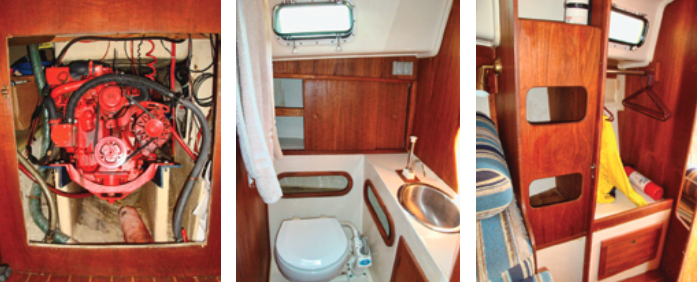
Aft of the forward cabin and to port is the head compartment, which is a molded fiberglass unit heavily accented and trimmed with teak. It contains a toilet and a single stainless-steel sink with a cold-water hand pump but no shower. The holding tank is situated beneath the V-berth. For illumination and ventilation there’s a single opening portlight. The door provides double-duty privacy — for the head or for the V-berth.
Across from the head are three stowage bins and a hanging locker. The hanging locker lacks a door because an opening portlight is located inside.
The saloon is traditional in layout with facing settee berths measuring 6 feet 3 inches in length. The port settee converts to a pullout double, bringing the total number of berths to five. The starboard settee is shorter than the port settee but a foot cubby located aft beneath the galley counter extends its sleeping length.
Two lockers are separated by an open shelf above each settee back. Like those in the forward cabin, each has a louvered teak door and the shelf is fiddled. The bulkhead-mounted table is to port and, when lowered, exposes a shallow spirits cabinet. Additional stowage is beneath the settees and behind the seatbacks. The lockers beneath the settees have drawer openings in the front and can be accessed from the top as well.
In addition to the companionway, six opening portlights and two Dorade vents provide the main cabin with light and airflow. For safety, a pair of teak handrails is mounted overhead.
The athwartships galley is basic but functional. To starboard is an alcohol cooktop, a single stainless-steel sink with foot pump, bins for dishes, and bins and lockers for provisions. The rather large icebox is on the port side, along with additional stowage cubbies. The icebox drains to the galley sink via a hand pump. Since the galley spans the width of the boat, the wood-grain-pattern plastic countertop also functions as one of the four companionway steps.
The electrical panel is located beneath the companionway opening. Access to the bilge is at the foot of the companionway ladder. The forward portion of the engine can be reached by removing the companionway ladder and a panel behind it.
The teak-and-holly sole, oiled-teak interior, and the attractively patterned vinyl headliner with teak battens make for a very positive overall impression. With 6 feet of headroom, a folding table, and the six opening portlights, the main cabin is bright and roomy.
The rig
The Aloha 8.5 is rigged as a masthead sloop, with a bridge clearance of 44 feet. The mast and boom are painted white with linear polyurethane. The mast is stepped on deck and fitted with a single set of airfoil spreaders. A pair of cap shrouds, dual lower shrouds, a headstay, and a split backstay support it.
The halyards, outhaul, and jiffy-reefing lines are internal. All lines are led aft to line stoppers and a pair of Barient single-speed winches mounted on the cabintop. The mainsheet is attached to the end of the boom and leads aft to a traveler mounted at the transom. Headsail sheets are led through snatch blocks shackled to the slotted toerail and run aft to a pair of Barlow #19 single-speed primaries.
The 8.5 originally came with a mainsail, a 150 percent genoa, and a working jib.
Under way
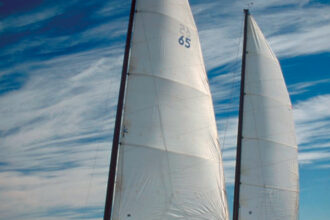
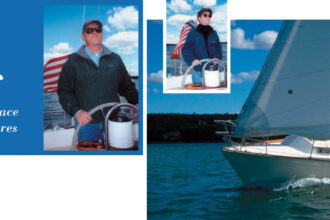
Our test boat, Tal Vez, owned by Bob Gloman, is a 1980 model, sail number 173. Although we had little wind on the day we tried her out, she seemed to be well balanced, very stable, and easy for two people to sail.
Reports from owners indicate that the Aloha 8.5 is dry under sail and, when set up right, it will almost sail itself.
The PHRF rating is 189 seconds per mile. This compares favorably with the Cape Dory 28 at 228 and a Pearson 28 at 192.
Two auxiliary power options were offered, depending on the year of production: an 11-hp Universal diesel or a 13-hp Westerbeke diesel. A standard 12-gallon aluminum fuel tank was also offered. Earlier engines were raw-water-cooled, but later ones incorporated a heat exchanger and were freshwater cooled. Access to the engine is average, and is obtained through removable side panels inside the cockpit lockers as well as the usual panel behind the companionway ladder.
Things to check
As you would with any boat of this vintage, sound out the deck, especially around deck fittings and the mast step. Delamination of balsa-cored decks is a common problem and, if extensive, can be a deal breaker. The fiberglass interiors of many of the lockers may be quite rough and have the potential to snag items such as clothing stowed in them . . . and flesh too. To get the most out of the large icebox, it will be necessary to increase its insulation all around — there is little to none.
Conclusion
The Aloha 8.5 is an attractive boat with graceful lines designed and equipped for safe, comfortable cruising. Overall, the quality of the workmanship is above average. At less than 30 feet, an Aloha 8.5 represents a good value. Expect to pay $18,000 to $25,000, depending upon age, condition, and equipment.
Gregg Nestor , a contributing editor with Good Old Boat, has had a lifelong interest in all things aquatic. He and his wife, Joyce, are currently refitting, upgrading, and sailing a 1994 Caliber 35.
Thank you to Sailrite Enterprises, Inc., for providing free access to back issues of Good Old Boat through intellectual property rights. Sailrite.com