Four family-sailers
Issue 58 : Jan/Feb 2008
In the September 2006 issue of Good Old Boat, I reviewed four other boats in the 28-foot/29-foot size range: the Ranger 28, Ranger 29, Islander 28, and Sabre 28. Each of the boats in that comparison has a near relative in the 27-foot/28-foot range.
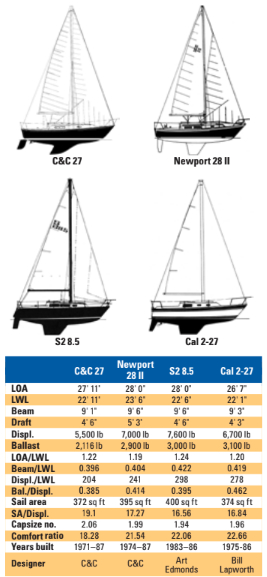
The S2 8.5 and Sabre 28 are quite close in size and displacement; the Islander 28 and Newport 28 are similar in many respects; and the Ranger 29 and Cal 2-27 share a number of characteristics. The C&C 27 and Ranger 28, at 5,500 and 5,100 pounds displacement, respectively, are the lightest boats in either group, by far.
This does not mean that one designer copied another. There are limited variations for a 27- to 28-foot yacht intended for general family use.
The C&C 27 is the smallest and slimmest of the group, having the lightest displacement and carrying the least ballast, so I would assume she is also slightly tender as a result. Surprisingly, her Newport 28 sister, also designed by C&C just three years later, is a considerably larger boat. She has 27 percent more displacement along with five inches more beam and also carries almost 800 pounds more ballast on a deeper fin. Surprisingly, some owners report her to be tender also, perhaps due to a fairly round midship section, according to Practical Sailor.
With the heaviest displacement, good ballast, and generous beam, the S2 may be the stiffest boat in this group and a good all-around performer. However, the deeper draft of the Newport and the high sail area/displacement ratio of the C&C 27 could give each of them an edge under certain conditions: the Newport in a moderate breeze to windward and the C&C in lighter air, where she should be able to accelerate faster in the puffs. The classic Cal 2-27 is no slouch either, and owners have reported good stability and excellent performance.
Performance essentials
Obviously, their ultimate performance for cruising or racing will depend to a large extent on the condition of the sails, plus having a well-tuned rig, a clean bottom, and a competent skipper and crew. Given those essentials, any one of them will give its owners a great deal of fun and a chance at the silver in local events.
A less-than-desirable feature of the interiors of many boats in this size range is that the head is arranged fully athwartships so no one can enter or exit the forward cabin when the head is occupied. This could be objectionable to a family cruising with children. Only the Newport 28 II and Islander 28 appear to have a proper head off to one side, leaving the passage free when the head is in use. Indeed, the Cal 2-27 has even less privacy than most, as there is no way to close off the head from the V-berth.
There is little to choose between the boats when considering motion comfort. Any of them will be reasonably steady when heeled under sail and will bounce like a cork given light winds and a leftover sloppy sea. As to bluewater capability, none is what I would call ocean-going but, given good condition, equipment, and an eye on the weather, each is quite capable of coastwise voyaging and hops to the islands.
Because these are older craft they will be affordable, yet perform well and provide fun and excitement in club competition . . . as well as a grand cruising experience for a couple or young family.
Ted Brewer is a contributing editor with Good Old Boat.
Thank you to Sailrite Enterprises, Inc., for providing free access to back issues of Good Old Boat through intellectual property rights. Sailrite.com