Steps in the process of measuring progress
Issue 80 : Sept/Oct 2011
Speed on the water is measured worldwide in knots. A knot is a speed of one nautical mile per hour and is abbreviated as kn or kt. A nautical mile is the length of one minute of latitude. It is defined by international agreement as 1.852 kilometers, approximately 1.151 statute miles.
It begins with a log
In the early days of exploration, the most common method of measuring speed, and consequently distance, was called the Dutchman’s Log.
On the sailing ships of that period, a large supply of firewood was carried aboard to fuel the galley stove. To determine how fast a ship was sailing, sailors threw a firewood log into the water at the bow of the ship and counted the time it took to reach the stern. Since speed is distance divided by time, and the distance was known (the length of the ship), the boat’s speed could be calculated.
A chip off the old log
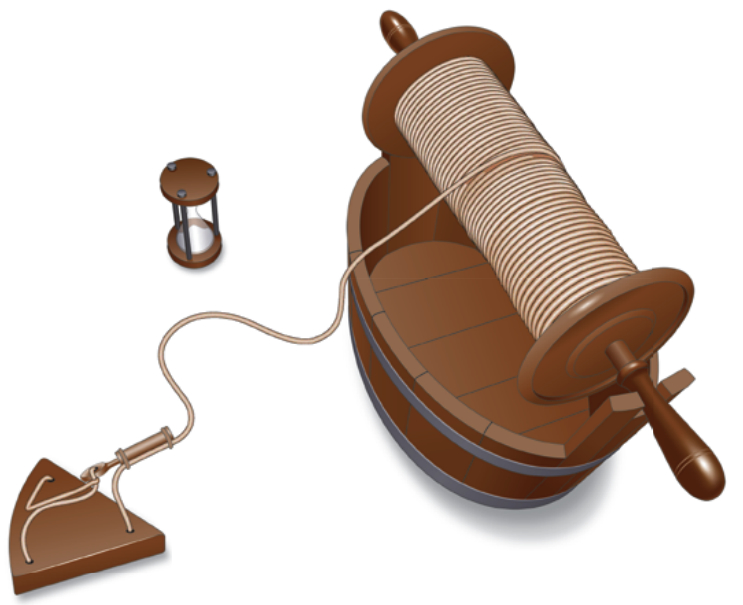
By 1600, speed through the water was measured more accurately with a device known as a chip log. It consisted of a piece of wood, usually in the shape of a quarter circle or half circle, weighted on the curved side so it floated vertically to create the greatest resistance to the water. A string bridle fastened at three points was led to a single line that had knots tied into it at equal intervals.
To measure speed, the chip was thrown into the water and the line allowed to run out through a sailor’s hand. The sailor counted the number of knots that passed through his hand during the period measured by a sand timer. Each knot tied in the line represented 1 nautical mile per hour. Thus, when the sailor called out, “Eight knots,” the ship was traveling 8 nautical miles per hour. Eventually the term “knots” (the actual knots on the chip log’s line) became synonymous with a boat’s speed through the water.
Revolutionary counter
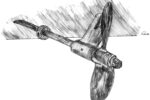
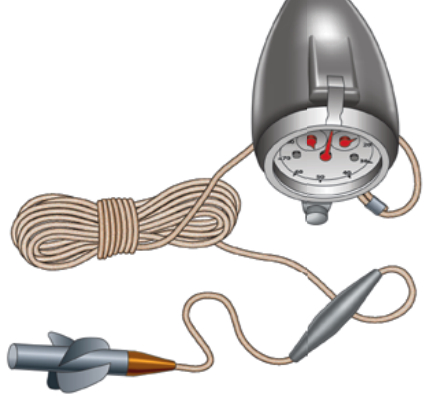
In the late 1700s, more accurate measurement of speed and distance was obtained by use of the Walker, patent, or taffrail log (the taffrail is the stern rail on a boat). This was a spinner that was towed behind the boat. It measured distance traveled by counting revolutions of the spinner, either directly on the spinner itself or on a gauge fastened to the taffrail. To make it less attractive to fish, the spinner was painted a dull black.
Electronic logs
A method of measuring speed through the water that has become common in modern times employs a small paddle wheel that projects from the bottom of the boat’s hull. Magnets on the blades of the paddle wheel pass a coil of wire inside the hub of the device, inducing a voltage that depends on the rotational speed of the paddle wheel. For many years, the voltage was registered by an analog-meter display calibrated in knots. These days, the displays are almost exclusively digital.
A diversity of devices
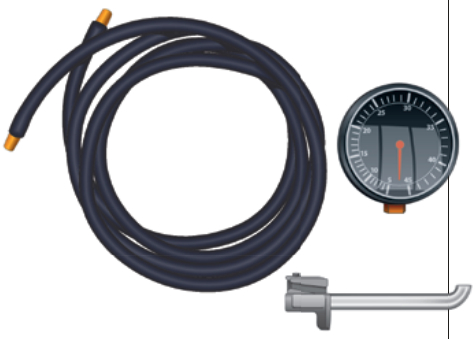
Many other methods are used for measuring speed through the water. One type of speed sensor uses ultrasonic sound and measures the Doppler shift in frequency resulting from the speed of the passing water. Other devices measure the resistance of an object that’s towed through the water, usually using a spring.
The Pitot tube, invented by French engineer Henri Pitot in the early 1700s, uses the pressure of the water arising from the boat’s forward motion to measure speed. It is widely used on airplanes to measure airspeed.
Speed over ground
All of the methods described above measure the boat’s speed through the water, which is not necessarily its speed over the surface of the earth, also called speed over ground (SOG).
If a boat were heading south through the Florida Straits between Florida and the Bahamas, it might be doing 3 knots through the water, but due to the north-fl owing Gulf Stream it could be going backward or standing still relative to the earth’s surface.
It wasn’t until the electronic age that speed across the face of the earth could be measured directly. Loran-C did this, and GPS still does, by determining a boat’s terrestrial position at frequent intervals and calculating how fast the boat must have been traveling to get from one point to the next. This is the most commonly used means to determine speed on recreational sailboats today.
Don Launer, a Good Old Boat contributing editor, built his two-masted schooner, Delphinus, from a bare hull and has held a USCG captain’s license for more than 36 years. He has written five books, including Navigation Through the Ages and frequently gives talks on the history of navigation.
Thank you to Sailrite Enterprises, Inc., for providing free access to back issues of Good Old Boat through intellectual property rights. Sailrite.com