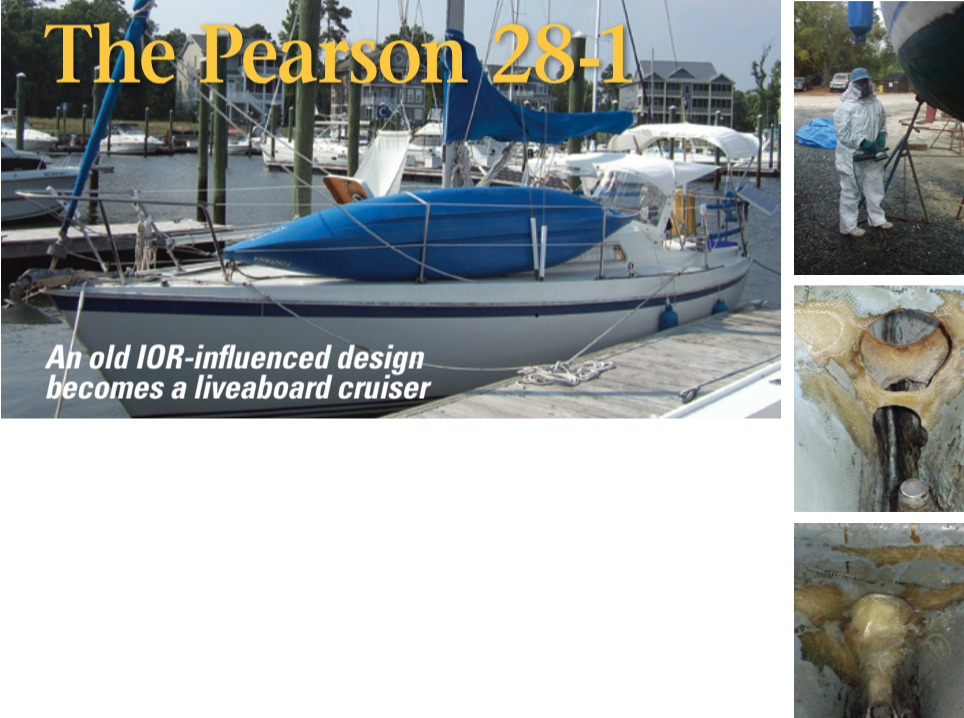
An old IOR-influenced design becomes a liveaboard cruiser
Issue 58 : Jan/Feb 2008
For 50 years, the name Pearson has been synonymous with sailing. Along the way, Pearson built three very different 28-footers. The first was the famous Triton from 1959 to 1967. Then there was the Pearson 28 Mk 1 (P28-1 as it’s called now), designed in 1974 and produced in 1975. Significant changes were imposed on the design in 1976, making the earliest examples of the boat a prototype of sorts for the higher interior volumes to come. Eventually, the demands of the recreational boating public for greater perceived luxury tolled the death knell for the 28-1. Launched in 1985, the P28-2 moved away from the traditional small seaboat concept toward increased interior volume. More than 350 P28-1s were built, and the boat is still popular. Selling prices vary, but seem to be somewhere around $10,000, just about what they sold for when new 25 years ago.
Miss Bohicket (hull 149, 1977) is a beautiful example of this classic boat. Her current owners, Phillip and Andie Reid of Wilmington, North Carolina, have lovingly “restored” their Pearson to a state that is in fundamental ways well beyond the original.
Phillip and Andie found Miss Bohicket near her eponymous creek in South Carolina in March 2000. After moving her to a berth at Masonboro Marina where they could be close to her, they began what became a six-year labor of love, bringing their new boat to a standard commensurate with their intentions: liveaboard cruising.
The Reids’ approach to cruising is pragmatic: rather than succumb to the present vogue of buying large boats of dubious pedigree, they focused on an affordable, well-found boat that they could fit out modestly with high-quality equipment and installations.
In reasonable condition
When they began their project, what they found was a boat in reasonable condition (for her 20-plus years) with anachronistic electronics and tired systems. As Phillip puts it, they “learned a lot.”
Any 20-something boat is going to require a thorough refi t as well as problem solving for the inevitable things like water intrusion, corrosion, former owners’ sins, and the like. The work that the Reids have done makes an excellent case study of the breadth and complexity of such a project.
Prior to the first haulout, the to-do list included delving into the bilge, replacing mooring cleats, cockpit drains, and through-hulls, plus the usual: acid-wash the hull, check the rudder and Cutless bearing, paint the bottom, and so on. During that haulout, the list expanded. Replacing and raising the bootstripe revealed some superficial gelcoat blisters under the old bootstripe. They repaired them and added a full barrier coat of Interprotect 2000, a new Awlgrip bootstripe, and two coats of Trinidad SR. All metal below the waterline was cleaned completely, then treated with Pettit Metal Primer, Interprotect 2000, and bottom paint. The good news was that the boat did not suffer from any general osmosis blistering below the waterline; a knowledgeable previous owner had already done a complete bottom restoration including drying, de-blistering, and epoxy barrier coating.
Repair, clean, and repaint
The bilge yielded a few bits of rusted metal, formerly known as hardware, plus the discovery that the foam used in the floors was completely saturated with muddy water. This was all removed and replaced with epoxy and mat, and the floors were re-glassed with epoxy. Then the whole bilge was thoroughly cleaned and repainted.
All the seacocks were removed and replaced. Three of the four originals were frozen or leaky gate valves, two of which had to be ground off from the outside. The new installations were done with glassed-in backing plates for strength. Phillip chose Marelon seacocks for simplicity of maintenance, durability, and lack of corrosion.
Back in the water after nearly a month in the yard, Miss Bohicket enjoyed a thorough cleaning and her topsides reflected both water and pride for the first time in years.
While the Reids are practical, they’re not Spartans. They installed a good stereo with a built-in sub-woofer to see them through the next five years of projects.
They found the Atomic 4 to be in serviceable condition — a testament to the quality and durability of these engines. Even lacking a mechanical background, Phillip found it to be a simple engine to learn about and care for.
The rig presented a special set of issues. Years of standing water at the base of the mast had corroded the mast butt, and it had to be trimmed 4 inches, cleaned, and repainted. Then Phillip built a riser and installed it to bring the total mast height back to its original (see Good Old Boat, September 2005). He kept the original mast step. It was ground down, corroded areas were drilled out and filled with epoxy, and proper drain holes were drilled. The step and the riser (both aluminum) were coated with zinc chromate primer, then epoxy primer, and finally painted. For this, Phillip recommends Interlux Bilgekote or any other paint suited for application below the waterline. To reduce corrosion between the aluminum parts and the steel bolts, Phillip bedded the step to the riser with 3M 5200 before bolting.
Rotted balsa core
The deck around the mast partners needed work where water had rotted the balsa core. The fiberglass was cleaned well inside and out and the rotted core ground back to fresh, dry wood. Then the cleaned-out area was epoxy filled and a new interior trim ring was made from plywood, coated in epoxy, epoxy primer, and Imron. This structural component backed the through-bolts of the mast collar on deck. A Spartite installation completed the project.
The chainplates were removed and, upon inspection, found to still be in serviceable condition, showing no signs of cracking, corrosion, or elongation of the mounting holes.
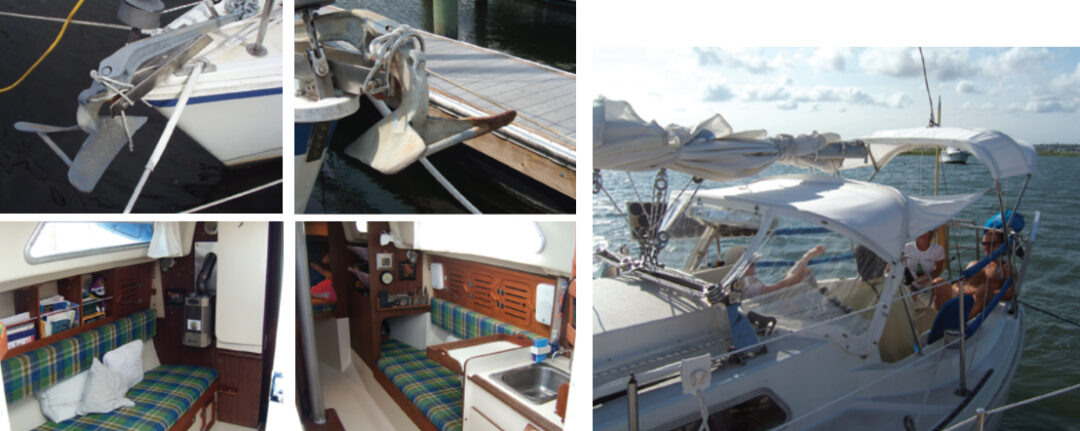
Another significant deck project, aimed at taking the boat from weekender to liveaboard status, was the addition of a bow roller and a deck hawse for ground tackle. Phillip chose a 35-pound CQR as his primary anchor and constructed a custom roller and chock system for it. The trick was to clear all the things on the bow — roller furler, stemhead fitting, fairleads, and stanchions — and to keep the anchor from gouging the fiberglass, while limiting the overhang and making the whole look good.
The roller is made of two pieces of 1⁄4-inch 316 stainless-steel angle, mounted on a pad made of three layers of 1⁄2-inch Starboard sealed with 5200 and fastened with four 3⁄8-inch, 316 stainless-steel, hex-head bolts. The roller is a urethane trailer bow roller (a quarter of the price of the black anchor roller) on a 1⁄2-inch 316 bolt. There’s a chrome-plated bronze deck plate behind the anchor.The rode is 40 feet of 5⁄16-inch chain on 300 feet of 5⁄8-inch nylon.
Back at the stubby end, some important modifications were made in the cockpit. The engine controls had to be moved to a location more accessible from the helm. A VHF radio was relocated to the helm. The manual bilge pump was replaced, and a sturdy pedestal guard was installed for support.
Mounted in locker
A custom teak box holds the VHF, ignition switches, and wiring. It supports a frame for a sliding Plexiglas door. This was all mounted into the aft section of the port cockpit locker with through-bolts and 5200. Permanent wiring and a deck gland were added for an adjustable solar panel mounted to the port pushpit.
On deck, the whole boat was treated to a new non-skid surface. The original deck had been repainted and no longer provided any traction, especially when wet. The original surface was ground back and then painted with Durabak 18 — a suspension of recycled rubber bits in a one-part xylene-based polyurethane. With the decks painted white, the interior is much cooler too.
Cockpit canvas, holding tank, windows, portlights, navigation lights . . . projects too numerous to list, distinguish the contemporary Miss Bohicket from her former self.
The culmination of all this work is a boat that’s comfortable and fun to sail. Four of us headed out into the Atlantic for a Saturday race and raft-up on board Miss Bohicket. Performance-wise, she was able to hold her own against other cruising boats in the 30-foot range. The helm was responsive and it was easy to find the groove upwind in a 2- to 3-foot chop.
The small wheel doesn’t provide much leverage and requires a heavy hand at times; a tiller might be more appropriate to the boat, but it wouldn’t play as well to the cruising theme.
When we were beating into the waves, the cockpit was remarkably dry for a 28-footer. The ride was comfortable, though it was easy to end up overcanvassed. A nimble, well-balanced boat does have a tighter wind range for any given sail configuration than a heavy-displacement cruiser would. Downwind, the sailing was easy; the boat was steady, making few demands on the helmsman. Although the waves weren’t big enough for us to surf, we could feel the acceleration with the larger swells.
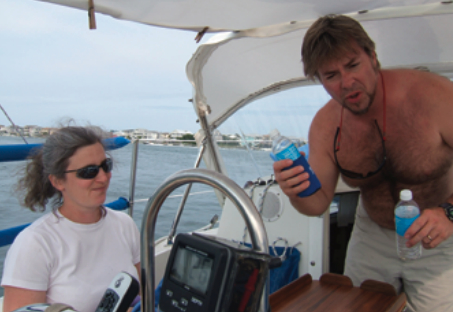
Reversing is interesting
Under motor, the offset prop gave the helm a constant bias, though nothing that any autopilot would have trouble with. We motored easily at 5-plus knots. Phillip says that the shaft offset also makes reversing an interesting exercise, but he had no trouble backing out of the tight marina slip.
Overall, it’s a pleasure to see a well-found boat like this P28-1 gain a new lease on life. Taking an older boat and bringing it back as a liveaboard cruiser is not a trivial endeavor.
It is essential, first of all, that the unchangeable basics — the initial design and the original construction — be credible. The Pearson 28 is. And second, the project must be approached with focused tenacity, a willingness to experiment and learn, and a good sense of humor. Miss Bohicket is testament to both the Reids and her builders.
Jeff Williams lives on board his J/40, Gryphon, on which he and his partner, Raine, circumnavigated from 1998 to 2004. See their story at http://www.j40.org. They are presently cruising the BVI.
Thank you to Sailrite Enterprises, Inc., for providing free access to back issues of Good Old Boat through intellectual property rights. Sailrite.com