. . . and a pair of CCA-style contemporaries
Issue 81 : Nov/Dec 2011
I was quite pleased to hear the Luders 36 was to be a feature boat as A.E. “Bill” Luders Jr. was my boss and mentor from 1960 to the ’70s and good friend until his death in 1999. Bill did not hire another assistant after the yard closed in ’67. He sent his work to me in Maine, and the various Cheoy Lee designs, including the Luders 36, are some of the last drawings I did for Bill.
The Luders 36 was about the last of her type as well, one of a dying breed. The IOR handicap rating rule had taken over from the earlier CCA rule, so long keels, short waterlines, long overhangs, moderate beam, husky displacement, and low-aspect-ratio rigs fell out of favor. The CCA rule produced many beautiful yachts.
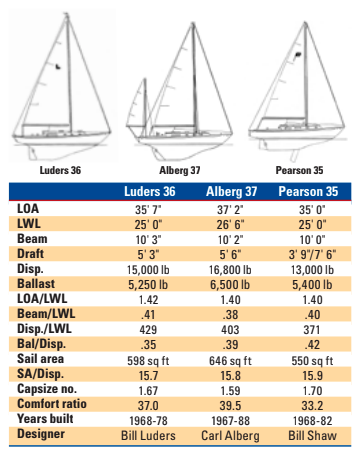
The Luders 36, with her lovely sheer and balanced overhangs, is one of the cream of the crop, but the CCA yachts could not compete in performance or accommodations with the longer-waterline, beamier, and lighter fin-keel yachts favored under the IOR. As a result, I had some trouble finding two CCA-type yachts to compare with the 36. After considerable searching, I came up with Bill Shaw’s Pearson 35, a typical CCA keel/centerboard yacht, along with the popular Alberg 37 built by Whitby Boat Works.
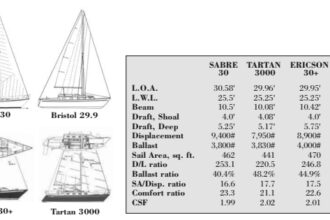
The Alberg 37 is the largest of the three with the longest waterline and the heaviest displacement. These boats have done well in club racing and their builder, Kurt Hansen, raced his 37 successfully and also sailed her across the Atlantic to visit his native Denmark. The 37 has a keel-stepped mast and was available with a yawl rig, which appealed to many cruising sailors. The yawl has always been one of my favorite rigs as well.
The Luders 36 is in the middle of the pack, lighter than the Alberg but heavier than the smaller Pearson and with the same waterline. The Luders has the lowest ballast ratio of the three but will still prove to be a good all-around performer with a light and balanced helm. She reminds me in many ways of Bill’s successful Luders 27 (27-foot LWL), Storm, which I raced aboard regularly in the 1960s.
The Pearson has the lightest displacement of the three and, by 2 inches, the narrowest beam. She also sports a deep, dagger-type board that is a big improvement over the short vee-shaped boards of the earlier keel/centerboard ocean racers. Her modest beam surprised me, as the keel/centerboard yachts were usually on the beamy side. However, she has a much higher ballast ratio than successful yachts of her type, such as the Bermuda 40 (see page 15) and the famous Sparkman & Stephens Finisterre, so should be amply stable despite her shoal draft.
In any case, the CCA types, with their modest beam and wineglass sections, have less form stability than a beamy, light-displacement, fin-keel yacht and will heel to a greater degree in a stiff breeze. The difference is that the narrower CCA yachts tend to roll down into the water as they heel, often with lee rail awash, while the beamy lightweights roll out. Indeed, in a really stiff breeze, the very light and beamy yacht can roll out so far that it exposes its rudder or even its fin, often with rather exciting and photogenic results.
I would be very torn if I had to choose between these three CCA yachts. For club racing, I might lean to the Pearson for the efficiency of that board, plus its advantage of shoal draft for gunkholing. For bluewater voyaging, the heavier Alberg is attractive with its keel-stepped mast and yawl rig. For coastal cruising, I would definitely take the Luders, simply for the beauty of Bill Luders’ classic design with its lovely sheerline and balanced ends.
All three of these good old boats have very low capsize figures and very high comfort ratios for their size. This bodes well for their safety, ability, and ease of motion in heavy weather, and should be reassuring to the skipper who wants to cruise offshore.
These are three very fine yachts from the CCA era. They are a bit cramped in accommodations by present-day standards and they will not keep up with modern beamy lightweights around the buoys either. But they will attract admiring glances from knowledgeable sailors in any harbor, and they will take you across the oceans and bring you home again in comfort and safety.
Ted Brewer is a contributing editor with Good Old Boat and a well-practiced and respected authority on the art of yacht design.
Thank you to Sailrite Enterprises, Inc., for providing free access to back issues of Good Old Boat through intellectual property rights. Sailrite.com