. . . an ode to classic design
Issue 81 : Nov/Dec 2011
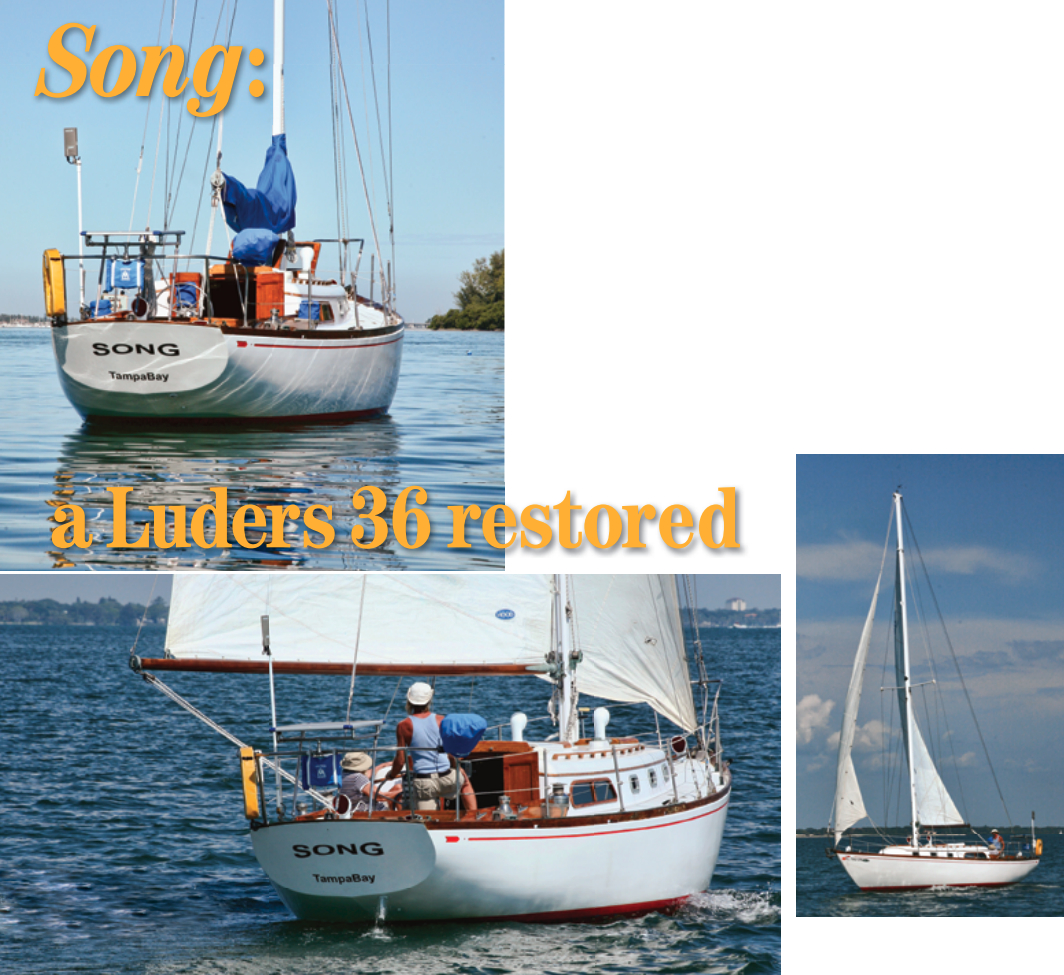
The morning light dawned on a quiet anchorage on the west coast of Florida. Not far from where our boat was anchored, one boat stood out proudly among the anchored fleet of more than 20 boats. Classic lines are not the norm nowadays. From her splendid sheer to her picturesque overhangs to her teak-trimmed toerail, cabin eyebrow, and coaming, she was a thing of beauty. I had to know more. Having left our marina without a destination in mind, we were without a dinghy. When the owner of the boat appeared on deck, I hailed him and asked about the boat. Our deck-to-deck conversation brought him over in his dinghy to pick me up for a closer look. Jim Stedman, owner of Song, a 1972 Luders 36, was justifiably proud.
The story starts on the drafting board of the famous Alfred “Bill” Luders. Born in 1909 to a boating family, Bill worked for his father who founded Luders Marine Corporation in Stamford, Connecticut. The company built commercial vessels and, — during WW II — minesweepers, sub chasers, and patrol boats. In the 1930s, Bill became a world-class helmsman in the 6-Meter class. In 1933, he designed the Luders 16, a 26-foot racing sloop, one of the most beautiful boats ever designed. When I reflect on my younger days and early morning walks along Belmont Harbor in Chicago, I see a fleet of at least a dozen Luders 16s bobbing at their moorings, looking like gulls afloat. They were so graceful and light they appeared to float in the sky. I dreamed of sailing one someday.
The Luders opus
When not busy running the yard, Bill designed a number of successful boats including the Luders 44 and, later, the Annapolis 44, both used as training yachts at the U.S. Naval Academy. His early racing successes and the wide acceptance of the L16s earned him a spot on the racecourses of the world. In 1958, his yard built the 12-Meter Weatherly to a design by Philip Rhodes. She was not successful in her first bid for the America’s Cup, but after a redesign by Bill Luders in 1964, she successfully defended the Cup. Bill also designed the 12-Meter American Eagle, which was later converted to an ocean racer and won races around the world with Ted Turner as the owner and helmsman. (Note: Ted Brewer was involved with the Weatherly and American Eagle projects as Bill’s assistant. –Eds.)
I’m convinced that unique design DNA inhabits yacht designers. Although the range of size and style of Bill’s designs is all-encompassing, there are familiar clues in the entire family. The combination of a springing sheer and pleasing overhang proportions are his hallmark. His reputation as a designer of fast seaworthy boats brought him many commissions for production sailboats. From 1960 to 1980 Bill designed more than 20 boats ranging from the Sea Sprite 27 to the Cheoy Lee 48. His very first of many designs for Cheoy Lee was the Luders 36, designed in 1968.
A Cheoy Lee tradition
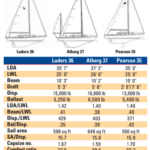
Cheoy Lee has been owned and managed by the same family for 140 years. The yard has produced more than 5,000 vessels, both yachts and ships. In the 1960s, it was among the pioneers of fi berglass construction in yachts and the Luders 36 was one of the early yachts to be produced. Hull #1 of the Luders 36 series (Cheoy Lee #2000) was completed in April of 1968. In all, 88 boats were produced.
I spoke with Jonathon Cannon of Cheoy Lee. He related the general construction practices at the Cheoy Lee yard when the Luders boats were built. The hull is built of a single skin GRP laminate comprised of multiple layers of chopped strand mat in polyester resin. The deck is two skins of chopped strand mat laminate with a mahogany-plank core to increase thickness and stiffness. The hull and deck are laminated together from the inside (the joint is not bolted or glued). Bulkheads are plywood, fiberglassed around their perimeters to the hull and deck. The full-keel boat was offered with three choices of rig: sloop, ketch, or yawl. Two interior layouts were offered. The “A” layout provided a convertible dinette to port with an adjustable-height table that converts to a double bunk. The “B” layout provides two fixed pilot berths with two extendable settees.
A boat restorer’s passion
Jim Doyle had learned the yacht construction business working with Charlie Morgan in Clearwater, Florida, in the 1970s. After running his own repair yard in St. Petersburg for a number of years, he turned to renovating sailboats.
His eye is attracted to classic yachts. His first restoration had been a Herreshoff Rozinante class. When he found Song, the Luders 36/Cheoy Lee hull #2454, she was abandoned and in a shambles at a small yard at the mouth of the Manatee River in Bradenton, Florida. She had been sitting in the sun, salt, and humidity for nine years. When he saw her in this deplorable condition, Jim says, he “got mad that someone could have neglected such a beautiful boat.” The teak decks were warped so badly the screws were pulling out. The boat was covered with mildew inside and out and the interior wood veneers were peeling off of the bulkheads. He walked away disgusted, but he couldn’t stop thinking about the boat. In January 2006, he made a very low offer that was accepted. The Luders 36 would become his 11th restoration project.
He tackled the decks first. The original deck had been glued down with an asphalt-like substance and fastened with hundreds of screws. After removing the planking with a crowbar, he tackled the adhesive with mineral spirits and a wire brush. It took two months of hard work to clean the deck. Jim decided not to replace the teak because of the Florida environment and decided to paint the decks. He used a product called KiwiGrip.
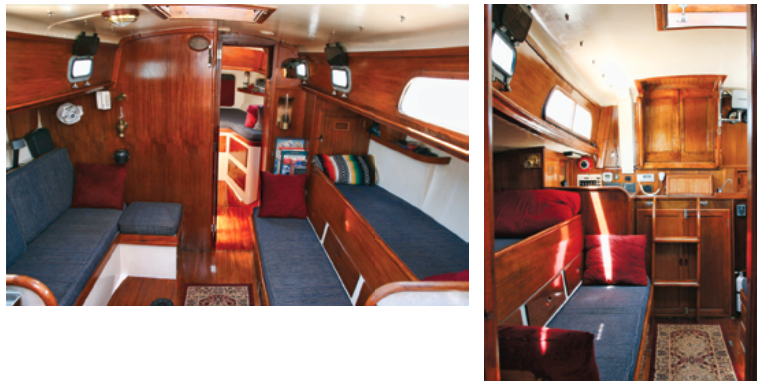
He cleaned the mildew off the hull, sanded it, and repainted it with AwlGrip. Down below, he refinished what could be salvaged of the veneer but had to replace most of it. New cushions, new opening ports, and new upholstery finished it off.
Although Song was originally equipped with a gasoline motor, a previous owner had replaced it with a Perkins 4-108 diesel engine. Jim did a total rebuild of the engine, transmission, and running gear.
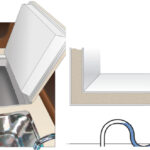
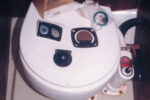
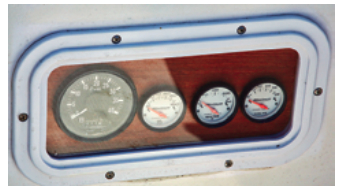
He is especially proud of a new instrument panel he designed and installed in the face of the cockpit bridge deck using a non-opening water-tight Beckson port. Behind the glass is a teak panel holding the tachometer and the temperature, oil-pressure, and engine-hour gauges. The ignition switch is inside the companionway.
Almost three years after purchasing the boat, Jim put her up for sale in order to start his 12th renovation, a 32-foot Allied Seawind II ketch. He was working on the Seawind when I met him, and was well on his way to another beautiful restoration.
Renovation continues
Jim Stedman, Song’s current owner, also has a substantial background in renovation and construction, but his is in the genre of Victorian homes. He first practiced professional marine photography in Florida, doing freelance jobs for a number of manufacturers of boating products. This led to a full-time position photographing the Hunter line of sailboats. Intrigued with sailing, Jim bought a Morgan 24. His first boat project was to rebuild the interior. Once that was completed, he sailed her on the west coast of Florida.
In 1985, he moved to San Francisco to assist family members in running and renovating a Victorian bed and breakfast. He shipped the Morgan 24 to Sausalito and enjoyed heavy-air sailing on the bay with an occasional cruise up into the California Delta.
Jim spent the next seven years in San Francisco, first renovating the family bed and breakfast. Word of his abilities spread and he did two more Victorian renovations and six smaller projects. More family commitments led Jim back to the Midwest. This time, he sold the Morgan.
His elderly father, a commercial photographer in Fort Wayne, Indiana, had purchased a number of old frame houses as investment properties over the years. Jim returned to Fort Wayne initially to manage, and then to restore, the properties. While there, he completed four historic homes and a number of remodeling projects. One by one, these properties were sold.
Following the deaths of his parents, Jim packed his tools in his van and headed back to the west coast of Florida. His goal was to fi nd a decent Morgan sailboat in the mid-30s size range, renovate it, and live aboard. He found a Morgan 38 on the Internet and contacted the broker. When he went to see it, he was disappointed.
“The photos on the Internet were not very accurate,” Jim says.
However, the broker had recently listed Jim Doyle’s project boat and sent that listing to Jim. He drove down to Bradenton and immediately fell in love with Song. As a fellow tradesman, he appreciated the quality of workmanship in the renovation.
“Jim Doyle and I spent about half an hour on the boat and we struck a deal,” Jim says. “I loved the lines of the boat and she had been carefully redone.” He moved aboard in February 2010. Riverview Marina is one of the last liveaboard, do-it-yourself boatyards in the area. It was perfect for Song’s new owner. “I spent so much time there that I pretty much had the run of the place,” he says.
A retune for the rig
The Luders 36 hull was sound and beautifully finished, and the decks were superb. The original wooden mast had not yet been refinished and was slightly warped. After thinking about the advantages of eliminating the teak decks, Jim applied the same line of thought to replacing the mast. This decision dictated an entire re-rigging of the boat.
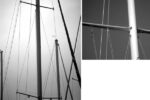
Luckily, Riverview Marina is a treasure trove of cast-off boat parts. On the spar rack, Jim found an aluminum mast that had been left by a previous boater. Careful measurements confirmed that it was almost an exact match for the original wooden spar. The 3⁄4 inch of additional length was just what Jim needed to saw and square off the mast base for the deck step. The deck-stepped mast is firmly supported below by the main bulkhead and a compression post that is located in the head and terminates at the keel. He did not learn the exact origin of the used mast he put into service, but it was a 7⁄8 rig. The sloop-rigged Luders 36 is a masthead rig, so Jim removed and modified the masthead fitting to provide blocks for his forward halyards. The spreaders were the correct length and could be reused.
The marina had a swaging machine so, with help from one of the workers, he fashioned all-new stainless-steel standing rigging and fitted new turnbuckles. He also replaced the stainless-steel main and jib halyards that operate from two reel winches. He cleaned the mast, etched it, and sprayed it with AwlGrip. The original wooden boom, made for roller reefing, was in decent shape, so he sanded it and applied 10 coats of varnish.
Jim was able to remove the original gooseneck track from the wooden mast and re-install it on the new mast. He replaced the running rigging as well as the mast wiring and anchor light. To maintain the original look of the boat, he continues to use headsails hanked onto the forestay. Although vintage, the sails are in decent shape. In addition to a Hood mainsail, Jim has a working jib, a 135 percent genoa, and a 160 percent genoa.
A medley of modifications
Since Jim was not happy with the location and condition of the propane locker, which was under the forward port cockpit seat and vented into the cockpit, he built a new airtight locker from a modified Igloo cooler glassed into the lazarette. The top is secured and vented to the hatch above and out the transom. For further security, he also sealed the bulkhead that separates the cockpit. The cooler was just the right size to hold a 10-pound propane tank, regulator, and solenoid switch.
The boat had an old marine head with an overboard discharge. Jim replaced it with a 5-gallon Sealand portable toilet that he modified so it could be pumped out through a deck fitting or through a through-hull via a Y-valve and a macerator.
Jim also built a stern-pulpit mount from scavenged Bimini hardware for a 60-watt solar panel. It’s connected to a Morningstar TriStar controller that gives Jim flexibility on whether he sends power to his two Group 27 house batteries or to his starting battery. A digital readout indicates charge rate and the batteries’ charge condition. While at the mooring in spring, summer, and fall months, the batteries are usually full by 2 p.m., but during the cloudy winter months he needs to run the engine more to keep them charged.
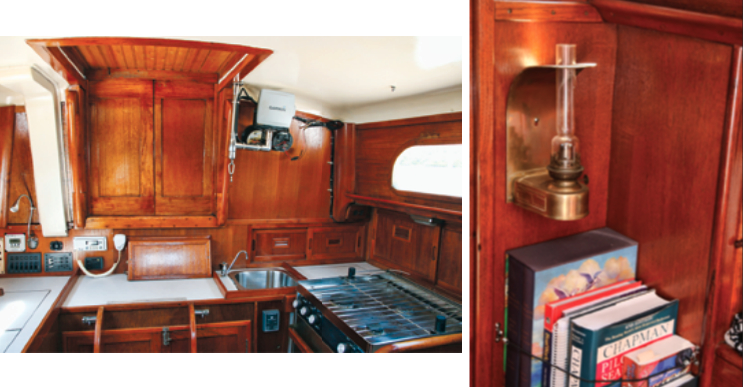
In addition to the previously mentioned engine-control panel, Jim installed a Garmin 546S GPS plotter/sonar unit on a unique swing-away mounting in the companionway (see Good Old Boat, March 2011). He also installed a Xantrex PROwatt SW 1000 inverter to handle 110 VAC electrical needs at the mooring and a Blue Sea Systems switch panel for shorepower. Evenings at anchor can provide entertainment through a Bose surround-sound system and an Insignia LED fl at-screen TV.
Jim enjoys his liveaboard life. He has become so fond of the excellent boating facilities in mid-coast West Florida that he hasn’t moved much in the last 12 months. “Everything I need is right here: secure and attractive anchorages; marinas; easy access to food, supplies, and occasional restaurants; beaches and bars; boating friends . . . it’s all right here,” he says. “I’m really not motivated to move at the moment.”
I have met few individuals who are so totally content in the here and now. Song is perfectly maintained, neat, and orderly inside and out. Stepping aboard Jim’s boat and entering his world is a Zen-like experience. His next projects, still in the planning stage, will provide additional bookshelves and stowage. He’s considering a number of options, but my guess is that nothing will happen quickly. That’s just not Jim’s way.
Bill Jacobs has spent the last 48 years in sailboats and powerboats. His marine photography appears in galleries, private collections, and museums, and has been printed in boating publications. He has written for boating publications since 2004. Bill winters in Sarasota, Florida, and cruises on a Mainship 34. In the summer he can be found sailing his Cape Dory Typhoon on Lake Michigan off the shores of Door County, Wisconsin.
Thank you to Sailrite Enterprises, Inc., for providing free access to back issues of Good Old Boat through intellectual property rights. Sailrite.com