Practice, observation, restraint, patience, persistence
Issue 81 : Nov/Dec 2011
Blinken, Sabot dinghy
In 1949, I was racing my Naples Sabot dinghy with very modest success. I complained to my mentor, Ray Wallace, that, while I had superior boat speed, the other kids got past me when rounding the marks and in close quarters.
Ray considered the problem then offered a solution. He said, “You have to practice to get better control over your boat. Early in the morning, before the wind becomes too strong, sail to a quiet basin in the harbor where you can be undisturbed and unobserved. Take along the Sunday edition of the Los Angeles Times, your lunch, water, and sunscreen; you’ll be there all day. Wad up the front page of the paper and pitch it over the side, turn back, and try to run it over. When it sinks, throw out another page. Repeat that until you can do it perfectly. Then start passing as close as you can without touching the paper. When you can do that perfectly, start throwing out two wads of newspaper and sailing between then. Then start making figure-eights between the paper wads. When you are comfortable with that, start throwing out three wads of paper and start tacking and gybing among them. By the time you get through the hundreds of pages of the Sunday Los Angeles Times, I guarantee you’ll be the best boat handler in the fleet.”
That advice was good enough to move me from “also ran” to a championship.
I vastly improved my maneuvering under sail, but maneuvering under power is a different matter since this is when boats are at their most idiosyncratic. Whenever I’m in an unfamiliar boat, I recall Ray’s advice, “Practice, with the newspapers or floating fenders. It’s cheaper than practicing inside the marina and hitting a dock or another boat.” With the help of fenders, I first determine the boat’s “crash stop” stopping distance: full ahead then full astern to a dead stop. (When the reverse prop wash reaches midships, the vessel is usually stopped.)
Next, I determine how far the boat will “head reach,” coasting to a stop in neutral. As the boat coasts to a stop, which way does the bow fall?
Then I start testing the diameter of the boat’s turning circle by doing “crash turns” with the engine in reverse, capitalizing on prop walk. Which way does the boat prefer to turn? That done, I practice turning in place. In this case, the boat is stopped with the helm over to one side. Then I apply short bursts (of equal duration) of forward and reverse at idle rpm. I do not touch the throttle. Instead, I depend upon duration to maneuver the boat. Once the engine revolutions begin to escalate, all is lost.
San Nicholas, tug
As kids growing up in San Pedro, the port of Los Angeles, we had little use for movie stars or sports figures. We dismissed them as celebrity lightweights. Our heroes were tug skippers, harbor pilots, tuna-clipper navigators, captains, and chief engineers. These were our heroes — real men.
When San Pedro Towing company’s new tug, the San Nicholas, arrived from the builders, a brass band, city officials, and I, along with all my grammar school pals, were waiting to see the new wonder. With 1,600 horsepower, she was the most powerful tug in the harbor.
She came up the channel covered in flags and bunting at speed with a bone in her teeth and throwing a huge wake. The delivery skipper brought her alongside with great élan. Half a boat length from the pier he backed down hard. We could hear the propeller rumble and pop as it cavitated. The stern squatted, prop walk pulled the stern around, and she came to a stop a couple of feet from the pier. Her following wake pushed her in the rest of the way and she came to rest perfectly, just inches from the pier. The deck hands nonchalantly dropped the mooring lines over the piles. It was a spectacular demonstration.
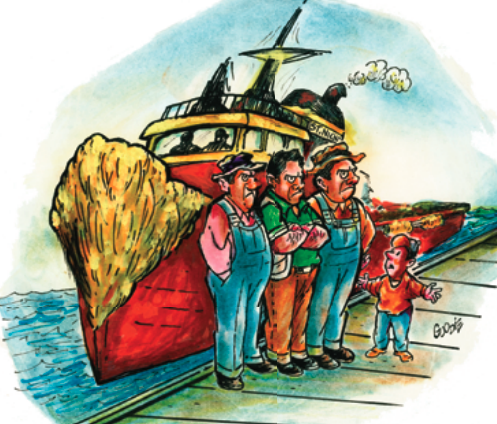
Yet the half dozen old-timers leaning on the rail beside me, in unison, crossed their arms, spat, and turned their backs contemptuously.
“What was that all about?” I asked. “That was a brilliant landing.”
An old-timer replied tersely, “He made smoke.”
“So?” I asked.
“The engine made smoke,” he explained, “because the skipper was overloading it, using too much throttle and too much rpm. What would have happened if his reverse failed?”
The point was made.
Malabar VII, Alden schooner
In 1956, I was deckhand on Malabar VII, a 55-foot Alden schooner. Owner Lou Tolhurst was frail, over 70 years old, and suffered cataracts in both eyes. I was only 16 and weighed 112 pounds. Yet we handled the boat just fine.
One afternoon, returning from Santa Catalina Island, as we were beating up Los Angeles Harbor in 15 to 18 knots of wind, Lou’s hat blew over the side. He spun the boat around, instructing me to leave the genoa sheet cleated. When we turned, the boat heeled and came to rest on the other tack. We were stopped — heeled a bit but stable.
I was amazed. The boat stood stock still. That was my first experience of heaving-to. The forward thrust of the main was balanced by the reverse thrust of the backed genoa. The keel was stalled and we were leaving a protective slick to windward. No one was needed on the helm.
“Don’t take your eyes off that hat,” Lou said, “It was given to me by my mother and I will not lose it. Keep it in sight while I go below to start the engine.”
With the engine, he powered, still in the hove-to attitude, back to a position directly to windward of the hat, so we could drift down upon it. A windshift placed us too far forward, so he simply applied a little reverse to reposition us. We had on board two boathooks, one 6 feet and one 15-feet long. We needed neither. He placed the boat so that when we drifted down on the hat, it was amidships at the main shrouds where freeboard was lowest. Lou simply leaned over and grabbed the hat. It was accomplished more quickly than I can describe it.
Challenger, oceangoing tug
Years later, I was working on a coastwise tug that, with 1,600 horse-power, was seriously underpowered for handling 2,000-ton barges. We worked in the Columbia River, San Francisco Bay, Puget Sound, the San Diego area, and the Sacramento River . . . all difficult places with lots of current. We normally towed at full speed, with 750 rpm.
In 32 days on board, I never saw the skipper maneuver with more than 250 rpm. The skipper was one of the best boat handlers I have ever seen. He was fond of saying, “I want to have that reserve power in my pocket. Go fast, be an ass. Go slow, look like a pro. It’s much cheaper when you hit something going slow.”
Mary T, Offshore 40
Our 35-year-old Perkins 4-107 diesel engine has, over the years, accumulated so many 4-108 parts that it has become a 4-107.25. So it should not have come as a surprise when it finally spun a main bearing and died en route from La Paz to Puerto Escondido, Baja California. Childbirth, death, and engine failure seldom come at convenient times.
With a 40- to 45-knot norther blowing, my wife and I sailed and warped ourselves into Honeymoon Cove, a tiny rock-bound, but snug, shelter.
The next morning, the norther had laid down somewhat and we wanted to leave for our charter jobs. But, in the night, other boats seeking shelter from the storm had crowded in tight all around and behind us. We were trapped. We would have liked to have flat-towed out with our dinghy “on the hip,” but the outboard was inoperative and the wind was still too strong.
Our problem was that, as soon as we heaved the anchor off the bottom, the bow would immediately fall off the wind, either to port or to starboard and there was no way of knowing which way it would go. Also, there was so little room that we would have collided with a neighbor before we could get up steerageway. Mary T is a Cheoy Lee Offshore 40 with a traditional long keel and small rudder. She is not a fin-keel spade-rudder ballerina.
To get out safely, we would have to drudge with our anchor, just as sailing ships did in olden times. Fortunately, the shallow smooth-sand bottom allowed us to heave up the anchor until it just began to drag. Then we judiciously dragged the anchor, while steering with the mizzen as a wind rudder. We successfully drudged backward out of the most crowded part of the anchorage. Then we let out enough chain to hold us while we planned the next move. Unfortunately, a rock ledge behind us made this awkward. There was not room to fall back and no room for error.
Back-winding the mizzen with a vang held the bow on the desired tack, 45 to 50 degrees off the wind. I hoisted the main, leaving it loose and flogging. As soon as the anchor came off the bottom, the bow fell farther onto the desired tack. Then I slowly brought in the mainsheet. The boat moved forward under complete control. She did not fall backward at all but instead moved forward under full control. Once clear of the rocks and the other boats, we hoisted the jib and were away. This works just as well in a sloop with a back-winded main.
Departing Honeymoon Cove was easy. Entering Puerto Escondido was another challenge because the entrance is narrow. We selected a small jib for easy tacking and a reefed main for reduced speed. We were to pick up a mooring in a tiny rock cleft off to the side of the inner harbor. It was challenging because the fluky wind was bouncing off cliffs. We needed speed enough to turn and abort if necessary, but not too much speed to be able to pick up the mooring. We had selected that difficult mooring location because it was off to the side of the bay. In the event of a hurricane, boats would drag by harmlessly just beyond us.
Every time I approached the mooring, the wind made a 90-degree shift and I had to abort. We made seven passes at the mooring and finally got it on the eighth.
When we were secure, my friend Pat rowed over and commented, “Nice job.”
I thought to myself, “You sarcastic jerk . . . making fun of my unsuccessful attempts.” I was hurt and angry at hearing this from a sailor for whom I have so much respect.
He saw the expression on my face. “I’m not being sarcastic,” he said. “I really admired how you didn’t try to save an unfortunate approach but, instead, you went around and around until you got it right. Clearly, you would have gone around again and again all day, if necessary, to get it right.”
Another lesson learned. As with an airplane, it’s better to abort and go around again than to try to save a poor approach.
I’m still learning.
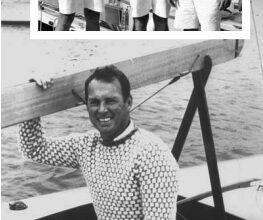
Sig Baardsen raced dinghies and crewed in the 1957 and 1959 Transpac races. He was a third-generation ship chandler but, in 1987, closed the family business and with his share bought Mary T, a Cheoy Lee Offshore 40 yawl in which he and his wife, Carol, sailed south from San Pedro on a cruise that became a circumnavigation.
Thank you to Sailrite Enterprises, Inc., for providing free access to back issues of Good Old Boat through intellectual property rights. Sailrite.com